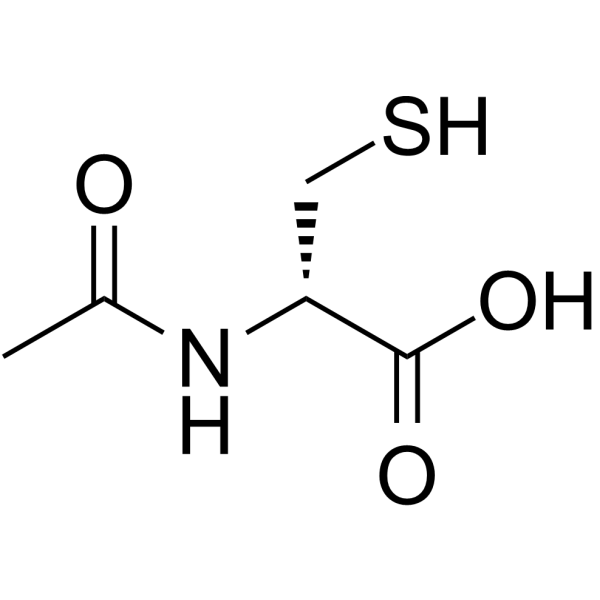
Physicochemical Properties
| Molecular Formula | C5H9NO3S |
| Molecular Weight | 163.19 |
| Exact Mass | 163.03 |
| CAS # | 26117-28-2 |
| PubChem CID | 94364 |
| Appearance | White to off-white solid powder |
| Density | 1.3±0.1 g/cm3 |
| Boiling Point | 407.7±40.0 °C at 760 mmHg |
| Flash Point | 200.4±27.3 °C |
| Vapour Pressure | 0.0±2.0 mmHg at 25°C |
| Index of Refraction | 1.519 |
| LogP | -0.15 |
| Hydrogen Bond Donor Count | 3 |
| Hydrogen Bond Acceptor Count | 4 |
| Rotatable Bond Count | 3 |
| Heavy Atom Count | 10 |
| Complexity | 148 |
| Defined Atom Stereocenter Count | 1 |
| SMILES | CC(=O)N[C@H](CS)C(=O)O |
| InChi Key | PWKSKIMOESPYIA-SCSAIBSYSA-N |
| InChi Code | InChI=1S/C5H9NO3S/c1-3(7)6-4(2-10)5(8)9/h4,10H,2H2,1H3,(H,6,7)(H,8,9)/t4-/m1/s1 |
| Chemical Name | (2S)-2-acetamido-3-sulfanylpropanoic acid |
| HS Tariff Code | 2934.99.9001 |
| Storage |
Powder-20°C 3 years 4°C 2 years In solvent -80°C 6 months -20°C 1 month Note: Please store this product in a sealed and protected environment (e.g. under nitrogen), avoid exposure to moisture. |
| Shipping Condition | Room temperature (This product is stable at ambient temperature for a few days during ordinary shipping and time spent in Customs) |
Biological Activity
| ln Vitro | Though GSH monoester does, N-acetyl-D-cysteine (20 mM; 1 hour pretreatment; 12 hours) did not raise intracellular GSH levels. D-NAC is unable to promote hypoxia apoptosis. This indicates that GSH, not D-NAC or NAC, is the factor that promotes hypoxia apoptosis[3]. |
| References |
[1]. Glutathione Participates in the Regulation of Mitophagy in Yeast.J Biol Chem. 2009 May 29;284(22):14828-37. [2]. Selective Effects of N-acetylcysteine Stereoisomers on Hepatic Glutathione and Plasma Sulfate in Mice. Toxicol Appl Pharmacol. [3]. N-Acetyl-L-cysteine Enhances Apoptosis Through Inhibition of Nuclear factor-kappaB in Hypoxic Murine Embryonic Fibroblasts. J Biol Chem. |
| Additional Infomation |
N-Acetyl-D-cysteine is a N-acyl-amino acid. N-Acetyl-D-cysteine is a metabolite found in or produced by Saccharomyces cerevisiae. See also: Acetylcysteine (annotation moved to). |
Solubility Data
| Solubility (In Vitro) | H2O: 250 mg/mL (1531.96 mM) |
| Solubility (In Vivo) |
Solubility in Formulation 1: 100 mg/mL (612.78 mM) in PBS (add these co-solvents sequentially from left to right, and one by one), clear solution; with sonication. (Please use freshly prepared in vivo formulations for optimal results.) |
| Preparing Stock Solutions | 1 mg | 5 mg | 10 mg | |
| 1 mM | 6.1278 mL | 30.6391 mL | 61.2783 mL | |
| 5 mM | 1.2256 mL | 6.1278 mL | 12.2557 mL | |
| 10 mM | 0.6128 mL | 3.0639 mL | 6.1278 mL |