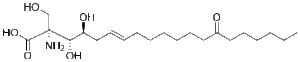
Myriocin (formerly also known as antibiotic ISP-1 and thermozymocidin), a fungal metabolite and an atypical amino acid and an antibiotic isolated from Myriococcum albomyces, Isaria sinclairi and Mycelia sterilia, is a novel and potent inhibitor of serine-palmitoyl-transferase (SPT) which is a key enzyme in de novo synthesis of sphingolipids. Myriocin strongly suppresses replication of both the subgenomic HCV-1b replicon and the JFH-1 strain of genotype 2a infectious HCV, with an IC50 of 3.5 µg/mL for inhibiting HCV infection. Myriocin, also known as antibiotic ISP-1 and thermozymocidin,
Physicochemical Properties
| Molecular Formula | C21H39NO6 |
| Molecular Weight | 401.5375 |
| Exact Mass | 401.277 |
| CAS # | 35891-70-4 |
| PubChem CID | 6438394 |
| Appearance | White to off-white solid powder |
| Density | 1.1±0.1 g/cm3 |
| Boiling Point | 636.7±55.0 °C at 760 mmHg |
| Flash Point | 338.8±31.5 °C |
| Vapour Pressure | 0.0±4.3 mmHg at 25°C |
| Index of Refraction | 1.522 |
| LogP | 4.21 |
| Hydrogen Bond Donor Count | 5 |
| Hydrogen Bond Acceptor Count | 7 |
| Rotatable Bond Count | 18 |
| Heavy Atom Count | 28 |
| Complexity | 468 |
| Defined Atom Stereocenter Count | 3 |
| SMILES | CCCCCCC(=O)CCCCCC/C=C/C[C@H]([C@@H]([C@@](CO)(C(=O)O)N)O)O |
| InChi Key | ZZIKIHCNFWXKDY-ANSFIGKPSA-N |
| InChi Code | InChI=1S/C21H39NO6/c1-2-3-4-10-13-17(24)14-11-8-6-5-7-9-12-15-18(25)19(26)21(22,16-23)20(27)28/h9,12,18-19,23,25-26H,2-8,10-11,13-16,22H2,1H3,(H,27,28)/b12-9+/t18-,19-,21+/m0/s1 |
| Chemical Name | (2R,3R,4S,E)-2-amino-3,4-dihydroxy-2-(hydroxymethyl)-14-oxoicos-6-enoic acid |
| Synonyms | Thermozymocidin; ISP-I; ISP I; ISP1 |
| HS Tariff Code | 2934.99.9001 |
| Storage |
Powder-20°C 3 years 4°C 2 years In solvent -80°C 6 months -20°C 1 month |
| Shipping Condition | Room temperature (This product is stable at ambient temperature for a few days during ordinary shipping and time spent in Customs) |
Biological Activity
| ln Vitro | Myriocin (Thermozymocidin; 0-10000 nM; 96 h; Huh7/Rep-Feo cells) suppresses the replication of the subgenomic hepatitis C virus (HCV) genotype 1b replicon [2]. Myriocin (100 nM; 72 hours) decreases sphingomyelin levels in Huh7 cells [2]. |
| ln Vivo | Myriocin (Thermozymocidin; 0–1 mg/kg; intraperitoneally; daily for 5 days; male Balb/c mice) induces the expression of c-myc in the liver and inhibits SPT, thereby blocking de novo sphingolipid synthesis in vivo [1]. |
| Cell Assay |
Western Blot Analysis[2] Cell Types: Huh7/Rep-Feo Cell Tested Concentrations: 0, 300 and 1000 nM Incubation Duration: 96 hrs (hours) Experimental Results: HCV NS5A levels diminished in a concentration-dependent manner. |
| Animal Protocol |
Animal/Disease Models: Male Balb/c mouse (22 g, 7-8 weeks old) [1] Doses: 0, 0.1, 0.3, and 1.0 mg/kg Route of Administration: intraperitoneal (ip) injection; one time/day for 5 days Experimental Results: Plasma Alanine aminotransferase and aspartate aminotransferase levels were not Dramatically altered. Free dihydrosphingosine was diminished in the liver and kidneys in a dose-dependent manner. Liver SPT activity diminished, with a correlation coefficient of -0.76. Increases hepatic c-myc expression in a dose-dependent manner. |
| References |
[1]. Inhibition of serine palmitoyltransferase by myriocin, a natural mycotoxin, causes induction of c-myc in mouse liver. Mycopathologia. 2004 Apr;157(3):339-47. [2]. Targeting lipid metabolism in the treatment of hepatitis C virus infection. J Infect Dis. 2008 Feb 1;197(3):361-70. [3]. The suppressive effect that myriocin has on hepatitis C virus RNA replication is independent of inhibition of serine palmitoyl transferase. J Infect Dis. 2008 Oct 1;198(7):1091-3. |
| Additional Infomation |
Myriocin is an amino acid-based antibiotic derived from certain thermophilic fungi; acts as a potent inhibitor of serine palmitoyltransferase, the first step in sphingosine biosynthesis. Myriocin also possesses immunosuppressant activity. It has a role as an antimicrobial agent, an antifungal agent, an immunosuppressive agent, an EC 2.3.1.50 (serine C-palmitoyltransferase) inhibitor, an apoptosis inducer, an antineoplastic agent and a fungal metabolite. It is a sphingoid, an alpha-amino fatty acid, a non-proteinogenic alpha-amino acid and a hydroxy monocarboxylic acid. Myriocin has been reported in Melanocarpus albomyces, Streptomyces, and other organisms with data available. |
Solubility Data
| Solubility (In Vitro) | DMSO : ~2.86 mg/mL (~7.12 mM) |
| Solubility (In Vivo) |
Solubility in Formulation 1: ≥ 0.29 mg/mL (0.72 mM) (saturation unknown) in 10% DMSO + 90% (20% SBE-β-CD in Saline) (add these co-solvents sequentially from left to right, and one by one), clear solution. For example, if 1 mL of working solution is to be prepared, you can add 100 μL of 2.9 mg/mL clear DMSO stock solution to 900 μL of 20% SBE-β-CD physiological saline solution and mix evenly. Preparation of 20% SBE-β-CD in Saline (4°C,1 week): Dissolve 2 g SBE-β-CD in 10 mL saline to obtain a clear solution. Solubility in Formulation 2: ≥ 0.29 mg/mL (0.72 mM) (saturation unknown) in 10% DMSO + 90% Corn Oil (add these co-solvents sequentially from left to right, and one by one), clear solution. For example, if 1 mL of working solution is to be prepared, you can add 100 μL of 2.9 mg/mL clear DMSO stock solution to 900 μL of corn oil and mix evenly. Solubility in Formulation 3: 5 mg/mL (12.45 mM) in 50% PEG300 50% Saline (add these co-solvents sequentially from left to right, and one by one), suspension solution; with ultrasonication. Preparation of saline: Dissolve 0.9 g of sodium chloride in 100 mL ddH₂ O to obtain a clear solution. (Please use freshly prepared in vivo formulations for optimal results.) |
| Preparing Stock Solutions | 1 mg | 5 mg | 10 mg | |
| 1 mM | 2.4904 mL | 12.4521 mL | 24.9041 mL | |
| 5 mM | 0.4981 mL | 2.4904 mL | 4.9808 mL | |
| 10 mM | 0.2490 mL | 1.2452 mL | 2.4904 mL |