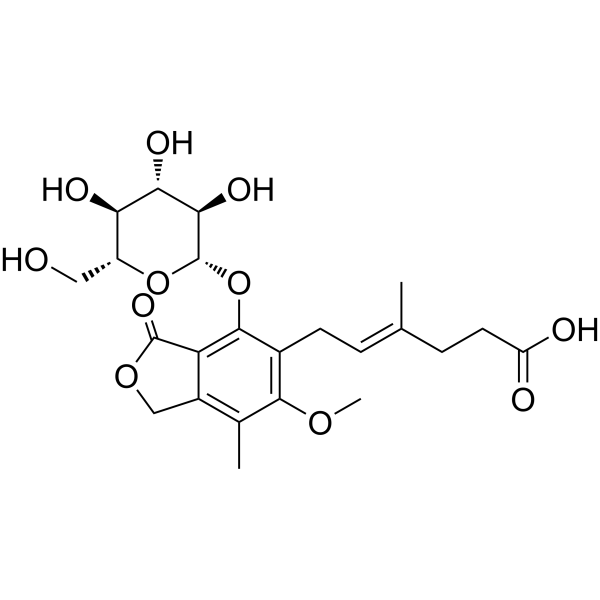
Physicochemical Properties
| Molecular Formula | C23H30O11 |
| Molecular Weight | 482.48 |
| CAS # | 55533-52-3 |
| PubChem CID | 71750874 |
| Appearance | Typically exists as solids at room temperature |
| LogP | 0.206 |
| Hydrogen Bond Donor Count | 5 |
| Hydrogen Bond Acceptor Count | 11 |
| Rotatable Bond Count | 9 |
| Heavy Atom Count | 34 |
| Complexity | 755 |
| Defined Atom Stereocenter Count | 5 |
| SMILES | CC1=C2COC(=O)C2=C(C(=C1OC)CC=C(C)CCC(=O)O)OC3C(C(C(C(O3)CO)O)O)O |
| Synonyms | Mycophenolic acid phenol β-D-glucoside; 55533-52-3; UNII-A63Y3157JG; A63Y3157JG; 6-(4-(beta-D-Glucopyranosyloxy)-1,3-dihydro-6-methoxy-7-methyl-3-oxo-5-isobenzofuranyl)-4-methyl-4-hexenoic acid, (4E)-; (E)-6-[6-methoxy-7-methyl-3-oxo-4-[(2S,3R,4S,5S,6R)-3,4,5-trihydroxy-6-(hydroxymethyl)oxan-2-yl]oxy-1H-2-benzofuran-5-yl]-4-methylhex-4-enoic acid; Mycophenolic Acid Phenolic beta-D-Glucoside; Mycophenolic Acid Phenolic b-D-Glucoside; 4-Hexenoic acid, 6-(4-(beta-D-glucopyranosyloxy)-1,3-dihydro-6-methoxy-7-methyl-3-oxo-5-isobenzofuranyl)-4-methyl-, (4E)-; |
| HS Tariff Code | 2934.99.9001 |
| Storage |
Powder-20°C 3 years 4°C 2 years In solvent -80°C 6 months -20°C 1 month |
| Shipping Condition | Room temperature (This product is stable at ambient temperature for a few days during ordinary shipping and time spent in Customs) |
Biological Activity
| Targets | Mycophenolic acid metabolite |
| References |
[1]. Varki A, et al editors. Essentials of Glycobiology [Internet]. 4th ed. Cold Spring Harbor (NY): Cold Spring Harbor Laboratory Press; 2022. |
| Additional Infomation | Glycobiology is the study of the structure, biosynthesis, biology, and evolution of saccharides (sugar chains or glycans) that are widely distributed in nature, in all life-forms. Glycobiology is a rapidly growing field in the natural sciences, with broad relevance to many areas of basic research, biomedicine, and biotechnology. The field includes the chemistry of carbohydrates, the enzymology of glycan formation and degradation, the recognition of glycans by specific proteins, roles of glycans in complex biological systems, and glycan analysis or manipulation by various techniques. The fourth edition of this primary textbook in the field continues in the prior tradition to provide a basic overview of Glycobiology, directed toward the advanced undergraduate or the beginning graduate-level student of molecular and cellular biology and biomedicine. This edition includes a broader focus on all lineages of life-forms; a wider range of topics, from biology and medicine to chemistry, bioenergy, and materials science; a more diverse and international group of contributing authors with expertise in specific areas; further expansion of the monosaccharide symbol nomenclature for representation of glycans; and a greater attention to informatics, with relevance to exploring the glycome in relation to the genome, transcriptome, proteome, lipidome, and metabolome. [1] |
Solubility Data
| Solubility (In Vitro) | May dissolve in DMSO (in most cases), if not, try other solvents such as H2O, Ethanol, or DMF with a minute amount of products to avoid loss of samples |
| Solubility (In Vivo) |
Note: Listed below are some common formulations that may be used to formulate products with low water solubility (e.g. < 1 mg/mL), you may test these formulations using a minute amount of products to avoid loss of samples. Injection Formulations (e.g. IP/IV/IM/SC) Injection Formulation 1: DMSO : Tween 80: Saline = 10 : 5 : 85 (i.e. 100 μL DMSO stock solution → 50 μL Tween 80 → 850 μL Saline) *Preparation of saline: Dissolve 0.9 g of sodium chloride in 100 mL ddH ₂ O to obtain a clear solution. Injection Formulation 2: DMSO : PEG300 :Tween 80 : Saline = 10 : 40 : 5 : 45 (i.e. 100 μL DMSO → 400 μLPEG300 → 50 μL Tween 80 → 450 μL Saline) Injection Formulation 3: DMSO : Corn oil = 10 : 90 (i.e. 100 μL DMSO → 900 μL Corn oil) Example: Take the Injection Formulation 3 (DMSO : Corn oil = 10 : 90) as an example, if 1 mL of 2.5 mg/mL working solution is to be prepared, you can take 100 μL 25 mg/mL DMSO stock solution and add to 900 μL corn oil, mix well to obtain a clear or suspension solution (2.5 mg/mL, ready for use in animals). Injection Formulation 4: DMSO : 20% SBE-β-CD in saline = 10 : 90 [i.e. 100 μL DMSO → 900 μL (20% SBE-β-CD in saline)] *Preparation of 20% SBE-β-CD in Saline (4°C,1 week): Dissolve 2 g SBE-β-CD in 10 mL saline to obtain a clear solution. Injection Formulation 5: 2-Hydroxypropyl-β-cyclodextrin : Saline = 50 : 50 (i.e. 500 μL 2-Hydroxypropyl-β-cyclodextrin → 500 μL Saline) Injection Formulation 6: DMSO : PEG300 : castor oil : Saline = 5 : 10 : 20 : 65 (i.e. 50 μL DMSO → 100 μLPEG300 → 200 μL castor oil → 650 μL Saline) Injection Formulation 7: Ethanol : Cremophor : Saline = 10: 10 : 80 (i.e. 100 μL Ethanol → 100 μL Cremophor → 800 μL Saline) Injection Formulation 8: Dissolve in Cremophor/Ethanol (50 : 50), then diluted by Saline Injection Formulation 9: EtOH : Corn oil = 10 : 90 (i.e. 100 μL EtOH → 900 μL Corn oil) Injection Formulation 10: EtOH : PEG300:Tween 80 : Saline = 10 : 40 : 5 : 45 (i.e. 100 μL EtOH → 400 μLPEG300 → 50 μL Tween 80 → 450 μL Saline) Oral Formulations Oral Formulation 1: Suspend in 0.5% CMC Na (carboxymethylcellulose sodium) Oral Formulation 2: Suspend in 0.5% Carboxymethyl cellulose Example: Take the Oral Formulation 1 (Suspend in 0.5% CMC Na) as an example, if 100 mL of 2.5 mg/mL working solution is to be prepared, you can first prepare 0.5% CMC Na solution by measuring 0.5 g CMC Na and dissolve it in 100 mL ddH2O to obtain a clear solution; then add 250 mg of the product to 100 mL 0.5% CMC Na solution, to make the suspension solution (2.5 mg/mL, ready for use in animals). Oral Formulation 3: Dissolved in PEG400 Oral Formulation 4: Suspend in 0.2% Carboxymethyl cellulose Oral Formulation 5: Dissolve in 0.25% Tween 80 and 0.5% Carboxymethyl cellulose Oral Formulation 6: Mixing with food powders Note: Please be aware that the above formulations are for reference only. InvivoChem strongly recommends customers to read literature methods/protocols carefully before determining which formulation you should use for in vivo studies, as different compounds have different solubility properties and have to be formulated differently. (Please use freshly prepared in vivo formulations for optimal results.) |
| Preparing Stock Solutions | 1 mg | 5 mg | 10 mg | |
| 1 mM | 2.0726 mL | 10.3631 mL | 20.7262 mL | |
| 5 mM | 0.4145 mL | 2.0726 mL | 4.1452 mL | |
| 10 mM | 0.2073 mL | 1.0363 mL | 2.0726 mL |