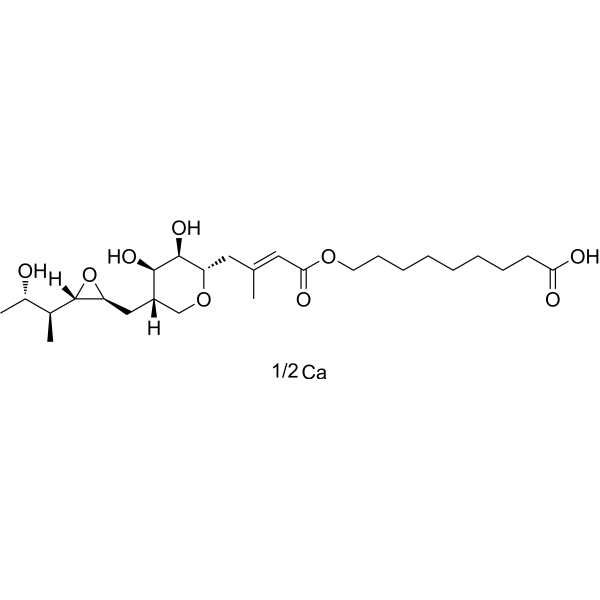
Physicochemical Properties
| Molecular Formula | C52H86CAO18 |
| Molecular Weight | 1039.30645799637 |
| Exact Mass | 1038.544 |
| CAS # | 104486-81-9 |
| Related CAS # | Mupirocin;12650-69-0;Mupirocin calcium hydrate;115074-43-6;Mupirocin lithium;73346-79-9 |
| PubChem CID | 6435927 |
| Appearance | Typically exists as solid at room temperature |
| Hydrogen Bond Donor Count | 6 |
| Hydrogen Bond Acceptor Count | 18 |
| Rotatable Bond Count | 32 |
| Heavy Atom Count | 71 |
| Complexity | 689 |
| Defined Atom Stereocenter Count | 16 |
| SMILES | [Ca+2].O1[C@@H]([C@@H](C)[C@H](C)O)[C@@H]1C[C@H]1CO[C@@H](C/C(=C/C(=O)OCCCCCCCCC(=O)[O-])/C)[C@@H]([C@@H]1O)O.O1[C@@H]([C@@H](C)[C@H](C)O)[C@@H]1C[C@H]1CO[C@@H](C/C(=C/C(=O)OCCCCCCCCC(=O)[O-])/C)[C@@H]([C@@H]1O)O |
| InChi Key | HAXVBVDETFUQGV-LNQHITRNSA-L |
| InChi Code | InChI=1S/2C26H44O9.Ca/c2*1-16(13-23(30)33-11-9-7-5-4-6-8-10-22(28)29)12-20-25(32)24(31)19(15-34-20)14-21-26(35-21)17(2)18(3)27;/h2*13,17-21,24-27,31-32H,4-12,14-15H2,1-3H3,(H,28,29);/q;;+2/p-2/b2*16-13+;/t2*17-,18-,19-,20-,21-,24+,25-,26-;/m00./s1 |
| Chemical Name | calcium;9-[(E)-4-[(2S,3R,4R,5S)-3,4-dihydroxy-5-[[(2S,3S)-3-[(2S,3S)-3-hydroxybutan-2-yl]oxiran-2-yl]methyl]oxan-2-yl]-3-methylbut-2-enoyl]oxynonanoate |
| HS Tariff Code | 2934.99.9001 |
| Storage |
Powder-20°C 3 years 4°C 2 years In solvent -80°C 6 months -20°C 1 month |
| Shipping Condition | Room temperature (This product is stable at ambient temperature for a few days during ordinary shipping and time spent in Customs) |
Biological Activity
| ln Vitro | Mupirocin (BRL-4910A, Pseudomonate) Calcium (0-100 μM; 48 h) exhibits antibacterial action against specific Gram-negative bacteria, Streptococcus, and Staphylococcus, with MIC values ranging from 0.06-0.25 μg/mL (MIC50 = 0.12 μg/mL, MIC90 = 0.25 μg/mL)[1]. Since human serum proteins and mugirocin calcium are substantially bound (95% bound), mugirocin calcium activity is inhibited when human serum is present [1]. According to research, mupirocin calcium inhibits bacterial protein and RNA production by reversibly blocking isoleucyl transfer RNA [2]. Mupirocin calcium (2% ointment) can decrease pro-inflammatory cytokine levels (IL-1β and IL-17), decrease tumor necrosis factor-α (TNF-α) expression, and boost VEGF (vascular endothelial growth factor) expression [4]. With MICs of 0.25, 1.26, and 1.59 mg/L, muticipin cal may suppress the growth of S. epidermidis ATCC 12228, MR (S. epidermidis (Se56-99), and VIR (S. epidermidis (Se43-98)). Note: Minimum inhibitory concentration, or MIC. |
| ln Vivo | After oral and parenteral administration, MRSA: Methicillin-Resistant Staphylococcus Aureus Mupirocin (BRL-4910A, Pseudomonic acid) Calcium is well absorbed; however, serum antibiotic concentrations are short-lived because of extensive degradation to the antibacterial inactive metabolite Mupirocin A [1]. During topical treatment, mugirocin calcium (2% ointment; twice daily; 3-6 days) lowers the overall bacterial load in lesions [3]. MRSA-infected mice's pressure ulcers are healed after four days of topical application of 2% mupirocin calcium ointment [4]. The use of mupirocin calcium (100 mg/mL; subcutaneous injection; 7 days) has been shown to be protective against Staphylococcus epidermidis-induced vascular prosthetic graft infections [5]. |
| Cell Assay |
Cell viability assay [1] Cell Types: Staphylococcus aureus Tested Concentrations: 0-100 μM/mL Incubation Duration: 24, 48 hrs (hours) Experimental Results: Cell viability diminished by 90% to 99% after 24 hrs (hours), MIC value ranged from 0.12-1.0 μM /mL At 48 hrs (hours), mL and MBC values ranged from 4.0-32 μM/mL. |
| Animal Protocol |
Animal/Disease Models: Mouse MRSA skin infection model (10-12 weeks old) [3] Doses: 2% ointment Route of Administration: external use; twice a day; 3-6 days Experimental Results: The total number of bacteria in the skin lesions diminished, 3rd day and day 6, respectively. Animal/Disease Models: Diabetic pressure ulcer mouse model (33.2-39.2 g) [4] Doses: 2% ointment Route of Administration: Topical; 4-day Experimental Results: Surface bacterial colony mats were diminished and histopathological assessment was improved. Animal/Disease Models: Adult male Wistar rats (body weight 275-325 g) [5] Usage and Doses: Impregnated with mupirocin 100 μg/mL; Segment: 1.5 cm *1 cm2 Route of Administration: subcutaneousimplantation; 7-day Experimental Results: Prevents Staphylococcus epidermidis infection of grafts by spontaneous union with collagen-sealed Dacron grafts in a rat model. |
| References |
[1]. Sutherland R, et al. Antibacterial activity of mupirocin (pseudomonic acid), a new antibiotic for topical use. Antimicrob Agents Chemother. 1985 Apr;27(4):495-8. [2]. Parenti MA, et al. Mupirocin: a topical antibiotic with a unique structure and mechanism of action. Clin Pharm. 1987 Oct;6(10):761-70. [3]. Vingsbo Lundberg C, et al. Efficacy of topical and systemic antibiotic treatment of meticillin-resistant Staphylococcus aureus in a murine superficial skin wound infection model. Int J Antimicrob Agents. 2013 Sep. 42(3):272-5. [4]. Mohammad H, Abutaleb NS, Dieterly AM, Lyle LT, Seleem MN. Investigating auranofin for the treatment of infected diabetic pressure ulcers in mice and dermal toxicity in pigs. Sci Rep. 2021 May 25;11(1):10935. [5]. Giacometti A, et al. Mupirocin prophylaxis against methicillin-susceptible, methicillin-resistant, or vancomycin-intermediate Staphylococcus epidermidis vascular-graft infection. Antimicrob Agents Chemother. 2000 Oct. 44(10):2842-4. |
| Additional Infomation |
Mupirocin calcium (anhydrous) is the anhydrous form of the calcium salt of mupirocin. The dihydrate form is used as an antibacterial drug for the treatment of skin infections. It has a role as an antibacterial drug and a protein synthesis inhibitor. It contains a mupirocin(1-). Mupirocin Calcium is the calcium salt form of mupirocin, a natural crotonic acid derivative extracted from Pseudomonas fluorescens. Mupirocin inhibits bacterial protein synthesis by specific reversible binding to bacterial isoleucyl tRNA synthase. With excellent activity against gram-positive staphylococci and streptococci, it is primarily used for treatment of primary and secondary skin disorders, nasal infections, and wound healing. (NCI04) A topically used antibiotic from a strain of Pseudomonas fluorescens. It has shown excellent activity against gram-positive staphylococci and streptococci. The antibiotic is used primarily for the treatment of primary and secondary skin disorders, nasal infections, and wound healing. |
Solubility Data
| Solubility (In Vitro) | May dissolve in DMSO (in most cases), if not, try other solvents such as H2O, Ethanol, or DMF with a minute amount of products to avoid loss of samples |
| Solubility (In Vivo) |
Note: Listed below are some common formulations that may be used to formulate products with low water solubility (e.g. < 1 mg/mL), you may test these formulations using a minute amount of products to avoid loss of samples. Injection Formulations (e.g. IP/IV/IM/SC) Injection Formulation 1: DMSO : Tween 80: Saline = 10 : 5 : 85 (i.e. 100 μL DMSO stock solution → 50 μL Tween 80 → 850 μL Saline) *Preparation of saline: Dissolve 0.9 g of sodium chloride in 100 mL ddH ₂ O to obtain a clear solution. Injection Formulation 2: DMSO : PEG300 :Tween 80 : Saline = 10 : 40 : 5 : 45 (i.e. 100 μL DMSO → 400 μLPEG300 → 50 μL Tween 80 → 450 μL Saline) Injection Formulation 3: DMSO : Corn oil = 10 : 90 (i.e. 100 μL DMSO → 900 μL Corn oil) Example: Take the Injection Formulation 3 (DMSO : Corn oil = 10 : 90) as an example, if 1 mL of 2.5 mg/mL working solution is to be prepared, you can take 100 μL 25 mg/mL DMSO stock solution and add to 900 μL corn oil, mix well to obtain a clear or suspension solution (2.5 mg/mL, ready for use in animals). Injection Formulation 4: DMSO : 20% SBE-β-CD in saline = 10 : 90 [i.e. 100 μL DMSO → 900 μL (20% SBE-β-CD in saline)] *Preparation of 20% SBE-β-CD in Saline (4°C,1 week): Dissolve 2 g SBE-β-CD in 10 mL saline to obtain a clear solution. Injection Formulation 5: 2-Hydroxypropyl-β-cyclodextrin : Saline = 50 : 50 (i.e. 500 μL 2-Hydroxypropyl-β-cyclodextrin → 500 μL Saline) Injection Formulation 6: DMSO : PEG300 : castor oil : Saline = 5 : 10 : 20 : 65 (i.e. 50 μL DMSO → 100 μLPEG300 → 200 μL castor oil → 650 μL Saline) Injection Formulation 7: Ethanol : Cremophor : Saline = 10: 10 : 80 (i.e. 100 μL Ethanol → 100 μL Cremophor → 800 μL Saline) Injection Formulation 8: Dissolve in Cremophor/Ethanol (50 : 50), then diluted by Saline Injection Formulation 9: EtOH : Corn oil = 10 : 90 (i.e. 100 μL EtOH → 900 μL Corn oil) Injection Formulation 10: EtOH : PEG300:Tween 80 : Saline = 10 : 40 : 5 : 45 (i.e. 100 μL EtOH → 400 μLPEG300 → 50 μL Tween 80 → 450 μL Saline) Oral Formulations Oral Formulation 1: Suspend in 0.5% CMC Na (carboxymethylcellulose sodium) Oral Formulation 2: Suspend in 0.5% Carboxymethyl cellulose Example: Take the Oral Formulation 1 (Suspend in 0.5% CMC Na) as an example, if 100 mL of 2.5 mg/mL working solution is to be prepared, you can first prepare 0.5% CMC Na solution by measuring 0.5 g CMC Na and dissolve it in 100 mL ddH2O to obtain a clear solution; then add 250 mg of the product to 100 mL 0.5% CMC Na solution, to make the suspension solution (2.5 mg/mL, ready for use in animals). Oral Formulation 3: Dissolved in PEG400 Oral Formulation 4: Suspend in 0.2% Carboxymethyl cellulose Oral Formulation 5: Dissolve in 0.25% Tween 80 and 0.5% Carboxymethyl cellulose Oral Formulation 6: Mixing with food powders Note: Please be aware that the above formulations are for reference only. InvivoChem strongly recommends customers to read literature methods/protocols carefully before determining which formulation you should use for in vivo studies, as different compounds have different solubility properties and have to be formulated differently. (Please use freshly prepared in vivo formulations for optimal results.) |
| Preparing Stock Solutions | 1 mg | 5 mg | 10 mg | |
| 1 mM | 0.9622 mL | 4.8109 mL | 9.6218 mL | |
| 5 mM | 0.1924 mL | 0.9622 mL | 1.9244 mL | |
| 10 mM | 0.0962 mL | 0.4811 mL | 0.9622 mL |