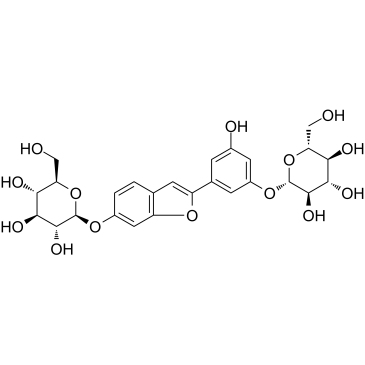
Mulberroside F is a natural product and the main component from mulberry (Morus alba L.) with inhibitory effects against tyrosinase. Also exhibits superoxide scavenging activity involved in the protection against auto-oxidation.
Physicochemical Properties
| Molecular Formula | C26H30O14 |
| Molecular Weight | 566.5080 |
| Exact Mass | 566.163 |
| CAS # | 193483-95-3 |
| PubChem CID | 60208818 |
| Appearance | White to off-white solid powder |
| Density | 1.6±0.1 g/cm3 |
| Boiling Point | 920.5±65.0 °C at 760 mmHg |
| Flash Point | 510.5±34.3 °C |
| Vapour Pressure | 0.0±0.3 mmHg at 25°C |
| Index of Refraction | 1.708 |
| LogP | -1.77 |
| Hydrogen Bond Donor Count | 9 |
| Hydrogen Bond Acceptor Count | 14 |
| Rotatable Bond Count | 7 |
| Heavy Atom Count | 40 |
| Complexity | 820 |
| Defined Atom Stereocenter Count | 10 |
| SMILES | C1=CC2=C(C=C1O[C@H]3[C@@H]([C@H]([C@@H]([C@H](O3)CO)O)O)O)OC(=C2)C4=CC(=CC(=C4)O[C@H]5[C@@H]([C@H]([C@@H]([C@H](O5)CO)O)O)O)O |
| InChi Key | YPMOTUXWPXDQDJ-PCIRLDFKSA-N |
| InChi Code | InChI=1S/C26H30O14/c27-8-17-19(30)21(32)23(34)25(39-17)36-13-2-1-10-5-15(38-16(10)7-13)11-3-12(29)6-14(4-11)37-26-24(35)22(33)20(31)18(9-28)40-26/h1-7,17-35H,8-9H2/t17-,18-,19-,20-,21+,22+,23-,24-,25-,26-/m1/s1 |
| Chemical Name | (2R,3S,4S,5R,6S)-2-(hydroxymethyl)-6-[[2-[3-hydroxy-5-[(2S,3R,4S,5S,6R)-3,4,5-trihydroxy-6-(hydroxymethyl)oxan-2-yl]oxyphenyl]-1-benzofuran-6-yl]oxy]oxane-3,4,5-triol |
| HS Tariff Code | 2934.99.9001 |
| Storage |
Powder-20°C 3 years 4°C 2 years In solvent -80°C 6 months -20°C 1 month |
| Shipping Condition | Room temperature (This product is stable at ambient temperature for a few days during ordinary shipping and time spent in Customs) |
Biological Activity
| Targets |
1. Tyrosinase (key enzyme in melanin biosynthesis, IC50 = 26.7 μM for enzyme activity inhibition) [2] |
| ln Vitro |
1. Tyrosinase activity inhibition: Mulberroside F exhibited dose-dependent inhibitory activity against mushroom tyrosinase; the IC50 value for inhibiting the enzyme’s monophenolase activity (conversion of L-tyrosine to L-DOPA) was 26.7 μM, and it showed a weaker inhibitory effect on diphenolase activity (conversion of L-DOPA to dopaquinone) with a 32% inhibition rate at 50 μM [2] 2. Melanin biosynthesis inhibition in melanoma cells: In murine B16 melanoma cells, Mulberroside F (10-50 μM) dose-dependently reduced intracellular melanin content; at 50 μM, melanin production was decreased by 48% relative to the control group, with no significant cytotoxicity to B16 cells (cell viability > 90% at concentrations up to 50 μM) [2] |
| Enzyme Assay |
1. Mushroom tyrosinase monophenolase/diphenolase activity assay: The reaction system was established with appropriate concentrations of mushroom tyrosinase, substrate (L-tyrosine for monophenolase or L-DOPA for diphenolase), and serial dilutions of Mulberroside F (0-100 μM) in a buffer solution (pH 6.8). The reaction was initiated by adding the enzyme and incubated at 37℃ for 10 min (monophenolase) or 5 min (diphenolase). The absorbance at 475 nm (for monophenolase) or 490 nm (for diphenolase) was measured using a microplate reader, and the residual enzyme activity was calculated relative to the vehicle control to determine the IC50 value and inhibition rate [2] |
| Cell Assay |
1. B16 melanoma cell melanin content detection assay: B16 cells were seeded in 6-well plates at a density of 2×10⁵ cells per well and incubated for 24 h to attach. The cells were then treated with different concentrations of Mulberroside F (10-50 μM) for 72 h, with a vehicle control group and a positive control group (arbutin) set in parallel. After treatment, the cells were harvested, washed, and lysed with a lysis buffer containing detergent. The cell lysate was centrifuged, and the absorbance of the supernatant was measured at 405 nm to quantify melanin content; the cell viability was simultaneously detected using a cell viability reagent to exclude the influence of cytotoxicity [2] |
| References |
[1]. In vitro pharmacokinetic characterization of mulberroside A, the main polyhydroxylated stilbene in mulberry (Morus alba L.), and its bacterial metabolite oxyresveratrol in traditional oral use. J Agric Food Chem. 2012 Mar 7;60(9):2299-308. [2]. Mulberroside F isolated from the leaves of Morus alba inhibits melanin biosynthesis. Biol Pharm Bull. 2002 Aug;25(8):1045-8. |
| Additional Infomation |
Mulberroside F is a member of benzofurans. Mulberroside F has been reported in Morus alba with data available. 1. Mulberroside F is a stilbene glycoside compound isolated from the leaves of Morus alba (white mulberry) via chromatographic separation and purification procedures [2] 2. The anti-melanogenic mechanism of Mulberroside F is primarily mediated by the inhibition of tyrosinase activity, which blocks the rate-limiting step of melanin biosynthesis (the conversion of L-tyrosine to L-DOPA and subsequent oxidation to dopaquinone), thereby reducing intracellular melanin accumulation in melanoma cells [2] 3. Mulberroside F has potential application value in cosmetic formulations for skin whitening due to its tyrosinase inhibitory activity and low cytotoxicity to skin-related cells at active concentrations [2] |
Solubility Data
| Solubility (In Vitro) | May dissolve in DMSO (in most cases), if not, try other solvents such as H2O, Ethanol, or DMF with a minute amount of products to avoid loss of samples |
| Solubility (In Vivo) |
Note: Listed below are some common formulations that may be used to formulate products with low water solubility (e.g. < 1 mg/mL), you may test these formulations using a minute amount of products to avoid loss of samples. Injection Formulations (e.g. IP/IV/IM/SC) Injection Formulation 1: DMSO : Tween 80: Saline = 10 : 5 : 85 (i.e. 100 μL DMSO stock solution → 50 μL Tween 80 → 850 μL Saline) *Preparation of saline: Dissolve 0.9 g of sodium chloride in 100 mL ddH ₂ O to obtain a clear solution. Injection Formulation 2: DMSO : PEG300 :Tween 80 : Saline = 10 : 40 : 5 : 45 (i.e. 100 μL DMSO → 400 μLPEG300 → 50 μL Tween 80 → 450 μL Saline) Injection Formulation 3: DMSO : Corn oil = 10 : 90 (i.e. 100 μL DMSO → 900 μL Corn oil) Example: Take the Injection Formulation 3 (DMSO : Corn oil = 10 : 90) as an example, if 1 mL of 2.5 mg/mL working solution is to be prepared, you can take 100 μL 25 mg/mL DMSO stock solution and add to 900 μL corn oil, mix well to obtain a clear or suspension solution (2.5 mg/mL, ready for use in animals). Injection Formulation 4: DMSO : 20% SBE-β-CD in saline = 10 : 90 [i.e. 100 μL DMSO → 900 μL (20% SBE-β-CD in saline)] *Preparation of 20% SBE-β-CD in Saline (4°C,1 week): Dissolve 2 g SBE-β-CD in 10 mL saline to obtain a clear solution. Injection Formulation 5: 2-Hydroxypropyl-β-cyclodextrin : Saline = 50 : 50 (i.e. 500 μL 2-Hydroxypropyl-β-cyclodextrin → 500 μL Saline) Injection Formulation 6: DMSO : PEG300 : castor oil : Saline = 5 : 10 : 20 : 65 (i.e. 50 μL DMSO → 100 μLPEG300 → 200 μL castor oil → 650 μL Saline) Injection Formulation 7: Ethanol : Cremophor : Saline = 10: 10 : 80 (i.e. 100 μL Ethanol → 100 μL Cremophor → 800 μL Saline) Injection Formulation 8: Dissolve in Cremophor/Ethanol (50 : 50), then diluted by Saline Injection Formulation 9: EtOH : Corn oil = 10 : 90 (i.e. 100 μL EtOH → 900 μL Corn oil) Injection Formulation 10: EtOH : PEG300:Tween 80 : Saline = 10 : 40 : 5 : 45 (i.e. 100 μL EtOH → 400 μLPEG300 → 50 μL Tween 80 → 450 μL Saline) Oral Formulations Oral Formulation 1: Suspend in 0.5% CMC Na (carboxymethylcellulose sodium) Oral Formulation 2: Suspend in 0.5% Carboxymethyl cellulose Example: Take the Oral Formulation 1 (Suspend in 0.5% CMC Na) as an example, if 100 mL of 2.5 mg/mL working solution is to be prepared, you can first prepare 0.5% CMC Na solution by measuring 0.5 g CMC Na and dissolve it in 100 mL ddH2O to obtain a clear solution; then add 250 mg of the product to 100 mL 0.5% CMC Na solution, to make the suspension solution (2.5 mg/mL, ready for use in animals). Oral Formulation 3: Dissolved in PEG400 Oral Formulation 4: Suspend in 0.2% Carboxymethyl cellulose Oral Formulation 5: Dissolve in 0.25% Tween 80 and 0.5% Carboxymethyl cellulose Oral Formulation 6: Mixing with food powders Note: Please be aware that the above formulations are for reference only. InvivoChem strongly recommends customers to read literature methods/protocols carefully before determining which formulation you should use for in vivo studies, as different compounds have different solubility properties and have to be formulated differently. (Please use freshly prepared in vivo formulations for optimal results.) |
| Preparing Stock Solutions | 1 mg | 5 mg | 10 mg | |
| 1 mM | 1.7652 mL | 8.8260 mL | 17.6519 mL | |
| 5 mM | 0.3530 mL | 1.7652 mL | 3.5304 mL | |
| 10 mM | 0.1765 mL | 0.8826 mL | 1.7652 mL |