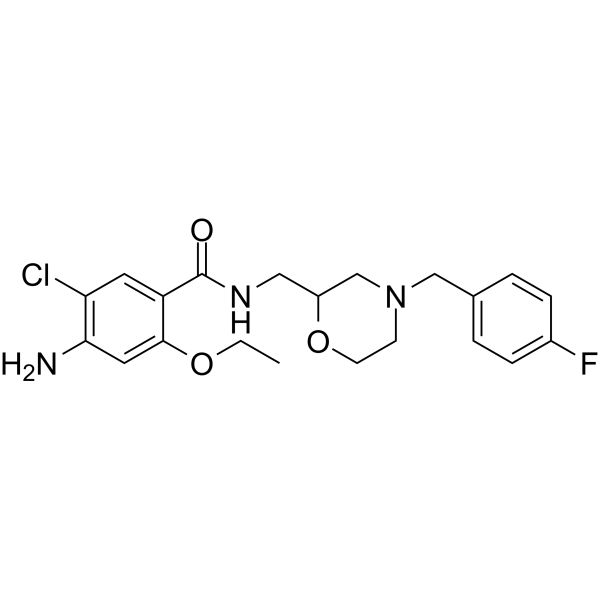
Physicochemical Properties
| Molecular Formula | C21H25CLFN3O3 |
| Molecular Weight | 421.8929 |
| Exact Mass | 421.156 |
| CAS # | 112885-41-3 |
| Related CAS # | Mosapride citrate;112885-42-4;Mosapride citrate dihydrate;636582-62-2;Mosapride-d5;1246820-66-5 |
| PubChem CID | 119584 |
| Appearance | White to off-white solid powder |
| Density | 1.3±0.1 g/cm3 |
| Boiling Point | 549.2±50.0 °C at 760 mmHg |
| Melting Point | 151-153°C |
| Flash Point | 286.0±30.1 °C |
| Vapour Pressure | 0.0±1.5 mmHg at 25°C |
| Index of Refraction | 1.585 |
| LogP | 2.82 |
| Hydrogen Bond Donor Count | 2 |
| Hydrogen Bond Acceptor Count | 6 |
| Rotatable Bond Count | 7 |
| Heavy Atom Count | 29 |
| Complexity | 521 |
| Defined Atom Stereocenter Count | 0 |
| SMILES | ClC1=C(C([H])=C(C(=C1[H])C(N([H])C([H])([H])C1([H])C([H])([H])N(C([H])([H])C2C([H])=C([H])C(=C([H])C=2[H])F)C([H])([H])C([H])([H])O1)=O)OC([H])([H])C([H])([H])[H])N([H])[H] |
| InChi Key | YPELFRMCRYSPKZ-UHFFFAOYSA-N |
| InChi Code | InChI=1S/C21H25ClFN3O3/c1-2-28-20-10-19(24)18(22)9-17(20)21(27)25-11-16-13-26(7-8-29-16)12-14-3-5-15(23)6-4-14/h3-6,9-10,16H,2,7-8,11-13,24H2,1H3,(H,25,27) |
| Chemical Name | 4-amino-5-chloro-2-ethoxy-N-[[4-[(4-fluorophenyl)methyl]morpholin-2-yl]methyl]benzamide |
| HS Tariff Code | 2934.99.9001 |
| Storage |
Powder-20°C 3 years 4°C 2 years In solvent -80°C 6 months -20°C 1 month |
| Shipping Condition | Room temperature (This product is stable at ambient temperature for a few days during ordinary shipping and time spent in Customs) |
Biological Activity
| Targets |
\(5-HT_4\) receptor \(5-HT_3\) receptor (antagonist) [1] |
| ln Vitro |
The average length of the proximal and distal constrictions in the guinea pig water body is dramatically increased by mosaicide citrate (1–100 nM), which also affects the proximal and distal water transit durations [3]. Human liver cells (HMC424, 478, and 493) have increased cytochrome P450 (CYP1A2, 2B6, and 3A4) sensing capability in response to mosapride citrate (869 ng/mL, 48 h) [4]. In the rat esophageal tunica muscularis mucosae, Mosapride exhibits 80–90% of the intrinsic activity of 5-HT, mediating relaxation [1] In the guinea pig distal colon, it has 80–100% of the intrinsic activity of 5-HT, mediating contractile responses [1] In the guinea pig ileum, it only shows 50–60% of the intrinsic activity of 5-HT [1] It has little effect on the rapid component of the delayed rectifying \(K^+\) channels in isolated rabbit Purkinje fibres and ventricular muscle [1] It shows no significant activity on hERG channels in hERG-transfected cells [1] |
| ln Vivo |
In a dose-dependent manner, mosapride citrate (0.3–3 mg/kg or 30 mg/kg dam) facilitates port emptying. A dosage of 30 mg/kg was found to cause significant port emptying [5]. By initiating 5-HT4 absorption in the channel, mosapride citrate (0.25, 0.5, 0.75 mg/kg channel) can mitigate the state brought on by non-steroidal anti-inflammatory drugs [6]. In dogs, Mosapride stimulates gastrointestinal motility [1] In healthy male volunteers, a single oral dose of 10 mg Mosapride does not cause significant changes in pulse, heart rate, QT interval, or ECG parameters [1] In healthy volunteers, co-administration of Mosapride (15 mg/day) with erythromycin for 14 days does not result in ECG changes [1] In patients with diabetic autonomic neuropathy, it enhances gastric motility [1] In asymptomatic volunteers, it affects esophageal motility and bolus transit [1] |
| Cell Assay |
hERG channel activity assay: Culture cells transfected with hERG gene, expose to Mosapride, and detect changes in hERG potassium currents using electrophysiological methods to evaluate the effect on the channel [1] Gastrointestinal smooth muscle cell/tissue assay: Isolate smooth muscle tissues from rat esophagus, guinea pig distal colon, and guinea pig ileum, incubate with Mosapride, and measure the contractile or relaxant responses of the tissues to assess the intrinsic activity relative to 5-HT [1] Delayed rectifying potassium channel assay: Isolate rabbit Purkinje fibres and ventricular muscle tissues, treat with Mosapride, and record the effect on the rapid component of the delayed rectifying \(K^+\) channels using electrophysiological techniques [1] |
| Animal Protocol |
Animal/Disease Models: NSAID-induced experimental ulcer model Doses: 0.25, 0.5, 0.75 mg/kg Route of Administration: Oral Experimental Results:Inhibits mucosal damage. Dog gastrointestinal motility assay: Administer Mosapride to dogs via oral route, observe and measure gastrointestinal peristalsis parameters (such as intestinal transit time, motility frequency) to evaluate the prokinetic effect [1] Rat esophageal/colon smooth muscle tissue preparation: Euthanize rats, isolate the esophageal tunica muscularis mucosae and colon smooth muscle tissues, prepare tissue strips, and use them for in vitro contractile/relaxant response experiments [1] Guinea pig ileum/colon tissue preparation: Euthanize guinea pigs, isolate the distal colon and ileum tissues, prepare tissue segments, and use them for in vitro pharmacological activity detection [1] |
| ADME/Pharmacokinetics |
Oral bioavailability: 8% in dogs, 14% in monkeys [1] Plasma peak time (tmax): 0.5–1.0 hours in humans after oral administration [1] Metabolism: Undergoes first-pass metabolism in the liver, with the principal metabolite M1; metabolized by CYP3A4 [1] Elimination: Excreted via both urine and feces [1] |
| Toxicity/Toxicokinetics |
No significant cardiovascular toxicity; does not prolong the QT interval in healthy volunteers and patients [1] Co-administration with erythromycin does not induce ECG abnormalities [1] A case report described a 68-year-old man with sick sinus syndrome who developed prolonged QTc interval after receiving Mosapride combined with flecainide, which may be related to the underlying disease and concurrent medication [1] |
| References |
[1]. Systematic review: cardiovascular safety profile of 5-HT(4) agonists developed for gastrointestinal disorders. Aliment Pharmacol Ther. 2012 Apr;35(7):745-67. [2]. Mosapride in gastrointestinal disorders. Drugs. 2008;68(7):981-91. [3]. The effect of mosapride citrate on proximal and distal colonic motor function in the guinea-pig in vitro. Neurogastroenterol Motil. 2008 Feb;20(2):169-76. [4]. Measurement of Human Cytochrome P450 Enzyme Induction Based on Mesalazine and Mosapride Citrate Treatments Using a Luminescent Assay. Biomol Ther (Seoul). 2015 Sep;23(5):486-92. [5]. Dual role of mosapride citrate hydrate on the gastric emptying evaluated by the breath test in conscious rats. J Pharmacol Sci. 2013;121(4):282-7. [6]. The 5-HT4 receptor agonist mosapride attenuates NSAID-induced gastric mucosal damage. J Gastroenterol. 2010 Feb;45(2):179-86. [7]. Effect of mosapride on Kv4.3 potassium channels expressed in CHO cells. Naunyn Schmiedebergs Arch Pharmacol. 2013 Oct;386(10):905-16. |
| Additional Infomation |
Mosapride is a racemate comprising equimolar amounts of (R)- and (S)-mosapride. It is a gastroprokinetic agent which acts on 5-hydroxytryptamine type 4 (5-HT4) receptors in the gastrointestinal plexus, consequently increasing the release of acetylcholine and hence enhancing gastrointestinal motility and gastric emptying. It has a role as a gastrointestinal drug and a serotonergic agonist. It contains a (R)-mosapride and a (S)-mosapride. Mosapride is under investigation for the treatment and prevention of Postoperative Ileus and Gastric Peroral Endoscopic Pyloromyotomy (G-POEM). Mosapride has been investigated for the treatment and diagnostic of Constipation, Type 2 Diabetes, Functional Dyspepsia, Functional Constipation, and Epigastric Pain Syndrome, among others. Mosapride is a substituted benzamide derivative, primarily acting as a selective \(5-HT_4\) receptor agonist in the gastrointestinal tract and a \(5-HT_3\) receptor antagonist [1] Its principal metabolite M1 is approximately 50% as potent as the parent compound in stimulating gastric motility [1] It enhances the release of acetylcholine from cholinergic nerve endings in the enteric nervous system by activating \(5-HT_4\) receptors, thereby stimulating gastrointestinal propulsive motility [1] It is available as a prokinetic agent in several Asian countries for the treatment of gastrointestinal motility disorders [1] |
Solubility Data
| Solubility (In Vitro) | May dissolve in DMSO (in most cases), if not, try other solvents such as H2O, Ethanol, or DMF with a minute amount of products to avoid loss of samples |
| Solubility (In Vivo) |
Note: Listed below are some common formulations that may be used to formulate products with low water solubility (e.g. < 1 mg/mL), you may test these formulations using a minute amount of products to avoid loss of samples. Injection Formulations (e.g. IP/IV/IM/SC) Injection Formulation 1: DMSO : Tween 80: Saline = 10 : 5 : 85 (i.e. 100 μL DMSO stock solution → 50 μL Tween 80 → 850 μL Saline) *Preparation of saline: Dissolve 0.9 g of sodium chloride in 100 mL ddH ₂ O to obtain a clear solution. Injection Formulation 2: DMSO : PEG300 :Tween 80 : Saline = 10 : 40 : 5 : 45 (i.e. 100 μL DMSO → 400 μLPEG300 → 50 μL Tween 80 → 450 μL Saline) Injection Formulation 3: DMSO : Corn oil = 10 : 90 (i.e. 100 μL DMSO → 900 μL Corn oil) Example: Take the Injection Formulation 3 (DMSO : Corn oil = 10 : 90) as an example, if 1 mL of 2.5 mg/mL working solution is to be prepared, you can take 100 μL 25 mg/mL DMSO stock solution and add to 900 μL corn oil, mix well to obtain a clear or suspension solution (2.5 mg/mL, ready for use in animals). Injection Formulation 4: DMSO : 20% SBE-β-CD in saline = 10 : 90 [i.e. 100 μL DMSO → 900 μL (20% SBE-β-CD in saline)] *Preparation of 20% SBE-β-CD in Saline (4°C,1 week): Dissolve 2 g SBE-β-CD in 10 mL saline to obtain a clear solution. Injection Formulation 5: 2-Hydroxypropyl-β-cyclodextrin : Saline = 50 : 50 (i.e. 500 μL 2-Hydroxypropyl-β-cyclodextrin → 500 μL Saline) Injection Formulation 6: DMSO : PEG300 : castor oil : Saline = 5 : 10 : 20 : 65 (i.e. 50 μL DMSO → 100 μLPEG300 → 200 μL castor oil → 650 μL Saline) Injection Formulation 7: Ethanol : Cremophor : Saline = 10: 10 : 80 (i.e. 100 μL Ethanol → 100 μL Cremophor → 800 μL Saline) Injection Formulation 8: Dissolve in Cremophor/Ethanol (50 : 50), then diluted by Saline Injection Formulation 9: EtOH : Corn oil = 10 : 90 (i.e. 100 μL EtOH → 900 μL Corn oil) Injection Formulation 10: EtOH : PEG300:Tween 80 : Saline = 10 : 40 : 5 : 45 (i.e. 100 μL EtOH → 400 μLPEG300 → 50 μL Tween 80 → 450 μL Saline) Oral Formulations Oral Formulation 1: Suspend in 0.5% CMC Na (carboxymethylcellulose sodium) Oral Formulation 2: Suspend in 0.5% Carboxymethyl cellulose Example: Take the Oral Formulation 1 (Suspend in 0.5% CMC Na) as an example, if 100 mL of 2.5 mg/mL working solution is to be prepared, you can first prepare 0.5% CMC Na solution by measuring 0.5 g CMC Na and dissolve it in 100 mL ddH2O to obtain a clear solution; then add 250 mg of the product to 100 mL 0.5% CMC Na solution, to make the suspension solution (2.5 mg/mL, ready for use in animals). Oral Formulation 3: Dissolved in PEG400 Oral Formulation 4: Suspend in 0.2% Carboxymethyl cellulose Oral Formulation 5: Dissolve in 0.25% Tween 80 and 0.5% Carboxymethyl cellulose Oral Formulation 6: Mixing with food powders Note: Please be aware that the above formulations are for reference only. InvivoChem strongly recommends customers to read literature methods/protocols carefully before determining which formulation you should use for in vivo studies, as different compounds have different solubility properties and have to be formulated differently. (Please use freshly prepared in vivo formulations for optimal results.) |
| Preparing Stock Solutions | 1 mg | 5 mg | 10 mg | |
| 1 mM | 2.3703 mL | 11.8514 mL | 23.7029 mL | |
| 5 mM | 0.4741 mL | 2.3703 mL | 4.7406 mL | |
| 10 mM | 0.2370 mL | 1.1851 mL | 2.3703 mL |