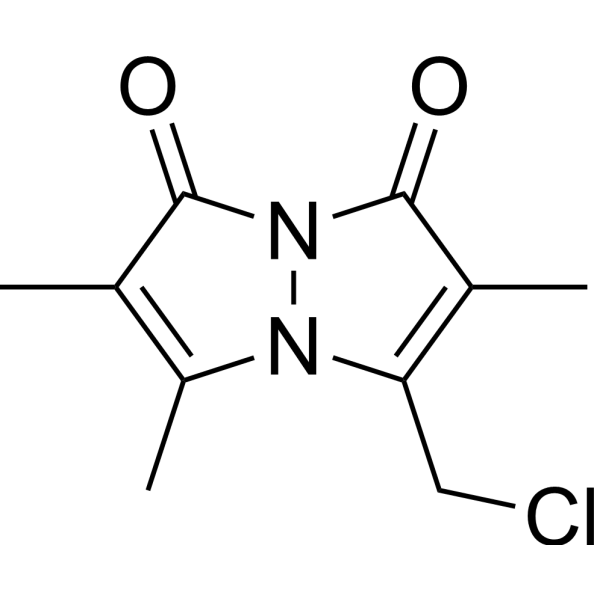
Physicochemical Properties
| Molecular Formula | C10H11N2O2CL |
| Molecular Weight | 226.65954 |
| Exact Mass | 226.051 |
| CAS # | 76421-73-3 |
| PubChem CID | 114886 |
| Appearance | Light yellow to yellow solid powder |
| Density | 1.4g/cm3 |
| Boiling Point | 314.9ºC at 760 mmHg |
| Melting Point | 135-136ºC(lit.) |
| Flash Point | 144.2ºC |
| Index of Refraction | 1.61 |
| LogP | 0.861 |
| Hydrogen Bond Donor Count | 0 |
| Hydrogen Bond Acceptor Count | 3 |
| Rotatable Bond Count | 1 |
| Heavy Atom Count | 15 |
| Complexity | 437 |
| Defined Atom Stereocenter Count | 0 |
| InChi Key | SUIPVTCEECPFIB-UHFFFAOYSA-N |
| InChi Code | InChI=1S/C10H11ClN2O2/c1-5-7(3)12-8(4-11)6(2)10(15)13(12)9(5)14/h4H2,1-3H3 |
| Chemical Name | 7-(chloromethyl)-1,2,6-trimethylpyrazolo[1,2-a]pyrazole-3,5-dione |
| HS Tariff Code | 2934.99.9001 |
| Storage |
Powder-20°C 3 years 4°C 2 years In solvent -80°C 6 months -20°C 1 month Note: This product requires protection from light (avoid light exposure) during transportation and storage. |
| Shipping Condition | Room temperature (This product is stable at ambient temperature for a few days during ordinary shipping and time spent in Customs) |
Biological Activity
| ln Vitro | Advice (The procedure we suggest is as follows. This protocol should be adjusted to suit your unique requirements; it merely offers guidelines. 1. Setting up the experimental and control wells: Parallel negative, positive, and experimental wells should make up the experiment, in that order. Test wells: Pour in 200 μL of cell culture media with the appropriate amount of GSH effectors (e.g., 200 μM H2O2). 2. Let the plate sit in 5% CO2 at 37°C for the entire night. Depending on your standard procedure, incubation times can differ. 3. At a final concentration of 20–100 μM, add monochlorodimethane (mBCl) from the 1 mM working solution to the cells. Dimethyl sulfoxide (DMSO) was used to prepare stock solutions of mBCl (50 mM), which were then kept at -20°C. Prior to use, the stock solution was diluted in 0.1 M PBS buffer (pH 7.0). In the experiment, the final DMSO concentration is less than 0.2% (v/v). 4. For around two hours, incubate the cell suspension with mBCl at 25°C in the dark. 5. Centrifuge the dye at 700 X g for five minutes to remove it. Fill each well with 200 μL of Assay Buffer, then proceed with your chosen detection technique. 6. GSH detection inside cells: The fluorescence plate reader can read fluorescence straight from the culture plate and is appropriate for adherent cells. To record fluorescence (blue) at EX/EM = 380/465 ±20 nm, respectively, aliquot 200 μL of culture suspension into white opaque plates if employing suspension cells. |
| ADME/Pharmacokinetics |
Metabolism / Metabolites Monochlorobimane has known human metabolites that include Bimane-glutathione. |
| References |
[1]. Monochlorobimane fluorometric method to measure tissue glutathione. Anal Biochem. 2000 Nov 1;286(1):35-7. [2]. Assessment of cellular reduced glutathione content in Pseudokirchneriella subcapitata using monochlorobimane. Journal of Applied Phycology volume 24, pages1509–1516(2012). |
| Additional Infomation | Monochlorobimane is an organochlorine compound and a pyrazolopyrazole. It has a role as a fluorochrome. |
Solubility Data
| Solubility (In Vitro) | DMSO : ~50 mg/mL (~220.59 mM) |
| Solubility (In Vivo) |
Solubility in Formulation 1: 2.5 mg/mL (11.03 mM) in 10% DMSO + 40% PEG300 + 5% Tween80 + 45% Saline (add these co-solvents sequentially from left to right, and one by one), clear solution; with sonication. For example, if 1 mL of working solution is to be prepared, you can add 100 μL of 25.0 mg/mL clear DMSO stock solution to 400 μL PEG300 and mix evenly; then add 50 μL Tween-80 to the above solution and mix evenly; then add 450 μL normal saline to adjust the volume to 1 mL. Preparation of saline: Dissolve 0.9 g of sodium chloride in 100 mL ddH₂ O to obtain a clear solution. Solubility in Formulation 2: 2.5 mg/mL (11.03 mM) in 10% DMSO + 90% (20% SBE-β-CD in Saline) (add these co-solvents sequentially from left to right, and one by one), suspension solution; with ultrasonication. For example, if 1 mL of working solution is to be prepared, you can add 100 μL of 25.0 mg/mL clear DMSO stock solution to 900 μL of 20% SBE-β-CD physiological saline solution and mix evenly. Preparation of 20% SBE-β-CD in Saline (4°C,1 week): Dissolve 2 g SBE-β-CD in 10 mL saline to obtain a clear solution. (Please use freshly prepared in vivo formulations for optimal results.) |
| Preparing Stock Solutions | 1 mg | 5 mg | 10 mg | |
| 1 mM | 4.4119 mL | 22.0595 mL | 44.1189 mL | |
| 5 mM | 0.8824 mL | 4.4119 mL | 8.8238 mL | |
| 10 mM | 0.4412 mL | 2.2059 mL | 4.4119 mL |