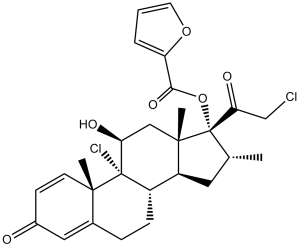
Mometasone Furoate (formerly Sch 32088; Sch32088; SCH-32088) is a potent glucocorticoid receptor agonist and an approved anti-inflammatory drug used as a topical formulation to reduce inflammation of the skin or in the airways. As a topical corticosteroid, mometasone furoate has anti-inflammatory, antipruritic, and vasoconstrictive properties.
Physicochemical Properties
| Molecular Formula | C27H30CL2O6 | |
| Molecular Weight | 521.43 | |
| Exact Mass | 520.14 | |
| Elemental Analysis | C, 62.19; H, 5.80; Cl, 13.60; O, 18.41 | |
| CAS # | 83919-23-7 | |
| Related CAS # | Mometasone furoate-d3; 141646-00-6 (furoate hydrate) 105102-22-5 (Mometasone) | |
| PubChem CID | 441336 | |
| Appearance | White to off-white solid powder | |
| Density | 1.4±0.1 g/cm3 | |
| Boiling Point | 655.5±55.0 °C at 760 mmHg | |
| Melting Point | 218-220°C | |
| Flash Point | 350.2±31.5 °C | |
| Vapour Pressure | 0.0±2.1 mmHg at 25°C | |
| Index of Refraction | 1.604 | |
| LogP | 4.27 | |
| Hydrogen Bond Donor Count | 1 | |
| Hydrogen Bond Acceptor Count | 6 | |
| Rotatable Bond Count | 5 | |
| Heavy Atom Count | 35 | |
| Complexity | 1020 | |
| Defined Atom Stereocenter Count | 8 | |
| InChi Key | WOFMFGQZHJDGCX-ZULDAHANSA-N | |
| InChi Code | InChI=1S/C27H30Cl2O6/c1-15-11-19-18-7-6-16-12-17(30)8-9-24(16,2)26(18,29)21(31)13-25(19,3)27(15,22(32)14-28)35-23(33)20-5-4-10-34-20/h4-5,8-10,12,15,18-19,21,31H,6-7,11,13-14H2,1-3H3/t15-,18+,19+,21+,24+,25+,26+,27+/m1/s1 | |
| Chemical Name | (8S,9R,10S,11S,13S,14S,16R,17R)-9-chloro-17-(2-chloroacetyl)-11-hydroxy-10,13,16-trimethyl-3-oxo-6,7,8,9,10,11,12,13,14,15,16,17-dodecahydro-3H-cyclopenta[a]phenanthren-17-yl furan-2-carboxylate | |
| Synonyms |
|
|
| HS Tariff Code | 2934.99.9001 | |
| Storage |
Powder-20°C 3 years 4°C 2 years In solvent -80°C 6 months -20°C 1 month |
|
| Shipping Condition | Room temperature (This product is stable at ambient temperature for a few days during ordinary shipping and time spent in Customs) |
Biological Activity
| Targets | Glucocorticoid Receptor/GR | ||
| ln Vitro | Mometasone furoate attaches to a glucocorticoid receptor induces conformational changes in the receptor, separation from chaperones, and the receptor travels to the nucleus[1]. Mometasone furoate (0.1-10 μM; 2h before LPS stimulation) substantially suppresses LPS-stimulated nitrite generation in a concentration-dependent manner in J774 macrophages, The IC50 value is 0.00024 μM for Mometasone furoate in J774 cells[1]. Mometasone furoate (0.1-10 μM; 2h before LPS stimulation) is more powerful than DEX, it significantly reduces iNOS expression at a 0.01 µM dose whereas Dex became active at 0.1 µM. Additionally, the inhibition of cox-2 protein expression at 0.01 µM is 79% for Mometasone furoate and 39% for Dex[1]. | ||
| ln Vivo |
|
||
| Enzyme Assay |
Extracellular signal regulated kinase 1/2 (pERK1/2), PARP-1 and Bax expression [1] Protein content for specific antibodies was evaluated in the spinal cord by SDS page electrophoresis and blotting according to standardized protocol for spinal cord tissues. Membranes were probed at 4 °C overnight with rabbit phospho-p44/42 MAPK (pERK1/2), rabbit PARP-1, rabbit Bax. Signal was developed following incubation with horseradish peroxidase-conjugated anti-rabbit for 1 h at room temperature and using an enhanced chemiluminescence system . p44/42 MAPK (ERK1/2) was used to normalize the signals of phospho-p44/42 MAPK, while β-actin and GAPDH were used to normalized PARP-1 and Bax expression, respectively. |
||
| Cell Assay | The murine monocyte/macrophage J774 cell line was grown in Dulbecco’s modified Eagles medium (DMEM) supplemented with 2 mM glutamine, 25 mM Hepes, penicillin (100 U/ml), streptomycin (100 μg/ml), 10% foetal bovine serum (FBS) and 1.2% Na pyruvate. Cells were plated in 24-well culture plates at a density of 2.5 ± 105 cells/ml or in 60 mm-diameter culture dishes (3 ± 106 cells per 3 ml dish) and allowed to adhere at 37 °C in 5% CO2. After 24 h, cells were pre-treated (for 2 h) with increasing concentration of old (Dex and MET) and new mometasone furoate (MF) , and stimulated with LPS from Escherichia coli, Serotype 0111:B4, (10 μg/ml). After 24 h of treatment, the supernatants were collected for nitrite measurement[1]. | ||
| Animal Protocol |
|
||
| ADME/Pharmacokinetics |
Absorption, Distribution and Excretion The mean time to peak concentration is 1.0 to 2.5 hours. Bioavailability has been reported as <1% but studies of repeat doses of inhaled corticosteroids suggest a bioavailability of 11%. The 0.1% ointment may have a bioavailability of 0.7%. For an inhaled dose, approximately 74% is excreted in the feces and 8% is excreted in the urine. Steady state volume of distribution of 152L. The clearance rate of mometasone furoate is not readily available, though it may be close to 90L/h. Metabolism / Metabolites Metabolism of mometasone furoate is largely performed hepatically by cytochrome P450 3A4 producing a number of metabolites. Some of these metabolites include free mometasone and 6-beta-hydroxy-mometasone furoate. Biological Half-Life The terminal half life of an inhaled dose is approximately 5 hours though it has been reported as 5.8 hours by other sources. |
||
| Toxicity/Toxicokinetics |
Protein Binding 98% to 99% (in vitro concentration of 5 to 500ng/mL). 441336 rat LD50 subcutaneous 300 mg/kg LUNGS, THORAX, OR RESPIRATION: RESPIRATORY DEPRESSION Kiso to Rinsho. Clinical Report., 24(4203), 1990 441336 mouse LDLo subcutaneous 1 gm/kg Kiso to Rinsho. Clinical Report., 24(4203), 1990 |
||
| References |
[1]. Use of Mometasone furoate in prolonged treatment of experimental spinal cord injury in mice: A comparative study of three different glucocorticoids. Pharmacol Res. 2015 Sep;99:316-28. [2]. https://go.drugbank.com/drugs/DB14512. |
||
| Additional Infomation |
Mometasone furoate is a 2-furoate ester, a steroid ester, an 11beta-hydroxy steroid, a 20-oxo steroid, an organochlorine compound and a 3-oxo-Delta(1),Delta(4)-steroid. It has a role as an anti-inflammatory drug and an anti-allergic agent. It is functionally related to a mometasone. Mometasone furoate is a corticosteroid drug that can be used for the treatment of asthma, rhinitis, and certain skin conditions. It has a glucocorticoid receptor binding affinity 22 times stronger than [dexamethasone] and higher than many other corticosteroids as well. Mometasone furoate is formulated as a dry powder inhaler, nasal spray, and ointment for its different indications. Mometasone Furoate is the furoate ester form of mometasone, a synthetic topical glucocorticoid receptor (GR) agonist with anti-inflammatory, anti-pruritic and vasoconstrictive properties. Upon administration, mometasone binds to cytoplasmic GRs and subsequently activates GR-mediated gene expression. This results in the synthesis of certain anti-inflammatory proteins, while inhibiting the synthesis of certain inflammatory mediators. Specifically, mometasone appears to induce phospholipase A2 inhibitory proteins, thereby controlling the release of the inflammatory precursor arachidonic acid from phospholipid membrane by phospholipase A2. A pregnadienediol derivative ANTI-ALLERGIC AGENT and ANTI-INFLAMMATORY AGENT that is used in the management of ASTHMA and ALLERGIC RHINITIS. It is also used as a topical treatment for skin disorders. See also: Mometasone (has active moiety); Formoterol fumarate; mometasone furoate (component of); Florfenicol; Mometasone furoate; Terbinafine (component of) ... View More ... Drug Indication Inhaled mometasone furoate is indicated for prophylaxis of asthma in patients ≥4 years. Applied topically as an ointment, mometasone furoate is indicated for symptomatic treatment of dermatitis and pruritis in patients ≥2 years. Mometasone furoate nasal spray is available both over-the-counter (OTC) and by prescription. The OTC nasal spray formulation of mometasone furoate is indicated for the treatment of upper respiratory allergic symptoms (e.g. rhinorrhea, sneezing) in patients ≥2 years of age. The prescription formulation is indicated for the treatment of chronic rhinosinusitis with nasal polyps in patients ≥18 year old and for the and prophylaxis of seasonal allergic rhinitis in patients ≥12 years old. It is also approved in combination with [olopatadine] for the symptomatic treatment of seasonal allergic rhinitis in patients ≥12 years. FDA Label Seasonal and perennial allergic rhinitis Mechanism of Action In asthma, mometasone is believed to inhibit mast cells, eosinophils, basophils, and lymphocytes. There is also evidence of inhibition of histamine, leukotrienes, and cytokines. Corticosteroids diffuse across cell membranes into the cytosol of cells where they bind to glucocorticoid receptors to produce their activity. Mometasone furoate has a particularly high receptor affinity compare to other corticosteroids, 22 times higher than that of [dexamethasone]. Mometasone furoate binding to a glucocorticoid receptor causes conformational changes in the receptor, separation from chaperones, and the receptor moves to the nucleus. Once at the nucleus, receptors dimerize and bind to a DNA sequence known as the glucocorticoid response element which either increases expression of anti-inflammatory molecules or inhibits expression of pro-inflammatory molecules (such as interleukins 4 and 5). Mometasone furoate also reduces inflammation by blocking transcription factors such as activator-protein-1 and nuclear factor kappa B (NF-kappaB). Pharmacodynamics Mometasone is a synthetic corticosteroid with an affinity for glucocorticoid receptors 22 times higher than that of [dexamethasone]. Mometasone furoate also has a lower affinity to mineralocorticoid receptors than natural corticosteroids, making it more selective in its action. Mometasone furoate diffuses across cell membranes to activate pathways responsible for reducing inflammation. |
Solubility Data
| Solubility (In Vitro) |
|
|||
| Solubility (In Vivo) |
Solubility in Formulation 1: ≥ 2.5 mg/mL (4.79 mM) (saturation unknown) in 10% DMSO + 90% (20% SBE-β-CD in Saline) (add these co-solvents sequentially from left to right, and one by one), clear solution. For example, if 1 mL of working solution is to be prepared, you can add 100 μL of 25.0 mg/mL clear DMSO stock solution to 900 μL of 20% SBE-β-CD physiological saline solution and mix evenly. Preparation of 20% SBE-β-CD in Saline (4°C,1 week): Dissolve 2 g SBE-β-CD in 10 mL saline to obtain a clear solution. Solubility in Formulation 2: ≥ 2.5 mg/mL (4.79 mM) (saturation unknown) in 10% DMSO + 90% Corn Oil (add these co-solvents sequentially from left to right, and one by one), clear solution. For example, if 1 mL of working solution is to be prepared, you can add 100 μL of 25.0 mg/mL clear DMSO stock solution to 900 μL of corn oil and mix evenly. (Please use freshly prepared in vivo formulations for optimal results.) |
| Preparing Stock Solutions | 1 mg | 5 mg | 10 mg | |
| 1 mM | 1.9178 mL | 9.5890 mL | 19.1780 mL | |
| 5 mM | 0.3836 mL | 1.9178 mL | 3.8356 mL | |
| 10 mM | 0.1918 mL | 0.9589 mL | 1.9178 mL |