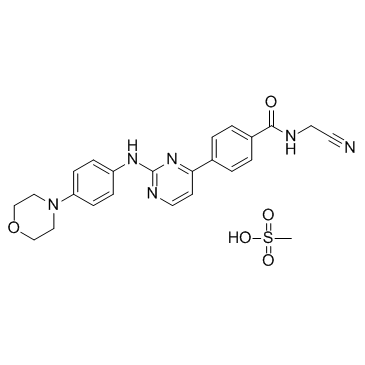
Momelotinib Mesylate, the mesylate salt of Momelotinib (CYT387; CYT11387; LM1149), is an aminopyrimidine analog acting as a novel, potent and ATP-competitive inhibitor of Janus kinases (JAK1/2) with potential antitumor and anti-inflammatory activity. It inhibits JAK1/2 with IC50s of 11 nM/18 nM, and shows ~10-fold selectivity for JAK1/2 over JAK3. CYT 387 is currently undergoing Phase I/II clinical trials for treating myelofibrosis. Momelotinib shows potent in vitro antiproliferative activity and high in vivo antitumor efficacy. It was discovered by high-throughput enzyme and cell-based screening along with the optimization using structure-guided medicinal chemistry.
Physicochemical Properties
| Molecular Formula | C24H26N6O5S |
| Molecular Weight | 510.565443515778 |
| Exact Mass | 510.168 |
| CAS # | 1056636-07-7 |
| Related CAS # | Momelotinib;1056634-68-4;Momelotinib sulfate;1056636-06-6; 1380317-28-1 (HCl) |
| PubChem CID | 78357762 |
| Appearance | Typically exists as solid at room temperature |
| Hydrogen Bond Donor Count | 3 |
| Hydrogen Bond Acceptor Count | 10 |
| Rotatable Bond Count | 6 |
| Heavy Atom Count | 36 |
| Complexity | 707 |
| Defined Atom Stereocenter Count | 0 |
| SMILES | CS(=O)(=O)O.C1COCCN1C2=CC=C(C=C2)NC3=NC=CC(=N3)C4=CC=C(C=C4)C(=O)NCC#N |
| InChi Key | LYIDPXWFFVJQLY-UHFFFAOYSA-N |
| InChi Code | InChI=1S/C23H22N6O2.CH4O3S/c24-10-12-25-22(30)18-3-1-17(2-4-18)21-9-11-26-23(28-21)27-19-5-7-20(8-6-19)29-13-15-31-16-14-29;1-5(2,3)4/h1-9,11H,12-16H2,(H,25,30)(H,26,27,28);1H3,(H,2,3,4) |
| Chemical Name | N-(cyanomethyl)-4-[2-(4-morpholin-4-ylanilino)pyrimidin-4-yl]benzamide;methanesulfonic acid |
| Synonyms | momelotinib Mesylate; 1056636-07-7; CYT387 Mesylate; CYT387 (Mesylate); N-(cyanomethyl)-4-[2-(4-morpholin-4-ylanilino)pyrimidin-4-yl]benzamide;methanesulfonic acid; |
| HS Tariff Code | 2934.99.9001 |
| Storage |
Powder-20°C 3 years 4°C 2 years In solvent -80°C 6 months -20°C 1 month |
| Shipping Condition | Room temperature (This product is stable at ambient temperature for a few days during ordinary shipping and time spent in Customs) |
Biological Activity
| Targets | Janus kinase 1/2 (JAK1/2) | ||
| ln Vitro | Momelotinib Mesylate is a JAK1/JAK2 inhibitor with an approximate 10-fold selectivity over JAK3 and an IC50 of 11 nM/18 nM. With an IC50 of 1400 nM, metelotritinib suppresses the growth of parental Ba/F3 cells (Ba/F3-wt) triggered by IL-3. Additionally, momelotinib inhibits the growth of cell lines constitutively stimulated by MPL or JAK2 signaling, such as Ba/F3-TEL-JAK2 cells, CHRF-288-11 cells, and Ba/F3-MPLW515L cells, with IC50 values of 200 nM, 1 nM, and 700 nM, respectively. Moreover, momelotinib has been demonstrated to similarly potently block the formation of erythroid colonies in vitro from PV patients who test positive for JAK2V617F, with an IC50 of 2 μM–4 μM[1]. Momelotinib blocks the effects of IL-6 and IGF-1-induced Ras/MAPK and PI3K/AKT signaling. Additionally, in primary multiple myeloma (MM) cells, momelotinib promotes apoptosis as a single agent and synergizes with the traditional anti-MM medicines melphalan and bortezomib[2]. | ||
| ln Vivo | Momelotinib normalizes hematocrit, spleen size, white cell counts, and the physiological levels of inflammatory cytokines in a mouse model of MPN[3]. | ||
| Animal Protocol |
|
||
| ADME/Pharmacokinetics |
Hepatotoxicity In the published preregistration clinical trials of momelotinib, rates of serum ALT or AST elevations ranged from 21% to 31% and were above 5 times the upper limit of normal (ULN) in 0.5% to 2.0%, and above 20 times ULN in 0.5%. Two of 448 momelotinib treated patients evaluated in the safety cohort developed clinically apparent, but self-limiting liver injury with jaundice. A third patient developed liver injury with jaundice that appeared to be due to reactivation of hepatitis B. The liver injury was typically hepatocellular without immune allergic or autoimmune features, arising after 2 to 4 months of therapy, and resolving soon after drug discontinuation. Peak ALT elevations ranged from 308 to 1178 U/L and peak bilirubin from 2.3 to 7.0 mg/dL. There were no deaths from hepatic failure. Since its approval and more widespread clinical use, there have been no further reports of serum enzyme or bilirubin elevations or instances of clinically apparent liver injury, but it has been available for a limited time only. Likelihood score: D (possible cause of clinically apparent liver injury including reactivation of hepatitis B). Effects During Pregnancy and Lactation ◉ Summary of Use during Lactation No information is available on the clinical use of momelotinib during breastfeeding. Because momelotinib is 91% bound to plasma proteins, the amount in milk is likely to be low. The manufacturer recommends that breastfeeding be discontinued during momelotinib therapy and for at least 1 week after the last dose. ◉ Effects in Breastfed Infants Relevant published information was not found as of the revision date. ◉ Effects on Lactation and Breastmilk Relevant published information was not found as of the revision date. Protein Binding Momelotinib is 91% bound to plasma proteins in healthy volunteers. Rodent repeat-dose toxicity: Male/female Sprague-Dawley rats (n=4/sex/group) received Momelotinib (LM1149; CYT387; CYT11387) (5/30/100 mg/kg, oral, daily) for 28 days: - No mortality; no-observed-adverse-effect level (NOAEL) = 30 mg/kg; - At 100 mg/kg: Mild thrombocytopenia (platelet count reduced by 20% vs. control), no histopathological changes in liver or kidneys; serum ALT/AST/creatinine unchanged [1] - In vivo safety in MPN mice: Momelotinib (LM1149; CYT387; CYT11387) (up to 60 mg/kg, oral, 28 days) caused ≤4% body weight loss, no overt toxicity (e.g., lethargy, diarrhea), and normal serum creatinine/BUN levels [3] - In vitro normal cell safety: Human PBMCs treated with Momelotinib (LM1149; CYT387; CYT11387) (≤10 μM) for 72 h showed >85% viability (MTT assay), with no significant apoptosis [1] |
||
| Toxicity/Toxicokinetics |
Absorption, Distribution and Excretion Momelotinib is rapidly absorbed following oral administration with a bioavailability of 97%. The mean (%CV) steady-state Cmax is 479 ng/mL (61%), and the mean (%CV) AUC is 3,288 ng x h/mL (60%) at the maximum recommended dosage. Momelotinib exposure (i.e., Cmax and AUC) increases dose proportionally from 100 mg to 300 mg (0.5 to 1.5 times the maximum recommended dosage), but less than dose-proportional at doses from 400 mg to 800 mg (two to four times the maximum recommended dosage). There is no clinically significant accumulation. The Tmax at steady state is two hours (Q1: 1 hour; Q3: 3 hours) post-dose. No clinically significant differences in momelotinib pharmacokinetics were observed following administration of either a high-fat meal (800 kcal; 50% fat) or low-fat meal (400 kcal; 20% fat) in healthy subjects. Momelotinib is primarily eliminated in feces and, to a lesser extent, in urine. Following a single oral dose of radiolabeled momelotinib in healthy subjects, about 69% of the total radioactive dose was recovered in fecesm with M14 accounting for 21.4% of the dose, momelotinib and M21 each accounting for 13%, and other 12 metabolites accounting for the remaining 22%. About 28% of radioactivity was recovered in urine, with M21 being the major species. The mean (%CV) apparent volume of distribution at steady-state is 984 L (118%). The mean (%CV) clearance is clearance is 103 L/h (87%). Metabolism / Metabolites Momelotinib is metabolized by multiple cytochrome P450 (CYP) enzymes, including CYP3A4 (36%), CYP2C8 (19%), CYP2C9 (17%), CYP2C19 (19%), and CYP1A2 (9%). M21 is initially formed via oxidation of the morpholine ring by the same CYP enzymes, followed by metabolism via aldehyde oxidase. M21 is a major metabolite in humans that retains approximately 40% of the pharmacological activity of the parent. The mean ratio of M21 to momelotinib for AUC ranged from 1.4 to 2.1. Momelotinib can undergo amide hydrolysis, N-dealkylation, nitrile hydrolysis, nitrile oxidation, and glucuronidation. Biological Half-Life The elimination half-life of momelotinib and the M21 metabolite is four to eight hours. Oral bioavailability in rats: Male Sprague-Dawley rats (250–300 g) received Momelotinib (LM1149; CYT387; CYT11387) via oral gavage (10 mg/kg) or intravenous injection (2 mg/kg): - Oral bioavailability = 50%; - Oral administration: Cmax = 3.1 μg/mL (Tmax = 1.6 h), terminal half-life (t1/2) = 4.3 h, AUC0-24h = 17.2 μg·h/mL; - Intravenous administration: Cmax = 7.9 μg/mL, t1/2 = 3.9 h, AUC0-∞ = 34.4 μg·h/mL [1] - Plasma protein binding: In human plasma, Momelotinib (LM1149; CYT387; CYT11387) had a protein binding rate of 93% (measured by equilibrium dialysis at 37°C) [1] - Tissue distribution in MPN mice: Oral Momelotinib (LM1149; CYT387; CYT11387) (60 mg/kg) in MPN mice resulted in bone marrow concentration of 4.8 μg/g and spleen concentration of 4.5 μg/g at 2 h post-administration, ~1.5-fold of plasma concentration (3.2 μg/mL) [3] |
||
| References |
[1]. CYT387, a selective JAK1/JAK2 inhibitor: in vitro assessment of kinase selectivity and preclinical studies using cell lines and primary cells from polycythemia vera patients. Leukemia, 2009, 23(8), 1441-1445. [2]. The novel JAK inhibitor CYT387 suppresses multiple signalling pathways, prevents proliferation and induces apoptosis in phenotypically diverse myeloma cells. Leukemia, 2011, 25(12), 1891-1899. [3]. CYT387, a novel JAK2 inhibitor, induces hematologic responses and normalizes inflammatory cytokines in murine myeloproliferative neoplasms. Blood, 2010, 115(25), 5232-5240. |
||
| Additional Infomation | Momelotinib Dihydrochloride is the dihydrochloride salt form of momelotinib, an orally bioavailable small molecule inhibitor of wild-type (WT) Janus kinases 1 and 2 (JAK1/2), the JAK2 mutant form JAK2V617F, and activin A receptor type 1 (ACVR1; activin receptor like kinase 2; ALK2), with antineoplastic activity. Upon oral administration, momelotinib competes with JAK1/2 for ATP binding, which results in inhibition of JAK1/2 activation, inhibition of the JAK-STAT signaling pathway, and leads to the induction of apoptosis and a reduction of tumor cell proliferation in JAK1/2-expressing tumor cells. In addition, the inhibition of ALK2 prevents liver hepcidin formation, increases iron availability and increases red blood cell (RBC) production. JAK2 is the most common mutated gene in bcr-abl-negative myeloproliferative disorders; the JAK2V617F gain-of-function mutation involves a valine-to-phenylalanine modification at position 617. The JAK-STAT signaling pathway is a major mediator of cytokine activity and is often dysregulated in a variety of tumor cell types. |
Solubility Data
| Solubility (In Vitro) | May dissolve in DMSO (in most cases), if not, try other solvents such as H2O, Ethanol, or DMF with a minute amount of products to avoid loss of samples |
| Solubility (In Vivo) |
Note: Listed below are some common formulations that may be used to formulate products with low water solubility (e.g. < 1 mg/mL), you may test these formulations using a minute amount of products to avoid loss of samples. Injection Formulations (e.g. IP/IV/IM/SC) Injection Formulation 1: DMSO : Tween 80: Saline = 10 : 5 : 85 (i.e. 100 μL DMSO stock solution → 50 μL Tween 80 → 850 μL Saline) *Preparation of saline: Dissolve 0.9 g of sodium chloride in 100 mL ddH ₂ O to obtain a clear solution. Injection Formulation 2: DMSO : PEG300 :Tween 80 : Saline = 10 : 40 : 5 : 45 (i.e. 100 μL DMSO → 400 μLPEG300 → 50 μL Tween 80 → 450 μL Saline) Injection Formulation 3: DMSO : Corn oil = 10 : 90 (i.e. 100 μL DMSO → 900 μL Corn oil) Example: Take the Injection Formulation 3 (DMSO : Corn oil = 10 : 90) as an example, if 1 mL of 2.5 mg/mL working solution is to be prepared, you can take 100 μL 25 mg/mL DMSO stock solution and add to 900 μL corn oil, mix well to obtain a clear or suspension solution (2.5 mg/mL, ready for use in animals). Injection Formulation 4: DMSO : 20% SBE-β-CD in saline = 10 : 90 [i.e. 100 μL DMSO → 900 μL (20% SBE-β-CD in saline)] *Preparation of 20% SBE-β-CD in Saline (4°C,1 week): Dissolve 2 g SBE-β-CD in 10 mL saline to obtain a clear solution. Injection Formulation 5: 2-Hydroxypropyl-β-cyclodextrin : Saline = 50 : 50 (i.e. 500 μL 2-Hydroxypropyl-β-cyclodextrin → 500 μL Saline) Injection Formulation 6: DMSO : PEG300 : castor oil : Saline = 5 : 10 : 20 : 65 (i.e. 50 μL DMSO → 100 μLPEG300 → 200 μL castor oil → 650 μL Saline) Injection Formulation 7: Ethanol : Cremophor : Saline = 10: 10 : 80 (i.e. 100 μL Ethanol → 100 μL Cremophor → 800 μL Saline) Injection Formulation 8: Dissolve in Cremophor/Ethanol (50 : 50), then diluted by Saline Injection Formulation 9: EtOH : Corn oil = 10 : 90 (i.e. 100 μL EtOH → 900 μL Corn oil) Injection Formulation 10: EtOH : PEG300:Tween 80 : Saline = 10 : 40 : 5 : 45 (i.e. 100 μL EtOH → 400 μLPEG300 → 50 μL Tween 80 → 450 μL Saline) Oral Formulations Oral Formulation 1: Suspend in 0.5% CMC Na (carboxymethylcellulose sodium) Oral Formulation 2: Suspend in 0.5% Carboxymethyl cellulose Example: Take the Oral Formulation 1 (Suspend in 0.5% CMC Na) as an example, if 100 mL of 2.5 mg/mL working solution is to be prepared, you can first prepare 0.5% CMC Na solution by measuring 0.5 g CMC Na and dissolve it in 100 mL ddH2O to obtain a clear solution; then add 250 mg of the product to 100 mL 0.5% CMC Na solution, to make the suspension solution (2.5 mg/mL, ready for use in animals). Oral Formulation 3: Dissolved in PEG400 Oral Formulation 4: Suspend in 0.2% Carboxymethyl cellulose Oral Formulation 5: Dissolve in 0.25% Tween 80 and 0.5% Carboxymethyl cellulose Oral Formulation 6: Mixing with food powders Note: Please be aware that the above formulations are for reference only. InvivoChem strongly recommends customers to read literature methods/protocols carefully before determining which formulation you should use for in vivo studies, as different compounds have different solubility properties and have to be formulated differently. (Please use freshly prepared in vivo formulations for optimal results.) |
| Preparing Stock Solutions | 1 mg | 5 mg | 10 mg | |
| 1 mM | 1.9586 mL | 9.7930 mL | 19.5860 mL | |
| 5 mM | 0.3917 mL | 1.9586 mL | 3.9172 mL | |
| 10 mM | 0.1959 mL | 0.9793 mL | 1.9586 mL |