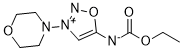
Molsidomine is an orally bioactive and long acting vasodilator acting as an NO donor and annexin A2 inhibitor. It is metabolized in the liver to the active metabolite linsidomine, which is an unstable compound that releases nitric oxide (NO) upon decay as the actual vasodilating compound. It inhibits PDGF-induced smooth muscle cell migration, suppresses carotid artery neointima formation, and prevents activated platelet adhesion.
Physicochemical Properties
| Molecular Formula | C9H14N4O4 |
| Molecular Weight | 242.23 |
| Exact Mass | 242.101 |
| CAS # | 25717-80-0 |
| PubChem CID | 5353788 |
| Appearance | White to off-white solid powder |
| Melting Point | 140-141°C |
| LogP | 2.2 |
| Hydrogen Bond Donor Count | 0 |
| Hydrogen Bond Acceptor Count | 7 |
| Rotatable Bond Count | 4 |
| Heavy Atom Count | 17 |
| Complexity | 270 |
| Defined Atom Stereocenter Count | 0 |
| SMILES | CCO/C(=N/C1=C[N+](=NO1)N2CCOCC2)/[O-] |
| InChi Key | XLFWDASMENKTKL-UHFFFAOYSA-N |
| InChi Code | InChI=1S/C9H14N4O4/c1-2-16-9(14)10-8-7-13(11-17-8)12-3-5-15-6-4-12/h7H,2-6H2,1H3 |
| Chemical Name | (1E)-1-ethoxy-N-(3-morpholin-4-yloxadiazol-3-ium-5-yl)methanimidate |
| Synonyms | N-(Ethoxycarbonyl)-3-(4-morpholinyl)sydnone imine Morsydomine SIN10 SIN-10 SIN 10Corvaton |
| HS Tariff Code | 2934.99.9001 |
| Storage |
Powder-20°C 3 years 4°C 2 years In solvent -80°C 6 months -20°C 1 month |
| Shipping Condition | Room temperature (This product is stable at ambient temperature for a few days during ordinary shipping and time spent in Customs) |
Biological Activity
| ADME/Pharmacokinetics |
Absorption, Distribution and Excretion Peak plasma drug concentration (tmax) occurs from 1 to 2 hours after administration. 98 L renal excretion is the main route of elimination of the metabolites in humans (90% to 95%) About 2% of the ingested drug is excreted unchanged in the urine. Metabolism / Metabolites Molsidomine hepatically metabolized to _linsidomine_. Linsidomine releases nitric oxide (NO) from endothelial cells when it decays, and acts as the active vasodilating metabolite responsible for molsidomine's pharmacological effects. Oral absorption of Molsidomine is found to be 95.5% ±4.5. Presystemic metabolism is noted to be 56% and metabolism is reported extensive by Liver. Renal Excretion accounts for 95 % and plasma half-life is 5 hr. Back to top |
| Additional Infomation |
1-ethoxy-N-[3-(4-morpholinyl)-5-oxadiazol-3-iumyl]methanimidate is a member of morpholines. Molsidomine is an orally active, long-acting vasodilator, which belongs to the class of medications known as syndnones. Interestingly, it is being studied as being a preventive measure in cerebral infarction. A morpholinyl sydnone imine ethyl ester, having a nitrogen in place of the keto oxygen. It acts as NITRIC OXIDE DONORS and is a vasodilator that has been used in ANGINA PECTORIS. Drug Indication The indications for use of molsidomine include ischemic heart disease, angina, chronic heart failure, and pulmonary hypertension. Mechanism of Action Molsidomine, a cardiovascular drug, acts in a similar fashion to organic nitrates. The SIN-1A metabolite of molsidomine has a pharmacologically active group of nitric oxide, which increases levels of cyclic GMP, and decreases intracellular calcium ions in smooth muscle cells. This leads to relaxation of smooth muscle in the blood vessels, and inhibits platelet aggregation. |
Solubility Data
| Solubility (In Vitro) |
DMSO : ≥ 100 mg/mL (~412.83 mM) H2O : ~25 mg/mL (~103.21 mM) |
| Solubility (In Vivo) |
Solubility in Formulation 1: ≥ 2.5 mg/mL (10.32 mM) (saturation unknown) in 10% DMSO + 40% PEG300 + 5% Tween80 + 45% Saline (add these co-solvents sequentially from left to right, and one by one), clear solution. For example, if 1 mL of working solution is to be prepared, you can add 100 μL of 25.0 mg/mL clear DMSO stock solution to 400 μL PEG300 and mix evenly; then add 50 μL Tween-80 to the above solution and mix evenly; then add 450 μL normal saline to adjust the volume to 1 mL. Preparation of saline: Dissolve 0.9 g of sodium chloride in 100 mL ddH₂ O to obtain a clear solution. Solubility in Formulation 2: ≥ 2.5 mg/mL (10.32 mM) (saturation unknown) in 10% DMSO + 90% (20% SBE-β-CD in Saline) (add these co-solvents sequentially from left to right, and one by one), clear solution. For example, if 1 mL of working solution is to be prepared, you can add 100 μL of 25.0 mg/mL clear DMSO stock solution to 900 μL of 20% SBE-β-CD physiological saline solution and mix evenly. Preparation of 20% SBE-β-CD in Saline (4°C,1 week): Dissolve 2 g SBE-β-CD in 10 mL saline to obtain a clear solution. Solubility in Formulation 3: ≥ 2.5 mg/mL (10.32 mM) (saturation unknown) in 10% DMSO + 90% Corn Oil (add these co-solvents sequentially from left to right, and one by one), clear solution. For example, if 1 mL of working solution is to be prepared, you can add 100 μL of 25.0 mg/mL clear DMSO stock solution to 900 μL of corn oil and mix evenly. Solubility in Formulation 4: 25 mg/mL (103.21 mM) in PBS (add these co-solvents sequentially from left to right, and one by one), clear solution; with ultrasonication. (Please use freshly prepared in vivo formulations for optimal results.) |
| Preparing Stock Solutions | 1 mg | 5 mg | 10 mg | |
| 1 mM | 4.1283 mL | 20.6415 mL | 41.2831 mL | |
| 5 mM | 0.8257 mL | 4.1283 mL | 8.2566 mL | |
| 10 mM | 0.4128 mL | 2.0642 mL | 4.1283 mL |