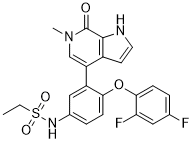
Mivebresib (formerly known as ABBV-075) is a novel potent bromodomain (BRD) inhibitor that is being tested in a Phase I study for the treatment of solid tumors. Mivebresib demonstrates excellent potency in biochemical and cellular assays, advantageous exposures and half-life both in animal models and in humans, and in vivo efficacy in mouse models of cancer progression and inflammation. As a potent BET (bromodomain and extraterminal domain) inhibitor (bromodomain (BRD)-containing proteind), Mivebresib has potential antineoplastic activity. It binds bromodomains of BRD2/4/T with similar affinities (Ki of 1-2.2 nM) and highly selective for 18 bromodomain proteins tested (Kd > 1 μM; more than 600-fold selectivity vs. BRD4), but exhibits roughly 10-fold weaker potency towards BRD3 (Ki of 12.2 nM) and has moderate activity towards CREBBP (Kd = 87 μM; 54-fold selectivity vs. BRD4). In addition, potent inhibition of the BET (bromodomain and extra-terminal) family with ABBV-075 is a highly efficacious therapy in pre-clinical models of prostate cancer. The single-digit to low nanomolar anti-proliferative IC50s and potent in vivo tumor growth inhibition of ABBV-075 is mediated in part via inhibition of androgen receptor (AR)-dependent transcription.
Physicochemical Properties
| Molecular Formula | C22H19F2N3O4S | |
| Molecular Weight | 459.47 | |
| Exact Mass | 459.106 | |
| CAS # | 1445993-26-9 | |
| Related CAS # |
|
|
| PubChem CID | 71600087 | |
| Appearance | White to off-white solid powder | |
| Density | 1.5±0.1 g/cm3 | |
| Boiling Point | 608.9±65.0 °C at 760 mmHg | |
| Flash Point | 322.0±34.3 °C | |
| Vapour Pressure | 0.0±1.7 mmHg at 25°C | |
| Index of Refraction | 1.647 | |
| LogP | 3.91 | |
| Hydrogen Bond Donor Count | 2 | |
| Hydrogen Bond Acceptor Count | 7 | |
| Rotatable Bond Count | 6 | |
| Heavy Atom Count | 32 | |
| Complexity | 834 | |
| Defined Atom Stereocenter Count | 0 | |
| InChi Key | RDONXGFGWSSFMY-UHFFFAOYSA-N | |
| InChi Code | InChI=1S/C22H19F2N3O4S/c1-3-32(29,30)26-14-5-7-19(31-20-6-4-13(23)10-18(20)24)16(11-14)17-12-27(2)22(28)21-15(17)8-9-25-21/h4-12,25-26H,3H2,1-2H3 | |
| Chemical Name | N-[4-(2,4-difluorophenoxy)-3-(6-methyl-7-oxo-1H-pyrrolo[2,3-c]pyridin-4-yl)phenyl]ethanesulfonamide | |
| Synonyms |
|
|
| HS Tariff Code | 2934.99.9001 | |
| Storage |
Powder-20°C 3 years 4°C 2 years In solvent -80°C 6 months -20°C 1 month |
|
| Shipping Condition | Room temperature (This product is stable at ambient temperature for a few days during ordinary shipping and time spent in Customs) |
Biological Activity
| ln Vitro | Without significantly affecting the expression of AR proteins, ivebresib suppresses DHT-stimulated transcription of AR target genes. Apart from inhibiting transcription activation downstream of AR, Mivebresib also exhibits strong anti-MYC and anti-TMPRSS2-ETS fusion protein activity[1]. | ||
| ln Vivo |
|
||
| Animal Protocol |
|
||
| References |
[1]. Abstract 4694: ABBV-075, a novel BET family inhibitor, disrupts critical transcription programs that drive prostate cancer growth to induce potent anti-tumor activity in vitro and in vivo. |
||
| Additional Infomation | Mivebresib is an inhibitor of the Bromodomain and Extra-Terminal (BET) family of proteins, with potential antineoplastic activity. Upon administration, mivebresib binds to the acetyl-lysine binding site of BRD-containing protein(s), thereby preventing the interaction between those proteins and acetylated histones. This disrupts chromatin remodeling, prevents the expression of certain growth-promoting genes, and leads to an inhibition of cell growth in susceptible tumors. |
Solubility Data
| Solubility (In Vitro) |
|
|||
| Solubility (In Vivo) |
Solubility in Formulation 1: ≥ 2.5 mg/mL (5.44 mM) (saturation unknown) in 10% DMSO + 40% PEG300 + 5% Tween80 + 45% Saline (add these co-solvents sequentially from left to right, and one by one), clear solution. For example, if 1 mL of working solution is to be prepared, you can add 100 μL of 25.0 mg/mL clear DMSO stock solution to 400 μL PEG300 and mix evenly; then add 50 μL Tween-80 to the above solution and mix evenly; then add 450 μL normal saline to adjust the volume to 1 mL. Preparation of saline: Dissolve 0.9 g of sodium chloride in 100 mL ddH₂ O to obtain a clear solution. Solubility in Formulation 2: ≥ 2.5 mg/mL (5.44 mM) (saturation unknown) in 10% DMSO + 90% (20% SBE-β-CD in Saline) (add these co-solvents sequentially from left to right, and one by one), clear solution. For example, if 1 mL of working solution is to be prepared, you can add 100 μL of 25.0 mg/mL clear DMSO stock solution to 900 μL of 20% SBE-β-CD physiological saline solution and mix evenly. Preparation of 20% SBE-β-CD in Saline (4°C,1 week): Dissolve 2 g SBE-β-CD in 10 mL saline to obtain a clear solution. (Please use freshly prepared in vivo formulations for optimal results.) |
| Preparing Stock Solutions | 1 mg | 5 mg | 10 mg | |
| 1 mM | 2.1764 mL | 10.8821 mL | 21.7642 mL | |
| 5 mM | 0.4353 mL | 2.1764 mL | 4.3528 mL | |
| 10 mM | 0.2176 mL | 1.0882 mL | 2.1764 mL |