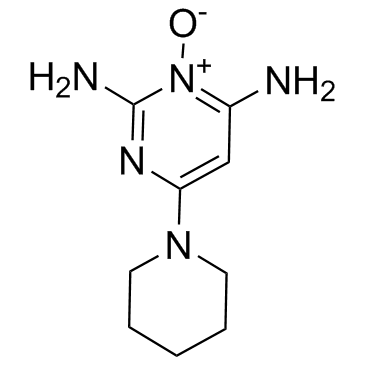
Minoxidil (U-10858; Loniten; Rogaine)is anantihypertensive agentand vasodilatorthat has also found usefulness in treatment of hair loss andalopecia areatawhenapplied topically.As an antihypertensive vasodilator medication, it targets the potassium channel and induces generalized hypertrichosis when administered systemically.
Physicochemical Properties
| Molecular Formula | C9H15N5O |
| Molecular Weight | 209.2483 |
| Exact Mass | 209.127 |
| Elemental Analysis | C, 51.66; H, 7.23; N, 33.47; O, 7.65 |
| CAS # | 38304-91-5 |
| PubChem CID | 4201 |
| Appearance | White to off-white solid |
| Density | 1.5±0.1 g/cm3 |
| Boiling Point | 351.7±45.0 °C at 760 mmHg |
| Melting Point | 272-274 °C (dec.)(lit.) |
| Flash Point | 166.5±28.7 °C |
| Vapour Pressure | 0.0±1.8 mmHg at 25°C |
| Index of Refraction | 1.724 |
| Source | Endogenous Metabolite |
| LogP | -1.49 |
| Hydrogen Bond Donor Count | 3 |
| Hydrogen Bond Acceptor Count | 3 |
| Rotatable Bond Count | 1 |
| Heavy Atom Count | 15 |
| Complexity | 329 |
| Defined Atom Stereocenter Count | 0 |
| SMILES | O([H])N1/C(=N/[H])/N=C(C([H])=C1N([H])[H])N1C([H])([H])C([H])([H])C([H])([H])C([H])([H])C1([H])[H] |
| InChi Key | ZIMGGGWCDYVHOY-UHFFFAOYSA-N |
| InChi Code | InChI=1S/C9H15N5O/c10-7-6-8(12-9(11)14(7)15)13-4-2-1-3-5-13/h6,11,15H,1-5,10H2 |
| Chemical Name | 3-hydroxy-2-imino-6-piperidin-1-ylpyrimidin-4-amine |
| HS Tariff Code | 2934.99.9001 |
| Storage |
Powder-20°C 3 years 4°C 2 years In solvent -80°C 6 months -20°C 1 month |
| Shipping Condition | Room temperature (This product is stable at ambient temperature for a few days during ordinary shipping and time spent in Customs) |
Biological Activity
| Targets | Endogenous Metabolite |
| ln Vitro | Using minoxidil (1-00 μM; 24 h; RAMEC cells) demonstrated extremely minimal cytotoxicity over the whole concentration range (from 1 μM to 100 μM) that was investigated [1]. |
| ln Vivo | Rats treated with minoxidil (0.01 mmol/kg body weight; intraperitoneal injection; 3.5 hours duration; Fisher 344 rats) showed 49% inhibitory efficacy in preventing carrageenan-induced paw edema [1]. |
| Animal Protocol |
Animal/Disease Models: Fisher 344 rat (150-200 g) edema [1] Doses: 0.01 mmol/kg body weight Route of Administration: intraperitoneal (ip) injection; intraperitoneal (ip) injection. 3.5 hrs (hrs (hours)) Experimental Results: Inhibits carrageenan-induced edema. |
| ADME/Pharmacokinetics |
Metabolism / Metabolites Minoxidil has known human metabolites that include 2-Pyrimidinamine, 1,6-dihydro-6-imino-4-(1-piperidinyl)-1-(sulfooxy)-. |
| References |
[1]. Synthesis and evaluation of the antioxidative potential of minoxidil-polyamine conjugates. Biochimie. 2013 Jul;95(7):1437-49. doi: 10.1016/j.biochi.2013.03.009. Epub 2013 Mar 28. [2]. Novel and established potassium channel openers stimulate hair growth in vitro: implications for their modes of action in hair follicles. J Invest Dermatol. 2005 Apr;124(4):686-94. [3]. Direct effects of minoxidil on epidermal cells in culture. J Invest Dermatol. 1984 Jan;82(1):90-3. |
| Additional Infomation |
Minoxidil is a pyrimidine N-oxide that is pyrimidine-2,4-diamine 3-oxide substituted by a piperidin-1-yl group at position 6. It has a role as a vasodilator agent and an antihypertensive agent. It is a pyrimidine N-oxide, a member of piperidines and an aminopyrimidine. Minoxidil is an Arteriolar Vasodilator. The physiologic effect of minoxidil is by means of Arteriolar Vasodilation. A potent direct-acting peripheral vasodilator (VASODILATOR AGENTS) that reduces peripheral resistance and produces a fall in BLOOD PRESSURE. (From Martindale, The Extra Pharmacopoeia, 30th ed, p371) See also: Minoxidil (annotation moved to). |
Solubility Data
| Solubility (In Vitro) |
Ethanol : ~7.14 mg/mL (~34.12 mM) H2O : ~1 mg/mL (~4.78 mM ) |
| Solubility (In Vivo) |
Solubility in Formulation 1: ≥ 0.71 mg/mL (3.39 mM) (saturation unknown) in 10% EtOH + 40% PEG300 + 5% Tween80 + 45% Saline (add these co-solvents sequentially from left to right, and one by one), clear solution. For example, if 1 mL of working solution is to be prepared, you can add 100 μL of 7.1 mg/mL clear EtOH stock solution to 400 μL of PEG300 and mix evenly; then add 50 μL of Tween-80 to the above solution and mix evenly; then add 450 μL of normal saline to adjust the volume to 1 mL. Preparation of saline: Dissolve 0.9 g of sodium chloride in 100 mL ddH₂ O to obtain a clear solution. Solubility in Formulation 2: ≥ 0.71 mg/mL (3.39 mM) (saturation unknown) in 10% EtOH + 90% (20% SBE-β-CD in Saline) (add these co-solvents sequentially from left to right, and one by one), clear solution. For example, if 1 mL of working solution is to be prepared, you can add 100 μL of 7.1 mg/mL clear EtOH stock solution to 900 μL of 20% SBE-β-CD physiological saline solution and mix evenly. Preparation of 20% SBE-β-CD in Saline (4°C,1 week): Dissolve 2 g SBE-β-CD in 10 mL saline to obtain a clear solution. Solubility in Formulation 3: ≥ 0.71 mg/mL (3.39 mM) (saturation unknown) in 10% EtOH + 90% Corn Oil (add these co-solvents sequentially from left to right, and one by one), clear solution. For example, if 1 mL of working solution is to be prepared, you can add 100 μL of 7.1 mg/mL clear EtOH stock solution to 900 μL of corn oil and mix well. Solubility in Formulation 4: ≥ 0.5 mg/mL (2.39 mM) (saturation unknown) in 10% DMSO + 40% PEG300 + 5% Tween80 + 45% Saline (add these co-solvents sequentially from left to right, and one by one), clear solution. For example, if 1 mL of working solution is to be prepared, you can add 100 μL of 5.0 mg/mL clear DMSO stock solution to 400 μL PEG300 and mix evenly; then add 50 μL Tween-80 to the above solution and mix evenly; then add 450 μL normal saline to adjust the volume to 1 mL. Preparation of saline: Dissolve 0.9 g of sodium chloride in 100 mL ddH₂ O to obtain a clear solution. Solubility in Formulation 5: ≥ 0.5 mg/mL (2.39 mM) (saturation unknown) in 10% DMSO + 90% (20% SBE-β-CD in Saline) (add these co-solvents sequentially from left to right, and one by one), clear solution. For example, if 1 mL of working solution is to be prepared, you can add 100 μL of 5.0 mg/mL clear DMSO stock solution to 900 μL of 20% SBE-β-CD physiological saline solution and mix evenly. Preparation of 20% SBE-β-CD in Saline (4°C,1 week): Dissolve 2 g SBE-β-CD in 10 mL saline to obtain a clear solution. Solubility in Formulation 6: ≥ 0.5 mg/mL (2.39 mM) (saturation unknown) in 10% DMSO + 90% Corn Oil (add these co-solvents sequentially from left to right, and one by one), clear solution. For example, if 1 mL of working solution is to be prepared, you can add 100 μL of 5.0 mg/mL clear DMSO stock solution to 900 μL of corn oil and mix evenly. Solubility in Formulation 7: 1.96 mg/mL (9.37 mM) in PBS (add these co-solvents sequentially from left to right, and one by one), clear solution; with ultrasonication (<60°C). Solubility in Formulation 8: 5 mg/mL (23.89 mM) in 50% PEG300 50% Saline (add these co-solvents sequentially from left to right, and one by one), clear solution; with ultrasonication. Preparation of saline: Dissolve 0.9 g of sodium chloride in 100 mL ddH₂ O to obtain a clear solution. (Please use freshly prepared in vivo formulations for optimal results.) |
| Preparing Stock Solutions | 1 mg | 5 mg | 10 mg | |
| 1 mM | 4.7790 mL | 23.8949 mL | 47.7897 mL | |
| 5 mM | 0.9558 mL | 4.7790 mL | 9.5579 mL | |
| 10 mM | 0.4779 mL | 2.3895 mL | 4.7790 mL |