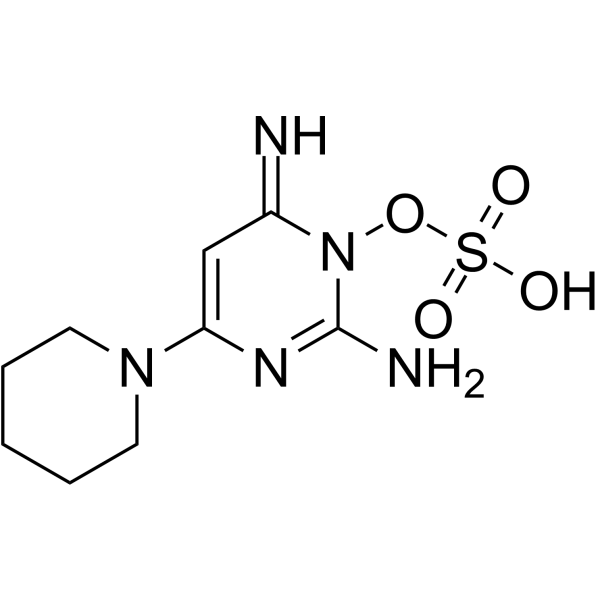
Physicochemical Properties
| Molecular Formula | C9H15N5O4S |
| Molecular Weight | 289.31 |
| Exact Mass | 289.084 |
| CAS # | 83701-22-8 |
| PubChem CID | 138113345 |
| Appearance | White to off-white solid powder |
| Boiling Point | 732ºC at 760 mmHg |
| Melting Point | 175-180°C |
| Flash Point | 396.5ºC |
| LogP | 0.72 |
| Hydrogen Bond Donor Count | 3 |
| Hydrogen Bond Acceptor Count | 7 |
| Rotatable Bond Count | 3 |
| Heavy Atom Count | 19 |
| Complexity | 529 |
| Defined Atom Stereocenter Count | 0 |
| HS Tariff Code | 2934.99.9001 |
| Storage |
Powder-20°C 3 years 4°C 2 years In solvent -80°C 6 months -20°C 1 month Note: Please store this product in a sealed and protected environment (e.g. under nitrogen), avoid exposure to moisture and light. |
| Shipping Condition | Room temperature (This product is stable at ambient temperature for a few days during ordinary shipping and time spent in Customs) |
Biological Activity
| Targets | IC50: K channel[2] |
| ln Vitro | Blood-brain tumor barrier (BTB) permeability in RBMEC monolayers is significantly reduced by minoxidil suLfate (1-100 μM; 2 hours) in a time-dependent manner. Additionally, high concentrations of MS have a high effect on transendothelial electrical resistance (TEER) after 2 hours[2]. In brain tumor tissue, minoxidil sulfate (0-100 μM; 0-4 hours) elevated RhoA activity for 1 hour, peaking at 2 hours. Moreover, it strongly increased PKB phosphorylation at Ser-473 in a transitory manner without changing PKB levels overall. Furthermore, LY294002 partially inhibits PKB phosphorylation produced by MS [2]. |
| Cell Assay |
Western Blot Analysis[2] Cell Types: Rat brain microvascular endothelial cells (RBMECs) Tested Concentrations: 0-100 μM Incubation Duration: 15 mins, 30 mins, 1 hour, 2 hrs (hours), 4 hrs (hours) Experimental Results: Induced RhoA activation and PKB phosphorylation at Ser -473. |
| References |
[1]. Minoxidil sulfate is the active metabolite that stimulates hair follicles. J Invest Dermatol. 1990 Nov;95(5):553-7. [2]. Minoxidil sulfate induced the increase in blood-brain tumor barrier permeability through ROS/RhoA/PI3K/PKB signaling pathway.Neuropharmacology 2013 Dec;75:407-15.doi: 10.1016/j.neuropharm. [3]. Effect of minoxidil sulfate and pinacidil on single potassium channel current in cultured human outer root sheath cells and dermal papilla cells. J Dermatol Sci. 1994 Jul;7 Suppl:S104-8. |
Solubility Data
| Solubility (In Vitro) |
DMSO: 250 mg/mL (864.12 mM) H2O: 50 mg/mL (172.82 mM) |
| Solubility (In Vivo) |
Solubility in Formulation 1: ≥ 2.08 mg/mL (7.19 mM) (saturation unknown) in 10% DMSO + 40% PEG300 + 5% Tween80 + 45% Saline (add these co-solvents sequentially from left to right, and one by one), clear solution. For example, if 1 mL of working solution is to be prepared, you can add 100 μL of 20.8 mg/mL clear DMSO stock solution to 400 μL PEG300 and mix evenly; then add 50 μL Tween-80 to the above solution and mix evenly; then add 450 μL normal saline to adjust the volume to 1 mL. Preparation of saline: Dissolve 0.9 g of sodium chloride in 100 mL ddH₂ O to obtain a clear solution. Solubility in Formulation 2: ≥ 2.08 mg/mL (7.19 mM) (saturation unknown) in 10% DMSO + 90% (20% SBE-β-CD in Saline) (add these co-solvents sequentially from left to right, and one by one), clear solution. For example, if 1 mL of working solution is to be prepared, you can add 100 μL of 20.8 mg/mL clear DMSO stock solution to 900 μL of 20% SBE-β-CD physiological saline solution and mix evenly. Preparation of 20% SBE-β-CD in Saline (4°C,1 week): Dissolve 2 g SBE-β-CD in 10 mL saline to obtain a clear solution. Solubility in Formulation 3: ≥ 2.08 mg/mL (7.19 mM) (saturation unknown) in 10% DMSO + 90% Corn Oil (add these co-solvents sequentially from left to right, and one by one), clear solution. For example, if 1 mL of working solution is to be prepared, you can add 100 μL of 20.8 mg/mL clear DMSO stock solution to 900 μL of corn oil and mix evenly. (Please use freshly prepared in vivo formulations for optimal results.) |
| Preparing Stock Solutions | 1 mg | 5 mg | 10 mg | |
| 1 mM | 3.4565 mL | 17.2825 mL | 34.5650 mL | |
| 5 mM | 0.6913 mL | 3.4565 mL | 6.9130 mL | |
| 10 mM | 0.3457 mL | 1.7282 mL | 3.4565 mL |