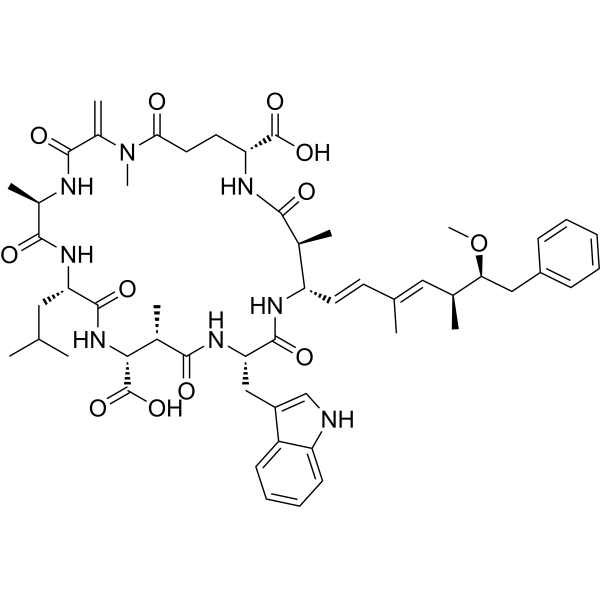
Physicochemical Properties
| Molecular Formula | C54H72N8O12 |
| Molecular Weight | 1025.20 |
| Exact Mass | 1024.53 |
| CAS # | 157622-02-1 |
| PubChem CID | 6442262 |
| Appearance | Typically exists as solid at room temperature |
| Density | 1.28g/cm3 |
| Boiling Point | 1336.1ºC at 760 mmHg |
| Flash Point | 761.9ºC |
| Vapour Pressure | 0mmHg at 25°C |
| Index of Refraction | 1.61 |
| LogP | 4.882 |
| Hydrogen Bond Donor Count | 9 |
| Hydrogen Bond Acceptor Count | 12 |
| Rotatable Bond Count | 13 |
| Heavy Atom Count | 74 |
| Complexity | 2090 |
| Defined Atom Stereocenter Count | 0 |
| SMILES | CC1C(NC(=O)C(NC(=O)C(C(NC(=O)C(NC(=O)C(NC(=O)C(=C)N(C(=O)CCC(NC1=O)C(=O)O)C)C)CC(C)C)C(=O)O)C)CC2=CNC3=CC=CC=C32)C=CC(=CC(C)C(CC4=CC=CC=C4)OC)C |
| InChi Key | CJIASZBWXIFQMU-ZVXOBQGSSA-N |
| InChi Code | InChI=1S/C54H72N8O12/c1-29(2)24-42-52(69)61-46(54(72)73)33(6)48(65)59-43(27-37-28-55-40-19-15-14-18-38(37)40)51(68)57-39(21-20-30(3)25-31(4)44(74-10)26-36-16-12-11-13-17-36)32(5)47(64)58-41(53(70)71)22-23-45(63)62(9)35(8)50(67)56-34(7)49(66)60-42/h11-21,25,28-29,31-34,39,41-44,46,55H,8,22-24,26-27H2,1-7,9-10H3,(H,56,67)(H,57,68)(H,58,64)(H,59,65)(H,60,66)(H,61,69)(H,70,71)(H,72,73)/b21-20-,30-25+ |
| Chemical Name | 15-(1H-indol-3-ylmethyl)-18-[(1Z,3E)-6-methoxy-3,5-dimethyl-7-phenylhepta-1,3-dienyl]-1,5,12,19-tetramethyl-2-methylidene-8-(2-methylpropyl)-3,6,9,13,16,20,25-heptaoxo-1,4,7,10,14,17,21-heptazacyclopentacosane-11,22-dicarboxylic acid |
| HS Tariff Code | 2934.99.9001 |
| Storage |
Powder-20°C 3 years 4°C 2 years In solvent -80°C 6 months -20°C 1 month |
| Shipping Condition | Room temperature (This product is stable at ambient temperature for a few days during ordinary shipping and time spent in Customs) |
Biological Activity
| ADME/Pharmacokinetics |
Metabolism / Metabolites Microcystins are extremely stable and resist common chemical breakdown such as hydrolysis or oxidation under conditions found in most natural water bodies. These toxins can break down slowly at high temperature (40 °C or 104 o F ) at either very low (<1) or high (>9) pH. The half-life, the time it takes for one-half of the toxin to degrade, at pH 1 and 40 oC is 3 weeks; at typical ambient conditions half-life is 10 weeks. |
| Toxicity/Toxicokinetics |
Toxicity Summary The site of action of microcystins is the hepatocyte, the commonest cell type in the liver. They act by disrupting the cytoskeleton, the adaptable protein framework that constantly shapes and reshapes the cell as it responds to the environment. The cells die and this destroys the finer blood vessels of the liver leading to massive hepatic bleeding. The molecular target are a group of enzymes called protein phosphatases that play a role in regulating protein interactions and activities. Very well-defined types of protein phosphatase (type 1 and type 2A) are inhibited very specifically by very low concentrations of microcystins. This enzyme removes phosphate from a protein, a common step in many biochemical pathways. This inhibition, with subsequent build up of phosphorylated proteins, is believed to be a mechanism by which microcystins destroy livers. Microcystins also activate the enzyme phosphorylase b, which plays a very important role in the affairs of the hepatocyte. The combination of inhibition and activation is rapidly lethal to the cell. The specificity of some of these toxins makes them valuable research tools. Toxicity Data LD50 for rats and mice are in the range 36-122 micrograms/kg with the inhalation toxicity 180 mg/min/m3 or 43 micrograms/kg. |
| References |
[1]. Microcystin production and ecological physiology of Caribbean black band disease cyanobacteria. Environ Microbiol. 2011 Apr;13(4):900-10. [2]. Comparative toxicity of four microcystins of different hydrophobicities to the protozoan, Tetrahymena pyriformis. J Appl Microbiol. 1999 May;86(5):874-82. |
| Additional Infomation |
Microcystin-LF is analog of Microcystin-LR with Phe substituted in place of Arg. It is believed to be more cell-permeable than other microcystins. Microcystins (also known as cyanoginosins) are a class of toxins produced by certain freshwater cyanobacteria. Microcystins are chemically stable over a wide range of temperature and pH, possibly as a result of their cyclic structure. The toxins are also resistant to enzymatic hydrolysis (in guts of animals) by some general proteases, such as pepsin, trypsin, collagenase, and chymotrypsin. See also: MC-LW (annotation moved to). |
Solubility Data
| Solubility (In Vitro) | May dissolve in DMSO (in most cases), if not, try other solvents such as H2O, Ethanol, or DMF with a minute amount of products to avoid loss of samples |
| Solubility (In Vivo) |
Note: Listed below are some common formulations that may be used to formulate products with low water solubility (e.g. < 1 mg/mL), you may test these formulations using a minute amount of products to avoid loss of samples. Injection Formulations (e.g. IP/IV/IM/SC) Injection Formulation 1: DMSO : Tween 80: Saline = 10 : 5 : 85 (i.e. 100 μL DMSO stock solution → 50 μL Tween 80 → 850 μL Saline) *Preparation of saline: Dissolve 0.9 g of sodium chloride in 100 mL ddH ₂ O to obtain a clear solution. Injection Formulation 2: DMSO : PEG300 :Tween 80 : Saline = 10 : 40 : 5 : 45 (i.e. 100 μL DMSO → 400 μLPEG300 → 50 μL Tween 80 → 450 μL Saline) Injection Formulation 3: DMSO : Corn oil = 10 : 90 (i.e. 100 μL DMSO → 900 μL Corn oil) Example: Take the Injection Formulation 3 (DMSO : Corn oil = 10 : 90) as an example, if 1 mL of 2.5 mg/mL working solution is to be prepared, you can take 100 μL 25 mg/mL DMSO stock solution and add to 900 μL corn oil, mix well to obtain a clear or suspension solution (2.5 mg/mL, ready for use in animals). Injection Formulation 4: DMSO : 20% SBE-β-CD in saline = 10 : 90 [i.e. 100 μL DMSO → 900 μL (20% SBE-β-CD in saline)] *Preparation of 20% SBE-β-CD in Saline (4°C,1 week): Dissolve 2 g SBE-β-CD in 10 mL saline to obtain a clear solution. Injection Formulation 5: 2-Hydroxypropyl-β-cyclodextrin : Saline = 50 : 50 (i.e. 500 μL 2-Hydroxypropyl-β-cyclodextrin → 500 μL Saline) Injection Formulation 6: DMSO : PEG300 : castor oil : Saline = 5 : 10 : 20 : 65 (i.e. 50 μL DMSO → 100 μLPEG300 → 200 μL castor oil → 650 μL Saline) Injection Formulation 7: Ethanol : Cremophor : Saline = 10: 10 : 80 (i.e. 100 μL Ethanol → 100 μL Cremophor → 800 μL Saline) Injection Formulation 8: Dissolve in Cremophor/Ethanol (50 : 50), then diluted by Saline Injection Formulation 9: EtOH : Corn oil = 10 : 90 (i.e. 100 μL EtOH → 900 μL Corn oil) Injection Formulation 10: EtOH : PEG300:Tween 80 : Saline = 10 : 40 : 5 : 45 (i.e. 100 μL EtOH → 400 μLPEG300 → 50 μL Tween 80 → 450 μL Saline) Oral Formulations Oral Formulation 1: Suspend in 0.5% CMC Na (carboxymethylcellulose sodium) Oral Formulation 2: Suspend in 0.5% Carboxymethyl cellulose Example: Take the Oral Formulation 1 (Suspend in 0.5% CMC Na) as an example, if 100 mL of 2.5 mg/mL working solution is to be prepared, you can first prepare 0.5% CMC Na solution by measuring 0.5 g CMC Na and dissolve it in 100 mL ddH2O to obtain a clear solution; then add 250 mg of the product to 100 mL 0.5% CMC Na solution, to make the suspension solution (2.5 mg/mL, ready for use in animals). Oral Formulation 3: Dissolved in PEG400 Oral Formulation 4: Suspend in 0.2% Carboxymethyl cellulose Oral Formulation 5: Dissolve in 0.25% Tween 80 and 0.5% Carboxymethyl cellulose Oral Formulation 6: Mixing with food powders Note: Please be aware that the above formulations are for reference only. InvivoChem strongly recommends customers to read literature methods/protocols carefully before determining which formulation you should use for in vivo studies, as different compounds have different solubility properties and have to be formulated differently. (Please use freshly prepared in vivo formulations for optimal results.) |
| Preparing Stock Solutions | 1 mg | 5 mg | 10 mg | |
| 1 mM | 0.9754 mL | 4.8771 mL | 9.7542 mL | |
| 5 mM | 0.1951 mL | 0.9754 mL | 1.9508 mL | |
| 10 mM | 0.0975 mL | 0.4877 mL | 0.9754 mL |