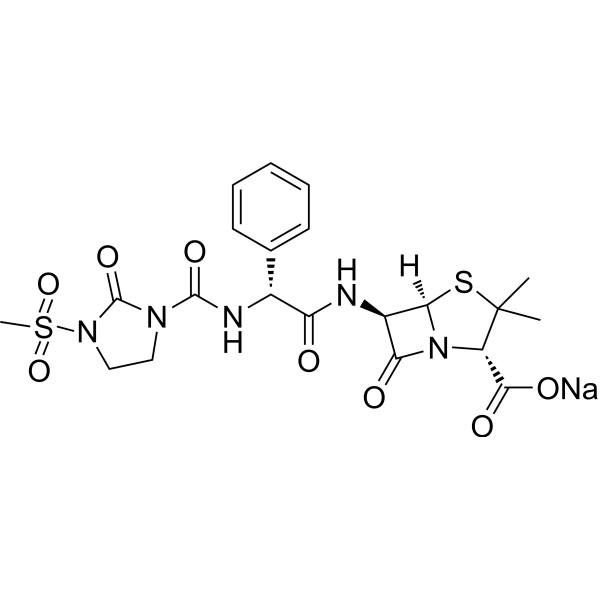
Physicochemical Properties
| Molecular Formula | C21H24NAN5O8S2 |
| Molecular Weight | 561.56 |
| Exact Mass | 561.096 |
| CAS # | 42057-22-7 |
| Related CAS # | Mezlocillin;51481-65-3 |
| PubChem CID | 23685177 |
| Appearance | White to off-white solid powder |
| LogP | 0.107 |
| Hydrogen Bond Donor Count | 2 |
| Hydrogen Bond Acceptor Count | 9 |
| Rotatable Bond Count | 6 |
| Heavy Atom Count | 37 |
| Complexity | 1090 |
| Defined Atom Stereocenter Count | 4 |
| SMILES | O=C([C@@H](C(C)(C)S[C@]1([H])[C@@H]2NC([C@H](NC(N3CCN(S(=O)(C)=O)C3=O)=O)C4=CC=CC=C4)=O)N1C2=O)[O-].[Na+] |
| InChi Key | GTGQRSIMEUWHPA-ZBJAFUORSA-M |
| InChi Code | InChI=1S/C21H25N5O8S2.Na/c1-21(2)14(18(29)30)26-16(28)13(17(26)35-21)22-15(27)12(11-7-5-4-6-8-11)23-19(31)24-9-10-25(20(24)32)36(3,33)34;/h4-8,12-14,17H,9-10H2,1-3H3,(H,22,27)(H,23,31)(H,29,30);/q;+1/p-1/t12-,13-,14+,17-;/m1./s1 |
| Chemical Name | sodium;(2S,5R,6R)-3,3-dimethyl-6-[[(2R)-2-[(3-methylsulfonyl-2-oxoimidazolidine-1-carbonyl)amino]-2-phenylacetyl]amino]-7-oxo-4-thia-1-azabicyclo[3.2.0]heptane-2-carboxylate |
| HS Tariff Code | 2934.99.9001 |
| Storage |
Powder-20°C 3 years 4°C 2 years In solvent -80°C 6 months -20°C 1 month Note: (1). This product requires protection from light (avoid light exposure) during transportation and storage.(2). Please store this product in a sealed and protected environment (e.g. under nitrogen), avoid exposure to moisture. |
| Shipping Condition | Room temperature (This product is stable at ambient temperature for a few days during ordinary shipping and time spent in Customs) |
Biological Activity
| Targets |
- Mezlocillin sodium exerts antibacterial effects by targeting bacterial penicillin-binding proteins (PBPs), which are key enzymes involved in bacterial cell wall synthesis[2] |
| ln Vitro |
- Antibacterial activity against gram-positive bacteria: Mezlocillin sodium showed inhibitory effects on various gram-positive bacteria. The minimum inhibitory concentration (MIC) against penicillin-susceptible Staphylococcus aureus was 0.25–1 μg/ml, and against Streptococcus pneumoniae was 0.125–0.5 μg/ml[2] - Antibacterial activity against gram-negative bacteria: Mezlocillin sodium exhibited broad-spectrum activity against gram-negative bacteria. Its MIC against Escherichia coli was 1–4 μg/ml, against Klebsiella pneumoniae was 2–8 μg/ml, and against Pseudomonas aeruginosa was 4–16 μg/ml[2] - Immunomodulatory effect on lymphocytes: In vitro, Mezlocillin sodium at a concentration of 100 μg/ml inhibited phytohemagglutinin (PHA)-induced proliferation of human peripheral blood lymphocytes (measured by 3H-thymidine incorporation assay). It had no significant effect on lymphocyte proliferation without PHA stimulation[1] - Effect on monocyte cytokine release: Mezlocillin sodium (100 μg/ml) did not significantly alter lipopolysaccharide (LPS)-induced release of tumor necrosis factor-α (TNF-α) or interleukin-1 (IL-1) from human monocytes in vitro[1] |
| ln Vivo |
Medlocillin subcutaneous injection (1.7-5.7 mg/kg; twice daily; 7 days) was used as an in vivo treatment to decrease IgM and IgG responses, delayed-type hypersensitivity reactions, hair loss, and lymphocyte proliferation dose[1]. - Accidental high-dose intraventricular administration in humans: A patient accidentally received an intraventricular injection of 2 g Mezlocillin sodium (concentration: 200 mg/ml) instead of the intended intrathecal medication. Within 10 minutes, the patient developed generalized tonic-clonic seizures and decreased consciousness (Glasgow Coma Scale score: 6). Cerebrospinal fluid (CSF) exchange was performed as treatment: ~10–15 ml of CSF was removed and replaced with sterile normal saline every 15–30 minutes, totaling ~100 ml of CSF exchanged. The patient’s seizures ceased 6 hours after treatment, and consciousness gradually recovered to normal within 48 hours.[3] |
| Cell Assay |
- Lymphocyte proliferation assay: Human peripheral blood lymphocytes were isolated from healthy donors and suspended in culture medium. The cells were divided into three groups: control group (no stimulation), PHA-stimulated group (5 μg/ml PHA), and PHA + Mezlocillin sodium group (5 μg/ml PHA + 100 μg/ml Mezlocillin sodium). All groups were incubated at 37°C in a 5% CO₂ atmosphere for 72 hours. During the last 18 hours of incubation, 3H-thymidine was added to each well. The amount of 3H-thymidine incorporated into DNA was measured using a liquid scintillation counter to assess lymphocyte proliferation[1] - In vitro antibacterial susceptibility assay (broth dilution method): Bacterial strains (including gram-positive and gram-negative species) were cultured to the logarithmic growth phase and adjusted to a concentration of 1×10⁶ colony-forming units (CFU)/ml. Serial two-fold dilutions of Mezlocillin sodium (ranging from 0.0625 to 128 μg/ml) were prepared in Mueller-Hinton broth. Equal volumes of bacterial suspension and drug dilutions were mixed, then incubated at 37°C for 18–24 hours. The MIC was defined as the lowest concentration of Mezlocillin sodium that completely inhibited bacterial growth (no visible turbidity)[2] |
| Animal Protocol |
Animal/Disease Models: Male balb/c (Bagg ALBino) mouse [1] Doses: 1.7, 4.3, and 5.7 mg/kg Route of Administration: subcutaneous injection; 1.7, 4.3, and 5.7 mg/kg; twice (two times) daily; 7-day Experimental Results: All dose treatments were Inhibits IgM and IgG responses as well as delayed-type hypersensitivity reactions. Hair loss was observed in most animals treated at all doses. Inhibits lymphocyte proliferation in animal spleen cell cultures. |
| Toxicity/Toxicokinetics |
- Acute toxicity from accidental high-dose intraventricular administration: Intraventricular injection of 2 g Mezlocillin sodium (200 mg/ml) in a human patient caused acute neurological toxicity, including generalized tonic-clonic seizures and severe consciousness impairment (Glasgow Coma Scale score: 6). The toxicity was reversible after CSF exchange treatment, with no long-term adverse effects[3] |
| References |
[1]. Roszkowski W, et al. Antibiotics and immunomodulation: effects of cefotaxime, amikacin, mezlocillin, piperacillin and clindamycin. Med Microbiol Immunol. 1985;173(5):279-89. [2]. Bodey GP, et al. Mezlocillin: in vitro studies of a new broad-spectrum penicillin. Antimicrob Agents Chemother. 1977 Jan;11(1):74-9. [3]. Kristof RA, et al. Treatment of accidental high dose intraventricular mezlocillin application by cerebrospinal fluid exchange. J Neurol Neurosurg Psychiatry. 1998 Mar;64(3):379-81. |
| Additional Infomation |
Mezlocillin sodium is an organic sodium salt. It contains a mezlocillin(1-). Semisynthetic ampicillin-derived acylureido penicillin. It has been proposed for infections with certain anaerobes and may be useful in inner ear, bile, and CNS infections. - Mezlocillin sodium is a broad-spectrum penicillin-class antibiotic, characterized by its activity against both gram-positive and gram-negative bacteria[2] - The immunomodulatory effects of Mezlocillin sodium are selective: it only inhibits mitogen (PHA)-induced lymphocyte proliferation, without affecting baseline lymphocyte activity or monocyte cytokine release[1] |
Solubility Data
| Solubility (In Vitro) | DMSO : ~250 mg/mL (~445.19 mM) |
| Solubility (In Vivo) |
Solubility in Formulation 1: ≥ 2.08 mg/mL (3.70 mM) (saturation unknown) in 10% DMSO + 40% PEG300 + 5% Tween80 + 45% Saline (add these co-solvents sequentially from left to right, and one by one), clear solution. For example, if 1 mL of working solution is to be prepared, you can add 100 μL of 20.8 mg/mL clear DMSO stock solution to 400 μL PEG300 and mix evenly; then add 50 μL Tween-80 to the above solution and mix evenly; then add 450 μL normal saline to adjust the volume to 1 mL. Preparation of saline: Dissolve 0.9 g of sodium chloride in 100 mL ddH₂ O to obtain a clear solution. Solubility in Formulation 2: ≥ 2.08 mg/mL (3.70 mM) (saturation unknown) in 10% DMSO + 90% (20% SBE-β-CD in Saline) (add these co-solvents sequentially from left to right, and one by one), clear solution. For example, if 1 mL of working solution is to be prepared, you can add 100 μL of 20.8 mg/mL clear DMSO stock solution to 900 μL of 20% SBE-β-CD physiological saline solution and mix evenly. Preparation of 20% SBE-β-CD in Saline (4°C,1 week): Dissolve 2 g SBE-β-CD in 10 mL saline to obtain a clear solution. Solubility in Formulation 3: ≥ 2.08 mg/mL (3.70 mM) (saturation unknown) in 10% DMSO + 90% Corn Oil (add these co-solvents sequentially from left to right, and one by one), clear solution. For example, if 1 mL of working solution is to be prepared, you can add 100 μL of 20.8 mg/mL clear DMSO stock solution to 900 μL of corn oil and mix evenly. (Please use freshly prepared in vivo formulations for optimal results.) |
| Preparing Stock Solutions | 1 mg | 5 mg | 10 mg | |
| 1 mM | 1.7808 mL | 8.9038 mL | 17.8075 mL | |
| 5 mM | 0.3562 mL | 1.7808 mL | 3.5615 mL | |
| 10 mM | 0.1781 mL | 0.8904 mL | 1.7808 mL |