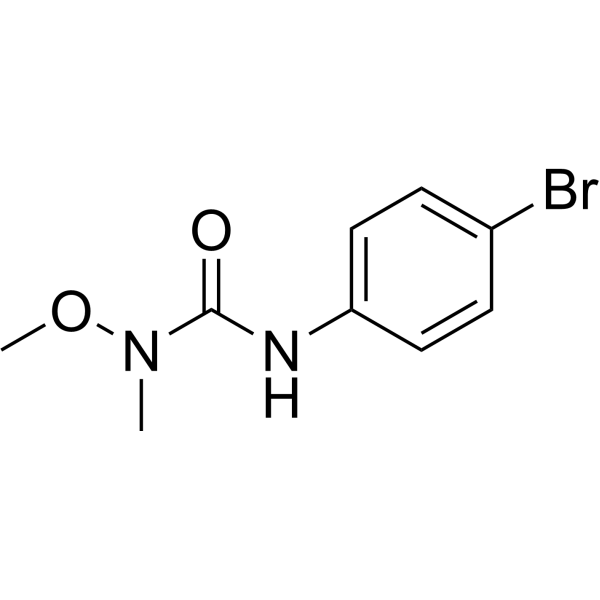
Physicochemical Properties
| Molecular Formula | C9H11N2O2BR |
| Molecular Weight | 259.10 |
| Exact Mass | 258 |
| CAS # | 3060-89-7 |
| PubChem CID | 18290 |
| Appearance |
CRYSTALS FROM CYCLOHEXANE WHITE CRYSTALS |
| Density | 1.5±0.1 g/cm3 |
| Melting Point | 95.5-96ºC |
| Flash Point | 2 °C |
| Index of Refraction | 1.607 |
| LogP | 2.32 |
| Hydrogen Bond Donor Count | 1 |
| Hydrogen Bond Acceptor Count | 2 |
| Rotatable Bond Count | 2 |
| Heavy Atom Count | 14 |
| Complexity | 193 |
| Defined Atom Stereocenter Count | 0 |
| SMILES | CON(C(NC1C=CC(Br)=CC=1)=O)C |
| InChi Key | WLFDQEVORAMCIM-UHFFFAOYSA-N |
| InChi Code | InChI=1S/C9H11BrN2O2/c1-12(14-2)9(13)11-8-5-3-7(10)4-6-8/h3-6H,1-2H3,(H,11,13) |
| Chemical Name | 3-(4-bromophenyl)-1-methoxy-1-methylurea |
| HS Tariff Code | 2934.99.9001 |
| Storage |
Powder-20°C 3 years 4°C 2 years In solvent -80°C 6 months -20°C 1 month |
| Shipping Condition | Room temperature (This product is stable at ambient temperature for a few days during ordinary shipping and time spent in Customs) |
Biological Activity
| ADME/Pharmacokinetics |
Absorption, Distribution and Excretion METOBROMURON IS ABSORBED BY ROOTS AND LEAVES ... ... Different urea herbicides exhibit different mobilities in plant systems. ... Uptake and translocation of chloroxuron, fluometuron, and metobromuron by bean plants when supplied to nutrient cultures in equal concn (essentially equimolar) and specific radioactivities were studied. Whereas the movement of chloroxuron to aerial parts was found to be restricted under the short-term conditions applied, both fluometuron and metobromuron were rapidly translocated into leaves. However, the two latter cmpd differed strikingly with regard to their distribution pattern within the leaves. In contrast to metobromuron, which was mainly confined to tracheal veins, fluometuron had almost completely moved out into the mesophyll tissues. Although no extensive comparisons of the movement of different urea structures are available at this time, it would appear that their apoplastic distribution in plants is regulated in part by the same physical-chemical phenomena which control the mobility and availability of the cmpd in soil. Metabolism / Metabolites METOBROMURON IS METABOLIZED IN PLANTS & ANIMALS BY N-DEMETHYLATION & N-DEMETHOXYLATION, RESPECTIVELY. ... RING-LABELED (14)C-METOBROMURON WAS SUPPLIED TO POTATOES AND CORN SEEDLINGS. ... FOLLOWING METABOLITES ... /WERE IDENTIFIED/: 3-(4-BROMOPHENYL)-1-METHOXYUREA, 3-(4-BROMOPHENYL)-1-METHYLUREA, AND 4-BROMOPHENYLUREA. METOBROMURON YIELDS 3-(P-BROMOPHENYL)-1-METHYLUREA AND 3-(P-BROMOPHENYL)-1-METHOXYUREA IN TALAROMYCES. /FROM TABLE/ (14)C-Metobromuron was incubated with human embryonic lung (HEL) cells. More than 95% of the label was recovered as unchanged metobromuron. Of four metabolites, three were identified: 3-(4-bromophenyl)-1-methylurea; 4-bromophenylurea; and 3-(4-bromophenyl)-1-methylurea. |
| Toxicity/Toxicokinetics |
Toxicity Data LC50 (rat) > 1,100 mg/m3/4hr Non-Human Toxicity Values LD50 RAT FEMALE ORAL 3000 + or - 800 MG/KG LD50 RAT PERCUTANEOUS > 3000 MG/KG LD50 RAT MALE ORAL 2700 + or - 300 MG/KG LD50 RABBIT PERCUTANEOUS > 10200 MG/KG For more Non-Human Toxicity Values (Complete) data for METOBROMURON (6 total), please visit the HSDB record page. |
| References | [1]. Metobromuron. Handbook of Analytical Separations, 2003. |
| Additional Infomation | Metobromuron is a member of ureas. |
Solubility Data
| Solubility (In Vitro) | May dissolve in DMSO (in most cases), if not, try other solvents such as H2O, Ethanol, or DMF with a minute amount of products to avoid loss of samples |
| Solubility (In Vivo) |
Note: Listed below are some common formulations that may be used to formulate products with low water solubility (e.g. < 1 mg/mL), you may test these formulations using a minute amount of products to avoid loss of samples. Injection Formulations (e.g. IP/IV/IM/SC) Injection Formulation 1: DMSO : Tween 80: Saline = 10 : 5 : 85 (i.e. 100 μL DMSO stock solution → 50 μL Tween 80 → 850 μL Saline) *Preparation of saline: Dissolve 0.9 g of sodium chloride in 100 mL ddH ₂ O to obtain a clear solution. Injection Formulation 2: DMSO : PEG300 :Tween 80 : Saline = 10 : 40 : 5 : 45 (i.e. 100 μL DMSO → 400 μLPEG300 → 50 μL Tween 80 → 450 μL Saline) Injection Formulation 3: DMSO : Corn oil = 10 : 90 (i.e. 100 μL DMSO → 900 μL Corn oil) Example: Take the Injection Formulation 3 (DMSO : Corn oil = 10 : 90) as an example, if 1 mL of 2.5 mg/mL working solution is to be prepared, you can take 100 μL 25 mg/mL DMSO stock solution and add to 900 μL corn oil, mix well to obtain a clear or suspension solution (2.5 mg/mL, ready for use in animals). Injection Formulation 4: DMSO : 20% SBE-β-CD in saline = 10 : 90 [i.e. 100 μL DMSO → 900 μL (20% SBE-β-CD in saline)] *Preparation of 20% SBE-β-CD in Saline (4°C,1 week): Dissolve 2 g SBE-β-CD in 10 mL saline to obtain a clear solution. Injection Formulation 5: 2-Hydroxypropyl-β-cyclodextrin : Saline = 50 : 50 (i.e. 500 μL 2-Hydroxypropyl-β-cyclodextrin → 500 μL Saline) Injection Formulation 6: DMSO : PEG300 : castor oil : Saline = 5 : 10 : 20 : 65 (i.e. 50 μL DMSO → 100 μLPEG300 → 200 μL castor oil → 650 μL Saline) Injection Formulation 7: Ethanol : Cremophor : Saline = 10: 10 : 80 (i.e. 100 μL Ethanol → 100 μL Cremophor → 800 μL Saline) Injection Formulation 8: Dissolve in Cremophor/Ethanol (50 : 50), then diluted by Saline Injection Formulation 9: EtOH : Corn oil = 10 : 90 (i.e. 100 μL EtOH → 900 μL Corn oil) Injection Formulation 10: EtOH : PEG300:Tween 80 : Saline = 10 : 40 : 5 : 45 (i.e. 100 μL EtOH → 400 μLPEG300 → 50 μL Tween 80 → 450 μL Saline) Oral Formulations Oral Formulation 1: Suspend in 0.5% CMC Na (carboxymethylcellulose sodium) Oral Formulation 2: Suspend in 0.5% Carboxymethyl cellulose Example: Take the Oral Formulation 1 (Suspend in 0.5% CMC Na) as an example, if 100 mL of 2.5 mg/mL working solution is to be prepared, you can first prepare 0.5% CMC Na solution by measuring 0.5 g CMC Na and dissolve it in 100 mL ddH2O to obtain a clear solution; then add 250 mg of the product to 100 mL 0.5% CMC Na solution, to make the suspension solution (2.5 mg/mL, ready for use in animals). Oral Formulation 3: Dissolved in PEG400 Oral Formulation 4: Suspend in 0.2% Carboxymethyl cellulose Oral Formulation 5: Dissolve in 0.25% Tween 80 and 0.5% Carboxymethyl cellulose Oral Formulation 6: Mixing with food powders Note: Please be aware that the above formulations are for reference only. InvivoChem strongly recommends customers to read literature methods/protocols carefully before determining which formulation you should use for in vivo studies, as different compounds have different solubility properties and have to be formulated differently. (Please use freshly prepared in vivo formulations for optimal results.) |
| Preparing Stock Solutions | 1 mg | 5 mg | 10 mg | |
| 1 mM | 3.8595 mL | 19.2976 mL | 38.5951 mL | |
| 5 mM | 0.7719 mL | 3.8595 mL | 7.7190 mL | |
| 10 mM | 0.3860 mL | 1.9298 mL | 3.8595 mL |