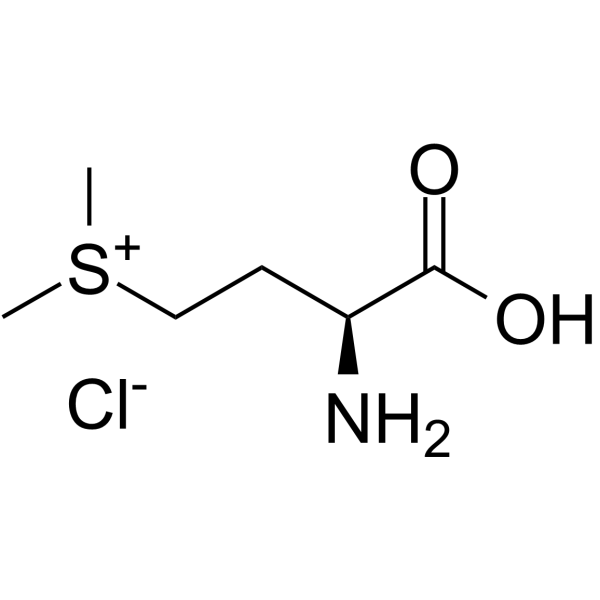
Physicochemical Properties
| Molecular Formula | C6H14CLNO2S |
| Molecular Weight | 199.693 |
| Exact Mass | 199.043 |
| CAS # | 1115-84-0 |
| PubChem CID | 16217806 |
| Appearance | Off-white to light yellow solid powder |
| Melting Point | 134ºC |
| LogP | 1.168 |
| Hydrogen Bond Donor Count | 2 |
| Hydrogen Bond Acceptor Count | 4 |
| Rotatable Bond Count | 4 |
| Heavy Atom Count | 11 |
| Complexity | 116 |
| Defined Atom Stereocenter Count | 1 |
| SMILES | C[S+](C)CC[C@@H](C(=O)O)N.[Cl-] |
| InChi Key | MYGVPKMVGSXPCQ-JEDNCBNOSA-N |
| InChi Code | InChI=1S/C6H13NO2S.ClH/c1-10(2)4-3-5(7)6(8)9;/h5H,3-4,7H2,1-2H3;1H/t5-;/m0./s1 |
| Chemical Name | [(3S)-3-amino-3-carboxypropyl]-dimethylsulfanium;chloride |
| Synonyms | FEMA No. 3445; EINECS 214-231-1; Methylmethionine sulfonium chloride |
| HS Tariff Code | 2934.99.9001 |
| Storage |
Powder-20°C 3 years 4°C 2 years In solvent -80°C 6 months -20°C 1 month |
| Shipping Condition | Room temperature (This product is stable at ambient temperature for a few days during ordinary shipping and time spent in Customs) |
Biological Activity
| ln Vitro | Human dermal fibroblasts (hDF) are encouraged to proliferate and migrate when exposed to 100 μM of vitamin U chloride for 24 hours [1]. For a 24-hour period, vitamin U chloride (0–1 mM) activates ERK1/2 in hDF[1]. Higher plants subjected to low temperature stress can benefit from the reduction of cell membrane damage caused by chlorinated vitamin U (0.1 g/L in nutritional solution) [2]. Adipocyte development is inhibited by vitamin U chloride (10–100 mM, 7 days) through the upregulation of AMPK activation and the downregulation of adipogenic factors [3]. |
| ln Vivo | In rats, valproic acid-induced liver damage can be avoided by administering 50 mg/kg of vitamin U chloride orally [4]. Rats exposed to 50 mg/kg of vitamin U chloride orally for three days show antioxidant benefits and are less likely to develop stomach injury from GalN [5]. |
| Cell Assay |
Cell proliferation experiment [1] Cell Types: human dermal fibroblasts (hDFs) Tested Concentrations: 100 μM Incubation Duration: 24 h Experimental Results: Promote the proliferation of hDFs. Western Blot Analysis[3] Cell Types: 3T3-L1 Cell Tested Concentrations: 50, 70, 90 mM Incubation Duration: 7 days Experimental Results: Increased AMPK phosphorylation and diminished PPAR-γ levels. |
| Animal Protocol |
Animal/Disease Models: Valproic acid (VPA) induced liver injury in rats [4] Doses: 50 mg/kg Route of Administration: po (oral gavage) Experimental Results: Blocked catalase (CAT), glutathione reductase (GR) ), glutathione peroxidase (GPx), and superoxide dismutase (SOD) activities. IL-1β, active caspase-3, and cytoplasmic cytochrome c levels were increased. The number of proliferating cell nuclear antigen (PCNA)-positive hepatocytes increased. |
| References |
[1]. Accelerated wound healing by S-methylmethionine sulfonium: evidence of dermal fibroblast activation via the ERK1/2 pathway. Pharmacology. 2010;85(2):68-76. [2]. S-methylmethionine reduces cell membrane damage in higher plants exposed to low-temperature stress. J Plant Physiol. 2008 Sep 29;165(14):1483-90. [3]. Inhibitory Effect of Vitamin U (S-Methylmethionine Sulfonium Chloride) on Differentiation in 3T3-L1 Pre-adipocyte Cell Lines. Ann Dermatol. 2012 Feb;24(1):39-44. [4]. Vitamin U prevents valproic acid-induced liver injury through supporting enzymatic antioxidant system and increasing hepatocyte proliferation triggered by inflammation and apoptosis. Toxicol Mech Methods. 2021 Oct;31(8):600-608. [5]. Gastroprotective effect of vitamin U in D-galactosamine-induced hepatotoxicity. J Biochem Mol Toxicol. 2022 Sep;36(9):e23124. |
| Additional Infomation |
Methylmethionine sulfonium salt is an organic molecular entity. Methylmethionine chloride may be useful in helping the healing of gastric ulcers. In Japan, it is used as an over the counter product for gastrointestinal health support. It is also called "Vitamin U", but it is not a true vitamin. A vitamin found in green vegetables. It is used in the treatment of peptic ulcers, colitis, and gastritis and has an effect on secretory, acid-forming, and enzymatic functions of the intestinal tract. See also: Cabbage (annotation moved to). |
Solubility Data
| Solubility (In Vitro) | May dissolve in DMSO (in most cases), if not, try other solvents such as H2O, Ethanol, or DMF with a minute amount of products to avoid loss of samples |
| Solubility (In Vivo) |
Note: Listed below are some common formulations that may be used to formulate products with low water solubility (e.g. < 1 mg/mL), you may test these formulations using a minute amount of products to avoid loss of samples. Injection Formulations (e.g. IP/IV/IM/SC) Injection Formulation 1: DMSO : Tween 80: Saline = 10 : 5 : 85 (i.e. 100 μL DMSO stock solution → 50 μL Tween 80 → 850 μL Saline) *Preparation of saline: Dissolve 0.9 g of sodium chloride in 100 mL ddH ₂ O to obtain a clear solution. Injection Formulation 2: DMSO : PEG300 :Tween 80 : Saline = 10 : 40 : 5 : 45 (i.e. 100 μL DMSO → 400 μLPEG300 → 50 μL Tween 80 → 450 μL Saline) Injection Formulation 3: DMSO : Corn oil = 10 : 90 (i.e. 100 μL DMSO → 900 μL Corn oil) Example: Take the Injection Formulation 3 (DMSO : Corn oil = 10 : 90) as an example, if 1 mL of 2.5 mg/mL working solution is to be prepared, you can take 100 μL 25 mg/mL DMSO stock solution and add to 900 μL corn oil, mix well to obtain a clear or suspension solution (2.5 mg/mL, ready for use in animals). Injection Formulation 4: DMSO : 20% SBE-β-CD in saline = 10 : 90 [i.e. 100 μL DMSO → 900 μL (20% SBE-β-CD in saline)] *Preparation of 20% SBE-β-CD in Saline (4°C,1 week): Dissolve 2 g SBE-β-CD in 10 mL saline to obtain a clear solution. Injection Formulation 5: 2-Hydroxypropyl-β-cyclodextrin : Saline = 50 : 50 (i.e. 500 μL 2-Hydroxypropyl-β-cyclodextrin → 500 μL Saline) Injection Formulation 6: DMSO : PEG300 : castor oil : Saline = 5 : 10 : 20 : 65 (i.e. 50 μL DMSO → 100 μLPEG300 → 200 μL castor oil → 650 μL Saline) Injection Formulation 7: Ethanol : Cremophor : Saline = 10: 10 : 80 (i.e. 100 μL Ethanol → 100 μL Cremophor → 800 μL Saline) Injection Formulation 8: Dissolve in Cremophor/Ethanol (50 : 50), then diluted by Saline Injection Formulation 9: EtOH : Corn oil = 10 : 90 (i.e. 100 μL EtOH → 900 μL Corn oil) Injection Formulation 10: EtOH : PEG300:Tween 80 : Saline = 10 : 40 : 5 : 45 (i.e. 100 μL EtOH → 400 μLPEG300 → 50 μL Tween 80 → 450 μL Saline) Oral Formulations Oral Formulation 1: Suspend in 0.5% CMC Na (carboxymethylcellulose sodium) Oral Formulation 2: Suspend in 0.5% Carboxymethyl cellulose Example: Take the Oral Formulation 1 (Suspend in 0.5% CMC Na) as an example, if 100 mL of 2.5 mg/mL working solution is to be prepared, you can first prepare 0.5% CMC Na solution by measuring 0.5 g CMC Na and dissolve it in 100 mL ddH2O to obtain a clear solution; then add 250 mg of the product to 100 mL 0.5% CMC Na solution, to make the suspension solution (2.5 mg/mL, ready for use in animals). Oral Formulation 3: Dissolved in PEG400 Oral Formulation 4: Suspend in 0.2% Carboxymethyl cellulose Oral Formulation 5: Dissolve in 0.25% Tween 80 and 0.5% Carboxymethyl cellulose Oral Formulation 6: Mixing with food powders Note: Please be aware that the above formulations are for reference only. InvivoChem strongly recommends customers to read literature methods/protocols carefully before determining which formulation you should use for in vivo studies, as different compounds have different solubility properties and have to be formulated differently. (Please use freshly prepared in vivo formulations for optimal results.) |
| Preparing Stock Solutions | 1 mg | 5 mg | 10 mg | |
| 1 mM | 5.0078 mL | 25.0388 mL | 50.0776 mL | |
| 5 mM | 1.0016 mL | 5.0078 mL | 10.0155 mL | |
| 10 mM | 0.5008 mL | 2.5039 mL | 5.0078 mL |