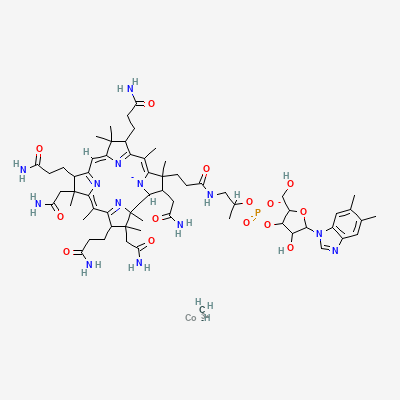
Physicochemical Properties
| Molecular Formula | C63H92CON13O14P |
| Molecular Weight | 1345.3903 |
| Exact Mass | 1343.587 |
| Elemental Analysis | C, 56.28; H, 6.82; Co, 4.38; N, 13.54; O, 16.66; P, 2.3 |
| CAS # | 13422-55-4 |
| Related CAS # | 288315-09-3 |
| PubChem CID | 60196341 |
| Appearance | Brown to red solid powder |
| Melting Point | >190°C (dec.) |
| LogP | 7.199 |
| Hydrogen Bond Donor Count | 9 |
| Hydrogen Bond Acceptor Count | 20 |
| Rotatable Bond Count | 26 |
| Heavy Atom Count | 92 |
| Complexity | 3140 |
| Defined Atom Stereocenter Count | 0 |
| SMILES | [CH3-].CC1=CC2=C(C=C1C)N(C=N2)C3C(C(C(O3)CO)OP(=O)([O-])OC(C)CNC(=O)CCC\4(C(C5C6(C(C(C(=N6)/C(=C\7/C(C(C(=N7)/C=C\8/C(C(C(=N8)/C(=C4\[N-]5)/C)CCC(=O)N)(C)C)CCC(=O)N)(C)CC(=O)N)/C)CCC(=O)N)(C)CC(=O)N)C)CC(=O)N)C)O.[Co+3] |
| InChi Key | ZFLASALABLFSNM-UHFFFAOYSA-L |
| InChi Code | InChI=1S/C62H90N13O14P.CH3.Co/c1-29-20-39-40(21-30(29)2)75(28-70-39)57-52(84)53(41(27-76)87-57)89-90(85,86)88-31(3)26-69-49(83)18-19-59(8)37(22-46(66)80)56-62(11)61(10,25-48(68)82)36(14-17-45(65)79)51(74-62)33(5)55-60(9,24-47(67)81)34(12-15-43(63)77)38(71-55)23-42-58(6,7)35(13-16-44(64)78)50(72-42)32(4)54(59)73-56;;/h20-21,23,28,31,34-37,41,52-53,56-57,76,84H,12-19,22,24-27H2,1-11H3,(H15,63,64,65,66,67,68,69,71,72,73,74,77,78,79,80,81,82,83,85,86);1H3;/q;-1;+3/p-2 |
| Chemical Name | carbanide;cobalt(3+);[5-(5,6-dimethylbenzimidazol-1-yl)-4-hydroxy-2-(hydroxymethyl)oxolan-3-yl] 1-[3-[(4Z,9Z,14Z)-2,13,18-tris(2-amino-2-oxoethyl)-7,12,17-tris(3-amino-3-oxopropyl)-3,5,8,8,13,15,18,19-octamethyl-2,7,12,17-tetrahydro-1H-corrin-21-id-3-yl]propanoylamino]propan-2-yl phosphate |
| Synonyms | DTXSID5048631; Algobaz; CH3-B12; Methylcobalamin, Cobaday, MBL-A, Mecobalamin, Cobalt-methylcobalamin, Cobamet, Cobametin, E0302, Methycobal, Methyl b12, Methyl cobalamine, Methyl vitamin B12, Methyl-B12, Vancomin; Mecobalamin; methylcobalamin; NCGC00188434-01; 13422-55-4 |
| HS Tariff Code | 2934.99.9001 |
| Storage |
Powder-20°C 3 years 4°C 2 years In solvent -80°C 6 months -20°C 1 month |
| Shipping Condition | Room temperature (This product is stable at ambient temperature for a few days during ordinary shipping and time spent in Customs) |
Biological Activity
| Targets | Endogenous Metabolite |
| ln Vitro | Methylcobalamin is a synthetic and active form of vitamin B12 that can cross the blood brain barrier without biotransformation, that may be used to treat or prevent vitamin B12 deficiency and its complications. Upon administration, mecobalamin is able to replace endogenous vitamin B12, increase vitamin B12 levels and improve vitamin B12 deficiency. Vitamin B12 is necessary for hematopoiesis, neural metabolism, DNA and RNA production, and carbohydrate, fat, and protein metabolism. It improves iron functions in the metabolic cycle and assists folic acid in choline synthesis. Its metabolism is interconnected with that of folic acid. |
| ln Vivo | After 4 weeks, 8 weeks, 3 months and 6 months, the difference of serum Hcy level between the two groups was statistically significant (t = 4.049, 3.896, 6.052, 6.159, respectively. All P <0.05). After the treatment, at 4 weeks, 8 weeks, 3 months and 6 months, the levels of hs-CRP in the treatment group were significantly lower than those in the control group (t = 37.249, 28.376, 26.454, 20.522, respectively. All P <0.01). After 3 months and 6 months, the carotid artery plaques were significantly reduced in the treatment group compared to those in the control group (t = 2.309 and 2.434. All P <0.05). After 3 months and 6 months, the NIHSS score was significantly higher in the treatment group compared to those in the control group (t = 2.455 and 2.193. All P <0.05). Conclusion: Mecobalamin can reduce the level of plasma homocysteine, then lead to reductions of levels of plasma inflammatory factors and volume of carotid artery plaques, resulting in more significant functional recovery.[1] |
| Animal Protocol | To analyze the effect of mecobalamin on the early-functional outcomes of patients with ischemic stroke and H-type hypertension. Methods: From October of 2014 to October of 2016, 224 cases of ischemic stroke and H-type hypertension were selected. The patients were randomly divided into treatment control groups, with 112 patients in each group. The control group was treated with the conventional therapy. The observation group was treated with 500 µg of mecobalamin three times a day in addition to the conventional therapy. We compared serum homocysteine (Hcy), hs-CRP levels, carotid plaques, and NIHSS scores between the two groups on the 2nd day and at 4 weeks, 8 weeks, 3 months, and 6 months.[1] |
| References |
[1]. http://en.wikipedia.org/wiki/Methylcobalamin. |
| Additional Infomation |
Mecobalamin is a synthetic and active form of vitamin B12 that can cross the blood brain barrier without biotransformation, that may be used to treat or prevent vitamin B12 deficiency and its complications. Upon administration, mecobalamin is able to replace endogenous vitamin B12, increase vitamin B12 levels and improve vitamin B12 deficiency. Vitamin B12 is necessary for hematopoiesis, neural metabolism, DNA and RNA production, and carbohydrate, fat, and protein metabolism. It improves iron functions in the metabolic cycle and assists folic acid in choline synthesis. Its metabolism is interconnected with that of folic acid. See also: Methylcobalamin (annotation moved to). |
Solubility Data
| Solubility (In Vitro) | May dissolve in DMSO (in most cases), if not, try other solvents such as H2O, Ethanol, or DMF with a minute amount of products to avoid loss of samples |
| Solubility (In Vivo) |
Note: Listed below are some common formulations that may be used to formulate products with low water solubility (e.g. < 1 mg/mL), you may test these formulations using a minute amount of products to avoid loss of samples. Injection Formulations (e.g. IP/IV/IM/SC) Injection Formulation 1: DMSO : Tween 80: Saline = 10 : 5 : 85 (i.e. 100 μL DMSO stock solution → 50 μL Tween 80 → 850 μL Saline) *Preparation of saline: Dissolve 0.9 g of sodium chloride in 100 mL ddH ₂ O to obtain a clear solution. Injection Formulation 2: DMSO : PEG300 :Tween 80 : Saline = 10 : 40 : 5 : 45 (i.e. 100 μL DMSO → 400 μLPEG300 → 50 μL Tween 80 → 450 μL Saline) Injection Formulation 3: DMSO : Corn oil = 10 : 90 (i.e. 100 μL DMSO → 900 μL Corn oil) Example: Take the Injection Formulation 3 (DMSO : Corn oil = 10 : 90) as an example, if 1 mL of 2.5 mg/mL working solution is to be prepared, you can take 100 μL 25 mg/mL DMSO stock solution and add to 900 μL corn oil, mix well to obtain a clear or suspension solution (2.5 mg/mL, ready for use in animals). Injection Formulation 4: DMSO : 20% SBE-β-CD in saline = 10 : 90 [i.e. 100 μL DMSO → 900 μL (20% SBE-β-CD in saline)] *Preparation of 20% SBE-β-CD in Saline (4°C,1 week): Dissolve 2 g SBE-β-CD in 10 mL saline to obtain a clear solution. Injection Formulation 5: 2-Hydroxypropyl-β-cyclodextrin : Saline = 50 : 50 (i.e. 500 μL 2-Hydroxypropyl-β-cyclodextrin → 500 μL Saline) Injection Formulation 6: DMSO : PEG300 : castor oil : Saline = 5 : 10 : 20 : 65 (i.e. 50 μL DMSO → 100 μLPEG300 → 200 μL castor oil → 650 μL Saline) Injection Formulation 7: Ethanol : Cremophor : Saline = 10: 10 : 80 (i.e. 100 μL Ethanol → 100 μL Cremophor → 800 μL Saline) Injection Formulation 8: Dissolve in Cremophor/Ethanol (50 : 50), then diluted by Saline Injection Formulation 9: EtOH : Corn oil = 10 : 90 (i.e. 100 μL EtOH → 900 μL Corn oil) Injection Formulation 10: EtOH : PEG300:Tween 80 : Saline = 10 : 40 : 5 : 45 (i.e. 100 μL EtOH → 400 μLPEG300 → 50 μL Tween 80 → 450 μL Saline) Oral Formulations Oral Formulation 1: Suspend in 0.5% CMC Na (carboxymethylcellulose sodium) Oral Formulation 2: Suspend in 0.5% Carboxymethyl cellulose Example: Take the Oral Formulation 1 (Suspend in 0.5% CMC Na) as an example, if 100 mL of 2.5 mg/mL working solution is to be prepared, you can first prepare 0.5% CMC Na solution by measuring 0.5 g CMC Na and dissolve it in 100 mL ddH2O to obtain a clear solution; then add 250 mg of the product to 100 mL 0.5% CMC Na solution, to make the suspension solution (2.5 mg/mL, ready for use in animals). Oral Formulation 3: Dissolved in PEG400 Oral Formulation 4: Suspend in 0.2% Carboxymethyl cellulose Oral Formulation 5: Dissolve in 0.25% Tween 80 and 0.5% Carboxymethyl cellulose Oral Formulation 6: Mixing with food powders Note: Please be aware that the above formulations are for reference only. InvivoChem strongly recommends customers to read literature methods/protocols carefully before determining which formulation you should use for in vivo studies, as different compounds have different solubility properties and have to be formulated differently. (Please use freshly prepared in vivo formulations for optimal results.) |
| Preparing Stock Solutions | 1 mg | 5 mg | 10 mg | |
| 1 mM | 0.7433 mL | 3.7164 mL | 7.4328 mL | |
| 5 mM | 0.1487 mL | 0.7433 mL | 1.4866 mL | |
| 10 mM | 0.0743 mL | 0.3716 mL | 0.7433 mL |