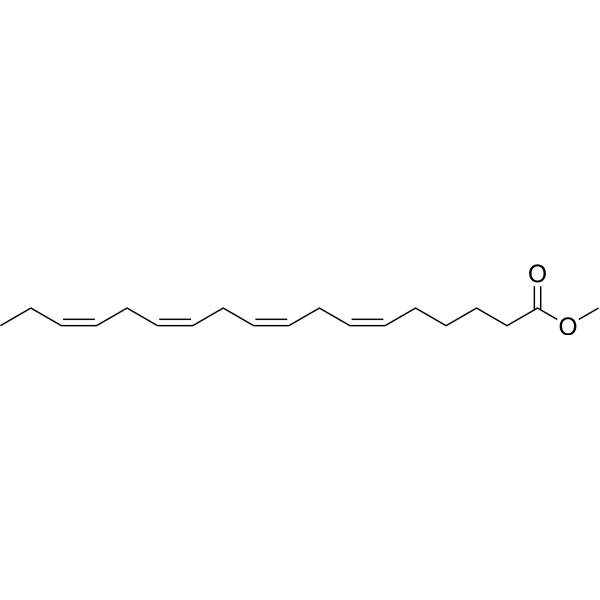
Physicochemical Properties
| Molecular Formula | C19H30O2 |
| Molecular Weight | 290.44 |
| Exact Mass | 290.224 |
| CAS # | 73097-00-4 |
| PubChem CID | 14069062 |
| Appearance | Liquid |
| Density | 0.9±0.1 g/cm3 |
| Boiling Point | 374.5±31.0 °C at 760 mmHg |
| Flash Point | 103.8±23.2 °C |
| Vapour Pressure | 0.0±0.8 mmHg at 25°C |
| Index of Refraction | 1.487 |
| LogP | 6.35 |
| Hydrogen Bond Donor Count | 0 |
| Hydrogen Bond Acceptor Count | 2 |
| Rotatable Bond Count | 13 |
| Heavy Atom Count | 21 |
| Complexity | 349 |
| Defined Atom Stereocenter Count | 0 |
| SMILES | CC/C=C\C/C=C\C/C=C\C/C=C\CCCCC(=O)OC |
| InChi Key | BIRKCHKCDPCDEG-GJDCDIHCSA-N |
| InChi Code | InChI=1S/C19H30O2/c1-3-4-5-6-7-8-9-10-11-12-13-14-15-16-17-18-19(20)21-2/h4-5,7-8,10-11,13-14H,3,6,9,12,15-18H2,1-2H3/b5-4-,8-7-,11-10-,14-13- |
| Chemical Name | methyl (6Z,9Z,12Z,15Z)-octadeca-6,9,12,15-tetraenoate |
| Synonyms | Methyl stearidonate; 73097-00-4; DTXSID801015995; RefChem:1089644; DTXCID401474147; METHYL (6Z,9Z,12Z,15Z)-OCTADECA-6,9,12,15-TETRAENOATE; 6,9,12,15-Octadecatetraenoicacid, methyl ester, (6Z,9Z,12Z,15Z)-; Stearidonic Acid methyl ester; |
| HS Tariff Code | 2934.99.9001 |
| Storage |
Powder-20°C 3 years 4°C 2 years In solvent -80°C 6 months -20°C 1 month |
| Shipping Condition | Room temperature (This product is stable at ambient temperature for a few days during ordinary shipping and time spent in Customs) |
Biological Activity
| Targets | Secondary metabolite |
| ln Vitro |
- Antioxidant Activity:
- Reference [1]: Methyl stearidonate (isolated from the marine alga Padina tenuis) exhibited in vitro antioxidant activity. In the DPPH radical scavenging assay, it showed a concentration-dependent scavenging effect, with a half-maximal inhibitory concentration (IC50) of 12.5 ± 0.8 μM (compared to the positive control ascorbic acid with IC50 = 5.2 ± 0.3 μM). In the ABTS radical cation decolorization assay, its IC50 was 15.3 ± 1.1 μM, indicating moderate radical scavenging capacity. Additionally, in the ferric reducing antioxidant power (FRAP) assay, it demonstrated a reducing power of 0.8 ± 0.05 mmol Fe²⁺/g at a concentration of 20 μM, suggesting potential to mitigate oxidative stress [1] |
| ln Vivo |
- Attenuation of Streptozotocin-Induced Type 2 Diabetic Indices:
- Reference [1]: In Wistar albino rats with streptozotocin (STZ)-induced type 2 diabetes, oral administration of Methyl stearidonate (20 mg/kg/day and 40 mg/kg/day) for 28 days showed dose-dependent improvement in diabetic indices. The high-dose group (40 mg/kg/day) exhibited: 1) A 42% reduction in fasting blood glucose (FBG) levels (from 320 ± 15 mg/dL to 185 ± 10 mg/dL) compared to the diabetic control group; 2) A 35% increase in serum insulin levels (from 5.2 ± 0.4 μU/mL to 7.0 ± 0.5 μU/mL); 3) Improved glucose tolerance, with a 30% decrease in the area under the curve (AUC) of the oral glucose tolerance test (OGTT) [1] - Reduction of Oxidative Stress in Vivo: - Reference [1]: In the same STZ-induced diabetic rat model, Methyl stearidonate (40 mg/kg/day, oral) for 28 days reduced oxidative stress markers in liver and kidney tissues. In liver tissue, it decreased malondialdehyde (MDA, a lipid peroxidation product) levels by 38% (from 6.8 ± 0.5 nmol/mg protein to 4.2 ± 0.3 nmol/mg protein) and increased superoxide dismutase (SOD) activity by 45% (from 12.3 ± 0.8 U/mg protein to 17.8 ± 1.0 U/mg protein). In kidney tissue, MDA levels were reduced by 32% and catalase (CAT) activity was increased by 39%, indicating protection against oxidative damage induced by diabetes [1] - Improvement of Lipid Profile: - Reference [1]: Methyl stearidonate (40 mg/kg/day, oral) administration to diabetic rats for 28 days normalized the lipid profile. It reduced serum total cholesterol (TC) by 28% (from 240 ± 12 mg/dL to 173 ± 9 mg/dL), triglycerides (TG) by 31% (from 185 ± 10 mg/dL to 128 ± 8 mg/dL), and low-density lipoprotein cholesterol (LDL-C) by 35% (from 150 ± 8 mg/dL to 97 ± 6 mg/dL), while increasing high-density lipoprotein cholesterol (HDL-C) by 25% (from 35 ± 3 mg/dL to 44 ± 4 mg/dL) [1] |
| Enzyme Assay |
- DPPH Radical Scavenging Assay:
- Reference [1]: Different concentrations of Methyl stearidonate (5–30 μM) were mixed with DPPH solution (0.1 mM in methanol) in a 96-well plate and incubated in the dark at room temperature for 30 minutes. The absorbance was measured at 517 nm using a microplate reader. The scavenging rate was calculated as [(Absorbance of control - Absorbance of sample)/Absorbance of control] × 100%, and the IC50 value was determined by plotting the scavenging rate against the concentration of Methyl stearidonate [1] - ABTS Radical Cation Decolorization Assay: - Reference [1]: ABTS radical cation was generated by reacting ABTS solution (7 mM) with potassium persulfate (2.45 mM) and incubating at room temperature in the dark for 16 hours. The ABTS radical cation solution was diluted with methanol to an absorbance of 0.7 ± 0.02 at 734 nm. Methyl stearidonate (5–30 μM) was added to the diluted ABTS solution, incubated for 10 minutes at room temperature, and the absorbance at 734 nm was measured. The IC50 was calculated based on the concentration-dependent decrease in absorbance [1] - FRAP Assay: - Reference [1]: FRAP reagent was prepared by mixing 300 mM acetate buffer (pH 3.6), 10 mM TPTZ (2,4,6-tripyridyl-s-triazine) in 40 mM HCl, and 20 mM FeCl₃•6H₂O at a volume ratio of 10:1:1. Methyl stearidonate (5–30 μM) was mixed with the FRAP reagent and incubated at 37°C for 30 minutes. The absorbance was measured at 593 nm, and the reducing power was calculated using a standard curve of FeSO₄•7H₂O [1] |
| Animal Protocol |
- STZ-Induced Type 2 Diabetic Rat Model and Drug Administration:
- Reference [1]: Male Wistar albino rats (180–220 g) were used to establish the type 2 diabetes model by a single intraperitoneal injection of streptozotocin (STZ, 40 mg/kg) dissolved in 0.1 M citrate buffer (pH 4.5). Rats with fasting blood glucose (FBG) levels >200 mg/dL after 7 days were considered diabetic and randomly divided into 4 groups (n=6 per group): 1) Normal control group (no STZ, oral normal saline); 2) Diabetic control group (STZ-induced, oral normal saline); 3) Methyl stearidonate low-dose group (STZ-induced, oral 20 mg/kg/day Methyl stearidonate dissolved in 0.5% carboxymethyl cellulose (CMC-Na)); 4) Methyl stearidonate high-dose group (STZ-induced, oral 40 mg/kg/day Methyl stearidonate dissolved in 0.5% CMC-Na). All groups were treated once daily for 28 days. During the treatment period, FBG levels were measured weekly using a glucometer. At the end of the treatment, rats were anesthetized with ketamine (80 mg/kg, intraperitoneal), blood samples were collected via cardiac puncture for serum insulin and lipid profile analysis, and liver and kidney tissues were harvested for oxidative stress marker detection [1] |
| Toxicity/Toxicokinetics |
- In Vivo Safety Evaluation:
- Reference [1]: In the 28-day treatment of Wistar albino rats, Methyl stearidonate (20 mg/kg/day and 40 mg/kg/day, oral) showed no obvious toxicity. No mortality or abnormal behaviors (e.g., lethargy, weight loss, reduced food/water intake) were observed in the treated groups. Serum levels of alanine transaminase (ALT), aspartate transaminase (AST), blood urea nitrogen (BUN), and creatinine were within the normal range, indicating no hepatic or renal toxicity. Histopathological examination of liver and kidney tissues also revealed no significant damage (e.g., hepatocellular necrosis, renal tubular degeneration) compared to the normal control group [1] |
| References |
[1].Padina tenuis (marine alga) attenuates oxidative stress and streptozotocin-induced type 2 diabetic indices in Wistar albino rats. South African Journal of Botany. 2020, 128, 87-100. |
| Additional Infomation |
- Natural Source and Isolation:
- Reference [1]: Methyl stearidonate was isolated from the marine alga Padina tenuis. The isolation process involved: 1) Drying and pulverizing the alga, then extracting with 80% ethanol under reflux for 3 hours (repeated 3 times); 2) Concentrating the ethanol extract under reduced pressure to obtain a crude extract; 3) Partitioning the crude extract with n-hexane, chloroform, ethyl acetate, and n-butanol sequentially; 4) Subjecting the ethyl acetate fraction (which showed the highest antioxidant activity) to silica gel column chromatography (eluted with a gradient of n-hexane-ethyl acetate from 10:1 to 1:1); 5) Further purifying the active fractions via preparative thin-layer chromatography (TLC) to obtain Methyl stearidonate; 6) Confirming the structure of Methyl stearidonate using nuclear magnetic resonance (¹H-NMR, ¹³C-NMR) and mass spectrometry (MS) [1] - Therapeutic Potential: - Reference [1]: Based on its in vitro antioxidant activity and in vivo effects on STZ-induced type 2 diabetes (improving glucose metabolism, reducing oxidative stress, normalizing lipid profile), Methyl stearidonate has potential as a natural therapeutic agent for the management of type 2 diabetes and related complications (e.g., diabetic nephropathy, diabetic hepatopathy) caused by oxidative stress [1] |
Solubility Data
| Solubility (In Vitro) |
DMSO (~50 mg/ml) DMF (~50 mg/ml) Water (~0.15 mg/ml) PBS(PH 7.2) (~0.15 mg/ml) Ethanol (Soluble) |
| Solubility (In Vivo) |
Note: Listed below are some common formulations that may be used to formulate products with low water solubility (e.g. < 1 mg/mL), you may test these formulations using a minute amount of products to avoid loss of samples. Injection Formulations (e.g. IP/IV/IM/SC) Injection Formulation 1: DMSO : Tween 80: Saline = 10 : 5 : 85 (i.e. 100 μL DMSO stock solution → 50 μL Tween 80 → 850 μL Saline) *Preparation of saline: Dissolve 0.9 g of sodium chloride in 100 mL ddH ₂ O to obtain a clear solution. Injection Formulation 2: DMSO : PEG300 :Tween 80 : Saline = 10 : 40 : 5 : 45 (i.e. 100 μL DMSO → 400 μLPEG300 → 50 μL Tween 80 → 450 μL Saline) Injection Formulation 3: DMSO : Corn oil = 10 : 90 (i.e. 100 μL DMSO → 900 μL Corn oil) Example: Take the Injection Formulation 3 (DMSO : Corn oil = 10 : 90) as an example, if 1 mL of 2.5 mg/mL working solution is to be prepared, you can take 100 μL 25 mg/mL DMSO stock solution and add to 900 μL corn oil, mix well to obtain a clear or suspension solution (2.5 mg/mL, ready for use in animals). Injection Formulation 4: DMSO : 20% SBE-β-CD in saline = 10 : 90 [i.e. 100 μL DMSO → 900 μL (20% SBE-β-CD in saline)] *Preparation of 20% SBE-β-CD in Saline (4°C,1 week): Dissolve 2 g SBE-β-CD in 10 mL saline to obtain a clear solution. Injection Formulation 5: 2-Hydroxypropyl-β-cyclodextrin : Saline = 50 : 50 (i.e. 500 μL 2-Hydroxypropyl-β-cyclodextrin → 500 μL Saline) Injection Formulation 6: DMSO : PEG300 : castor oil : Saline = 5 : 10 : 20 : 65 (i.e. 50 μL DMSO → 100 μLPEG300 → 200 μL castor oil → 650 μL Saline) Injection Formulation 7: Ethanol : Cremophor : Saline = 10: 10 : 80 (i.e. 100 μL Ethanol → 100 μL Cremophor → 800 μL Saline) Injection Formulation 8: Dissolve in Cremophor/Ethanol (50 : 50), then diluted by Saline Injection Formulation 9: EtOH : Corn oil = 10 : 90 (i.e. 100 μL EtOH → 900 μL Corn oil) Injection Formulation 10: EtOH : PEG300:Tween 80 : Saline = 10 : 40 : 5 : 45 (i.e. 100 μL EtOH → 400 μLPEG300 → 50 μL Tween 80 → 450 μL Saline) Oral Formulations Oral Formulation 1: Suspend in 0.5% CMC Na (carboxymethylcellulose sodium) Oral Formulation 2: Suspend in 0.5% Carboxymethyl cellulose Example: Take the Oral Formulation 1 (Suspend in 0.5% CMC Na) as an example, if 100 mL of 2.5 mg/mL working solution is to be prepared, you can first prepare 0.5% CMC Na solution by measuring 0.5 g CMC Na and dissolve it in 100 mL ddH2O to obtain a clear solution; then add 250 mg of the product to 100 mL 0.5% CMC Na solution, to make the suspension solution (2.5 mg/mL, ready for use in animals). Oral Formulation 3: Dissolved in PEG400 Oral Formulation 4: Suspend in 0.2% Carboxymethyl cellulose Oral Formulation 5: Dissolve in 0.25% Tween 80 and 0.5% Carboxymethyl cellulose Oral Formulation 6: Mixing with food powders Note: Please be aware that the above formulations are for reference only. InvivoChem strongly recommends customers to read literature methods/protocols carefully before determining which formulation you should use for in vivo studies, as different compounds have different solubility properties and have to be formulated differently. (Please use freshly prepared in vivo formulations for optimal results.) |
| Preparing Stock Solutions | 1 mg | 5 mg | 10 mg | |
| 1 mM | 3.4431 mL | 17.2153 mL | 34.4305 mL | |
| 5 mM | 0.6886 mL | 3.4431 mL | 6.8861 mL | |
| 10 mM | 0.3443 mL | 1.7215 mL | 3.4431 mL |