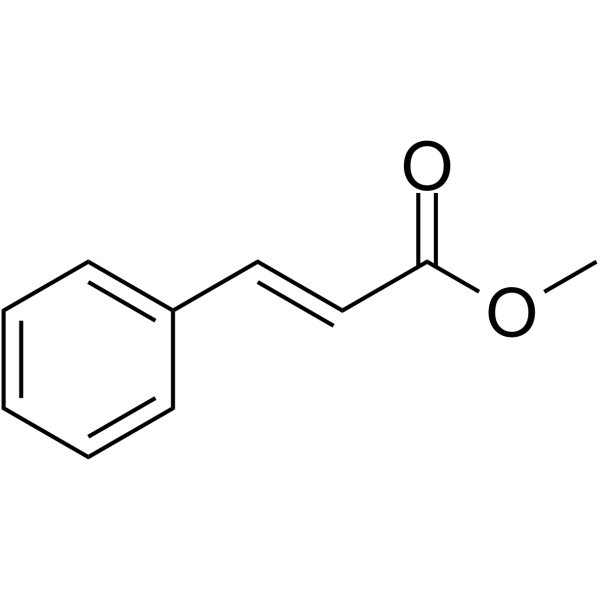
Physicochemical Properties
| Molecular Formula | C10H10O2 |
| Molecular Weight | 162.1852 |
| Exact Mass | 162.068 |
| CAS # | 103-26-4 |
| PubChem CID | 637520 |
| Appearance | White to off-white <34°C powder,>38°C liquid |
| Density | 1.1±0.1 g/cm3 |
| Boiling Point | 261.9±0.0 °C at 760 mmHg |
| Melting Point | 34-38 °C(lit.) |
| Flash Point | 141.3±9.9 °C |
| Vapour Pressure | 0.0±0.5 mmHg at 25°C |
| Index of Refraction | 1.559 |
| LogP | 2.18 |
| Hydrogen Bond Donor Count | 0 |
| Hydrogen Bond Acceptor Count | 2 |
| Rotatable Bond Count | 3 |
| Heavy Atom Count | 12 |
| Complexity | 167 |
| Defined Atom Stereocenter Count | 0 |
| SMILES | O(C)C(/C=C/C1C=CC=CC=1)=O |
| InChi Key | CCRCUPLGCSFEDV-BQYQJAHWSA-N |
| InChi Code | InChI=1S/C10H10O2/c1-12-10(11)8-7-9-5-3-2-4-6-9/h2-8H,1H3/b8-7+ |
| Chemical Name | methyl (E)-3-phenylprop-2-enoate |
| HS Tariff Code | 2934.99.9001 |
| Storage |
Powder-20°C 3 years 4°C 2 years In solvent -80°C 6 months -20°C 1 month |
| Shipping Condition | Room temperature (This product is stable at ambient temperature for a few days during ordinary shipping and time spent in Customs) |
Biological Activity
| ln Vitro | Methyl Cinnamate (methyl 3-phenylacrylate) suppresses adipocyte differentiation in the 3T3-L1 cell model by reducing the expression of adipogenic transcription factors SREBP-1, PPARγ, and C/EBPα, as well as PPARγ's transcriptional activity. Furthermore, methyl cinnamate, also known as methyl 3-phenylacrylate, triggers the CaMKK2−AMPK signaling cascade that controls adipogenesis [1]. |
| References |
[1]. Methyl cinnamate inhibits adipocyte differentiation via activation of the CaMKK2-AMPK pathwayin 3T3-L1 preadipocytes. J Agric Food Chem. 2012 Feb 1;60(4):955-63. |
| Additional Infomation |
Methyl cinnamate is a methyl ester resulting from the formal condensation of methyl cinnamic acid with methanol. It is found naturally in the essential oils of Alpinia and Basil leaf oil, and widely used in the flavor and perfume industries. It has a role as a flavouring agent, a fragrance, an insect attractant, a volatile oil component and an anti-inflammatory agent. It is a methyl ester and an alkyl cinnamate. Methyl cinnamate has been reported in Alpinia hainanensis, Alpinia mutica, and other organisms with data available. Methyl cinnamate is a metabolite found in or produced by Saccharomyces cerevisiae. |
Solubility Data
| Solubility (In Vitro) |
DMSO : ≥ 100 mg/mL (~616.56 mM) H2O : ~1 mg/mL (~6.17 mM) |
| Solubility (In Vivo) |
Solubility in Formulation 1: ≥ 2.5 mg/mL (15.41 mM) (saturation unknown) in 10% DMSO + 40% PEG300 + 5% Tween80 + 45% Saline (add these co-solvents sequentially from left to right, and one by one), clear solution. For example, if 1 mL of working solution is to be prepared, you can add 100 μL of 25.0 mg/mL clear DMSO stock solution to 400 μL PEG300 and mix evenly; then add 50 μL Tween-80 to the above solution and mix evenly; then add 450 μL normal saline to adjust the volume to 1 mL. Preparation of saline: Dissolve 0.9 g of sodium chloride in 100 mL ddH₂ O to obtain a clear solution. Solubility in Formulation 2: ≥ 2.5 mg/mL (15.41 mM) (saturation unknown) in 10% DMSO + 90% (20% SBE-β-CD in Saline) (add these co-solvents sequentially from left to right, and one by one), clear solution. For example, if 1 mL of working solution is to be prepared, you can add 100 μL of 25.0 mg/mL clear DMSO stock solution to 900 μL of 20% SBE-β-CD physiological saline solution and mix evenly. Preparation of 20% SBE-β-CD in Saline (4°C,1 week): Dissolve 2 g SBE-β-CD in 10 mL saline to obtain a clear solution. Solubility in Formulation 3: ≥ 2.5 mg/mL (15.41 mM) (saturation unknown) in 10% DMSO + 90% Corn Oil (add these co-solvents sequentially from left to right, and one by one), clear solution. For example, if 1 mL of working solution is to be prepared, you can add 100 μL of 25.0 mg/mL clear DMSO stock solution to 900 μL of corn oil and mix evenly. Solubility in Formulation 4: 2 mg/mL (12.33 mM) in PBS (add these co-solvents sequentially from left to right, and one by one), clear solution; with ultrasonication (<60°C). (Please use freshly prepared in vivo formulations for optimal results.) |
| Preparing Stock Solutions | 1 mg | 5 mg | 10 mg | |
| 1 mM | 6.1656 mL | 30.8280 mL | 61.6561 mL | |
| 5 mM | 1.2331 mL | 6.1656 mL | 12.3312 mL | |
| 10 mM | 0.6166 mL | 3.0828 mL | 6.1656 mL |