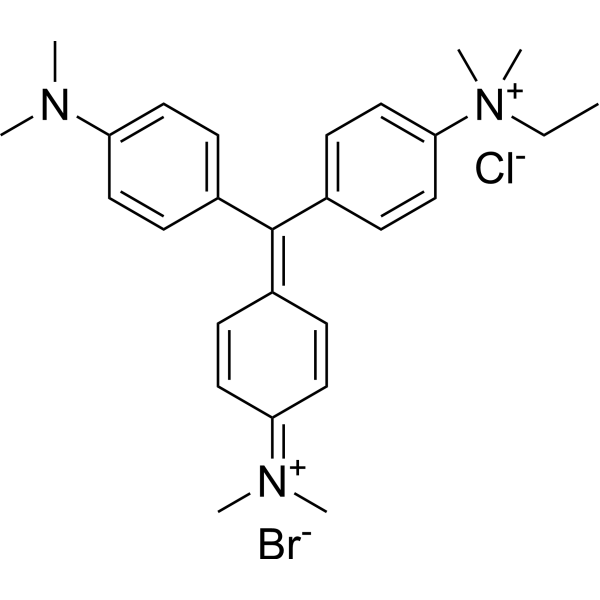
Physicochemical Properties
| Molecular Formula | C27H35N3BRCL |
| Molecular Weight | 516.9439 |
| Exact Mass | 457.205 |
| CAS # | 14855-76-6 |
| PubChem CID | 84671 |
| Appearance | Green to dark green solid powder |
| Hydrogen Bond Donor Count | 0 |
| Hydrogen Bond Acceptor Count | 3 |
| Rotatable Bond Count | 5 |
| Heavy Atom Count | 32 |
| Complexity | 645 |
| Defined Atom Stereocenter Count | 0 |
| InChi Key | IDAQSADEMXDTKN-UHFFFAOYSA-L |
| InChi Code | InChI=1S/C27H35N3.BrH.ClH/c1-8-30(6,7)26-19-13-23(14-20-26)27(21-9-15-24(16-10-21)28(2)3)22-11-17-25(18-12-22)29(4)5;;/h9-20H,8H2,1-7H3;2*1H/q+2;;/p-2 |
| Chemical Name | [4-[[4-(dimethylamino)phenyl]-(4-dimethylazaniumylidenecyclohexa-2,5-dien-1-ylidene)methyl]phenyl]-ethyl-dimethylazanium;bromide;chloride |
| HS Tariff Code | 2934.99.9001 |
| Storage |
Powder-20°C 3 years 4°C 2 years In solvent -80°C 6 months -20°C 1 month Note: Please store this product in a sealed and protected environment (e.g. under nitrogen), avoid exposure to moisture and light. |
| Shipping Condition | Room temperature (This product is stable at ambient temperature for a few days during ordinary shipping and time spent in Customs) |
Biological Activity
| References |
[1]. A fast, low cost, and highly efficient fluorescent DNA labeling method using methyl green. Histochem Cell Biol. 2014 Sep;142(3):335-45. [2]. Methyl green. A DNA major-groove binding drug. FEBS Lett. 1993 Jan 2;315(1):61-4. |
| Additional Infomation |
Ethyl green is an iminium salt composed of [4-([4-(dimethylamino)phenyl]{4-[ethyl(dimethyl)azaniumyl]phenyl}methylidene)cyclohexa-2,5-dien-1-ylidene](dimethyl)ammonium, bromide and chloride ions in a 1:1:1 ratio. A histological dye used to demonstrate nucleic acids by the Unna-Pappenheim stain, in conjunction with Pyronin Y. It has a role as a fluorochrome and a histological dye. It is an organic chloride salt, a quaternary ammonium salt, an iminium salt and an organic bromide salt. It contains an ethyl green(1+). See also: Methyl Green (annotation moved to). |
Solubility Data
| Solubility (In Vitro) | DMSO : ~125 mg/mL (~241.81 mM) |
| Solubility (In Vivo) |
Solubility in Formulation 1: ≥ 2.08 mg/mL (4.02 mM) (saturation unknown) in 10% DMSO + 40% PEG300 + 5% Tween80 + 45% Saline (add these co-solvents sequentially from left to right, and one by one), clear solution. For example, if 1 mL of working solution is to be prepared, you can add 100 μL of 20.8 mg/mL clear DMSO stock solution to 400 μL PEG300 and mix evenly; then add 50 μL Tween-80 to the above solution and mix evenly; then add 450 μL normal saline to adjust the volume to 1 mL. Preparation of saline: Dissolve 0.9 g of sodium chloride in 100 mL ddH₂ O to obtain a clear solution. Solubility in Formulation 2: ≥ 2.08 mg/mL (4.02 mM) (saturation unknown) in 10% DMSO + 90% (20% SBE-β-CD in Saline) (add these co-solvents sequentially from left to right, and one by one), clear solution. For example, if 1 mL of working solution is to be prepared, you can add 100 μL of 20.8 mg/mL clear DMSO stock solution to 900 μL of 20% SBE-β-CD physiological saline solution and mix evenly. Preparation of 20% SBE-β-CD in Saline (4°C,1 week): Dissolve 2 g SBE-β-CD in 10 mL saline to obtain a clear solution. (Please use freshly prepared in vivo formulations for optimal results.) |
| Preparing Stock Solutions | 1 mg | 5 mg | 10 mg | |
| 1 mM | 1.9345 mL | 9.6723 mL | 19.3446 mL | |
| 5 mM | 0.3869 mL | 1.9345 mL | 3.8689 mL | |
| 10 mM | 0.1934 mL | 0.9672 mL | 1.9345 mL |