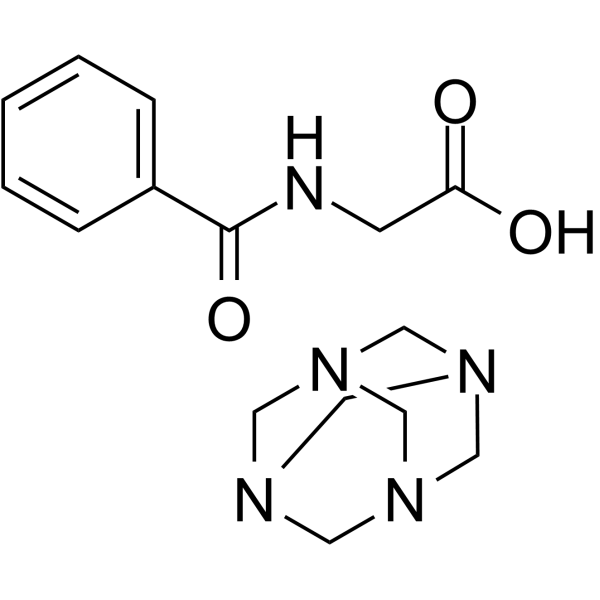
Physicochemical Properties
| Molecular Formula | C₁₅H₂₁N₅O₃ |
| Molecular Weight | 319.36 |
| Exact Mass | 319.164 |
| CAS # | 5714-73-8 |
| PubChem CID | 21945 |
| Appearance | Typically exists as solid at room temperature |
| Boiling Point | 464.1ºC at 760mmHg |
| Melting Point | 89-95ºC |
| Flash Point | 234.5ºC |
| Hydrogen Bond Donor Count | 2 |
| Hydrogen Bond Acceptor Count | 7 |
| Rotatable Bond Count | 3 |
| Heavy Atom Count | 23 |
| Complexity | 282 |
| Defined Atom Stereocenter Count | 0 |
| SMILES | O=C(C1C([H])=C([H])C([H])=C([H])C=1[H])N([H])C([H])([H])C(=O)O[H].N12C([H])([H])N3C([H])([H])N(C([H])([H])N(C3([H])[H])C1([H])[H])C2([H])[H] |
| Synonyms | Methenamine hippurate; Methenamine hippurate |
| HS Tariff Code | 2934.99.9001 |
| Storage |
Powder-20°C 3 years 4°C 2 years In solvent -80°C 6 months -20°C 1 month Note: Please store this product in a sealed and protected environment, avoid exposure to moisture. |
| Shipping Condition | Room temperature (This product is stable at ambient temperature for a few days during ordinary shipping and time spent in Customs) |
Biological Activity
| ln Vitro | Formaldehyde is released by the urinary antibacterial agent hexamine hippurate, which is eliminated in the urine. At pH 5 to 6, urotropine hippurate exhibits strong in vitro action against Escherichia coli, Staphylococcus aureus, Aerobacter, Pseudomonas aeruginosa, and Proteus vulgaris. It also exhibits activity against Klebsiella pneumoniae. The consequences of Lebsiella and Proteus species are diverse. Staphylococcus aureus, Escherichia coli, and pseudomonas aeruginosa. Hemolytic Streptococcus and Staphylococcus aureus at pH 7.4. Compared to methenamine, hippuric acid, or sulfadiazine alone, this impact is more potent [1]. |
| Toxicity/Toxicokinetics |
Effects During Pregnancy and Lactation ◉ Summary of Use during Lactation Methenamine passes into milk in small quantities and appears safe to use, even while nursing a newborn. ◉ Effects in Breastfed Infants Four newborn infants were allowed to breastfeed in one study after a maternal dose of 1 gram of methenamine hippurate. No adverse effects were reported. ◉ Effects on Lactation and Breastmilk Relevant published information was not found as of the revision date. |
| References |
[1]. Forbes R, et al. ALternatives To prophylactic Antibiotics for the treatment of Recurrent urinary tract infection in women (ALTAR): study protocol for a multicentre, pragmatic, patient-randomised, non-inferiority trial. Trials. 2018;19(1):616. Published 20 [2]. Gibson GR. A clinical appraisal of methenamine hippurate in urinary tract infections. Med J Aust. 1970;1(4):167‐170. |
| Additional Infomation |
Methenamine hippurate is a N-acylglycine. It is functionally related to a N-benzoylglycine. Methenamine Hippurate is the hippurate salt form of methenamine, a prodrug and inactive weak base that slowly hydrolyzes in acidic urine to ammonia and the effective, urinary tract antiseptic formaldehyde. Formaldehyde probably exerts its antibacterial effect by denaturation of protein. Depending on the urinary concentrations, formaldehyde is either bactericidal or bacteriostatic. Formaldehyde urinary concentrations are dependent on urine pH, volume, and flow rate. Formaldehyde acts as an antibacterial agent against gram-positive and gram-negative organisms. See also: Methenamine (has active moiety). |
Solubility Data
| Solubility (In Vitro) |
H2O : ~100 mg/mL (~313.13 mM) DMSO : ~25 mg/mL (~78.28 mM) |
| Solubility (In Vivo) |
Solubility in Formulation 1: 100 mg/mL (313.13 mM) in PBS (add these co-solvents sequentially from left to right, and one by one), clear solution; with sonication. (Please use freshly prepared in vivo formulations for optimal results.) |
| Preparing Stock Solutions | 1 mg | 5 mg | 10 mg | |
| 1 mM | 3.1313 mL | 15.6563 mL | 31.3126 mL | |
| 5 mM | 0.6263 mL | 3.1313 mL | 6.2625 mL | |
| 10 mM | 0.3131 mL | 1.5656 mL | 3.1313 mL |