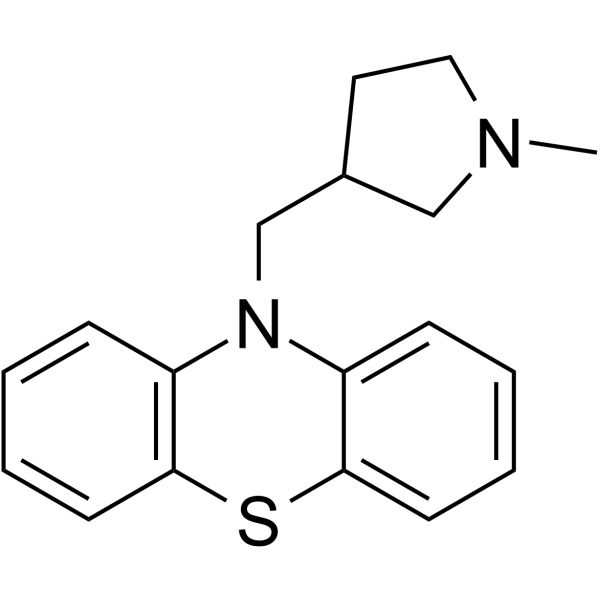
Physicochemical Properties
| Molecular Formula | C18H20N2S |
| Molecular Weight | 296.4298 |
| Exact Mass | 296.135 |
| CAS # | 1982-37-2 |
| Related CAS # | Methdilazine hydrochloride;1229-35-2 |
| PubChem CID | 14677 |
| Appearance | Typically exists as solid at room temperature |
| Density | 1.185 g/cm3 |
| Boiling Point | 430.4ºC at 760 mmHg |
| Melting Point |
189 to 190 °F (NTP, 1992) 87-88 °C 87 - 88 °C |
| Flash Point | 214.1ºC |
| LogP | 4.243 |
| Hydrogen Bond Donor Count | 0 |
| Hydrogen Bond Acceptor Count | 3 |
| Rotatable Bond Count | 2 |
| Heavy Atom Count | 21 |
| Complexity | 339 |
| Defined Atom Stereocenter Count | 0 |
| SMILES | CN1CCC(C1)CN2C3=CC=CC=C3SC4=CC=CC=C42 |
| InChi Key | HTMIBDQKFHUPSX-UHFFFAOYSA-N |
| InChi Code | InChI=1S/C18H20N2S/c1-19-11-10-14(12-19)13-20-15-6-2-4-8-17(15)21-18-9-5-3-7-16(18)20/h2-9,14H,10-13H2,1H3 |
| Chemical Name | 10-[(1-methylpyrrolidin-3-yl)methyl]phenothiazine |
| HS Tariff Code | 2934.99.9001 |
| Storage |
Powder-20°C 3 years 4°C 2 years In solvent -80°C 6 months -20°C 1 month |
| Shipping Condition | Room temperature (This product is stable at ambient temperature for a few days during ordinary shipping and time spent in Customs) |
Biological Activity
| ln Vitro | Mediazine (about 0-20 μg/mL, 18 h) inhibits several mycobacteria, with MIC values ranging from 5 μg/mL to 15 μg/mL [1]. |
| ln Vivo | Mediazine (ip, 10 μg/gm body weight/day, 6 weeks) exhibits antagonistic effects against mycobacteria in H37Rv-infected mice [1]. Mediizine (oral, 10 mg/kg daily for 28 days) enhances survival in mice infected with Mycobacterium tuberculosis (Mtb) H37Rv [2]. |
| Cell Assay |
Cell proliferation assay [1] Cell Types: Mycobacteria: M. smegmatis 798/1546, M., fortuitum 1529, M. scrofulaceum 1323, M. gordonae 1324, M. rnarinum 50, M., flavescens 1541, M. terrae 1450, Mycobacterium tuberculosis, H37Ra 16, H37Rv 16, K1, K2, ICRC bacilli, "Skinnis" bacilli. Tested Concentrations: Approximately 0-20 μg/mL Incubation Duration: 18 hrs (hours) Experimental Results: Inhibition of mycobacteria with MIC values ranging from 5 μg/mL to 15 μg/mL. |
| Animal Protocol |
Animal/Disease Models: H37Rv infected mice [1] Doses: 10 μg/gm body weight/day, 6 weeks Route of Administration: intraperitoneal (ip) injection Experimental Results: Demonstrated antimycobacterial activity against mycobacteria. Animal/Disease Models: Swiss albino male mice infected with Mycobacterium tuberculosis (Mtb) H37Rv [2] Doses: 10 mg/kg per day for 28 days Route of Administration: Oral Experimental Results: Survival time extended to 28 days, no signs of disease, The survival rate is 71.42%. |
| ADME/Pharmacokinetics |
Absorption, Distribution and Excretion Well absorbed in the digestive tract. |
| Toxicity/Toxicokinetics |
Toxicity Summary Methdilazine binds to the histamine H1 receptor. This blocks the action of endogenous histamine, which subsequently leads to temporary relief of the negative symptoms brought on by histamine. |
| References |
[1]. Antimycobacterial activity of methdilazine (Md), an antimicrobic phenothiazine. APMIS. 1993 Jun;101(6):449-54. [2]. Activity of the phenothiazine methdilazine alone or in combination with isoniazid or streptomycin against Mycobacterium tuberculosis in mice. J Med Microbiol. 2009 Dec;58(Pt 12):1667-1668. |
| Additional Infomation |
Crystals. (NTP, 1992) Methdilazine is a phenothiazine substituted on nitrogen by a (1-methylpyrrolidin-3-yl)methyl group; a first-generation antihistamine with anticholinergic properties. It has a role as a histamine antagonist, a cholinergic antagonist and an antipruritic drug. It is a member of phenothiazines and a N-alkylpyrrolidine. Methdilazine is a phenothiazine compound with antihistaminic activity. It is used in the treatment of various dermatoses to relieve pruritus. Methdilazine is only found in individuals that have used or taken this drug. It is a phenothiazine compound with antihistaminic activity. It is used in the treatment of various dermatoses to relieve pruritus.Methdilazine binds to the histamine H1 receptor. This blocks the action of endogenous histamine, which subsequently leads to temporary relief of the negative symptoms brought on by histamine. See also: Methdilazine Hydrochloride (has salt form). Drug Indication Used for the symptomatic relief of hypersensitivity reactions and particularly for the control of pruritic skin disorders Mechanism of Action Methdilazine binds to the histamine H1 receptor. This blocks the action of endogenous histamine, which subsequently leads to temporary relief of the negative symptoms brought on by histamine. Pharmacodynamics In allergic reactions an allergen interacts with and cross-links surface IgE antibodies on mast cells and basophils. Once the mast cell-antibody-antigen complex is formed, a complex series of events occurs that eventually leads to cell-degranulation and the release of histamine (and other chemical mediators) from the mast cell or basophil. Once released, histamine can react with local or widespread tissues through histamine receptors. Histamine, acting on H1-receptors, produces pruritis, vasodilatation, hypotension, flushing, headache, tachycardia, and bronchoconstriction. Histamine also increases vascular permeability and potentiates pain. Methdilazine is a histamine H1 antagonist. It competes with histamine for the normal H1-receptor sites on effector cells of the gastrointestinal tract, blood vessels and respiratory tract. It provides effective, temporary relief of sneezing, watery and itchy eyes, and runny nose due to hay fever and other upper respiratory allergies. |
Solubility Data
| Solubility (In Vitro) | May dissolve in DMSO (in most cases), if not, try other solvents such as H2O, Ethanol, or DMF with a minute amount of products to avoid loss of samples |
| Solubility (In Vivo) |
Note: Listed below are some common formulations that may be used to formulate products with low water solubility (e.g. < 1 mg/mL), you may test these formulations using a minute amount of products to avoid loss of samples. Injection Formulations (e.g. IP/IV/IM/SC) Injection Formulation 1: DMSO : Tween 80: Saline = 10 : 5 : 85 (i.e. 100 μL DMSO stock solution → 50 μL Tween 80 → 850 μL Saline) *Preparation of saline: Dissolve 0.9 g of sodium chloride in 100 mL ddH ₂ O to obtain a clear solution. Injection Formulation 2: DMSO : PEG300 :Tween 80 : Saline = 10 : 40 : 5 : 45 (i.e. 100 μL DMSO → 400 μLPEG300 → 50 μL Tween 80 → 450 μL Saline) Injection Formulation 3: DMSO : Corn oil = 10 : 90 (i.e. 100 μL DMSO → 900 μL Corn oil) Example: Take the Injection Formulation 3 (DMSO : Corn oil = 10 : 90) as an example, if 1 mL of 2.5 mg/mL working solution is to be prepared, you can take 100 μL 25 mg/mL DMSO stock solution and add to 900 μL corn oil, mix well to obtain a clear or suspension solution (2.5 mg/mL, ready for use in animals). Injection Formulation 4: DMSO : 20% SBE-β-CD in saline = 10 : 90 [i.e. 100 μL DMSO → 900 μL (20% SBE-β-CD in saline)] *Preparation of 20% SBE-β-CD in Saline (4°C,1 week): Dissolve 2 g SBE-β-CD in 10 mL saline to obtain a clear solution. Injection Formulation 5: 2-Hydroxypropyl-β-cyclodextrin : Saline = 50 : 50 (i.e. 500 μL 2-Hydroxypropyl-β-cyclodextrin → 500 μL Saline) Injection Formulation 6: DMSO : PEG300 : castor oil : Saline = 5 : 10 : 20 : 65 (i.e. 50 μL DMSO → 100 μLPEG300 → 200 μL castor oil → 650 μL Saline) Injection Formulation 7: Ethanol : Cremophor : Saline = 10: 10 : 80 (i.e. 100 μL Ethanol → 100 μL Cremophor → 800 μL Saline) Injection Formulation 8: Dissolve in Cremophor/Ethanol (50 : 50), then diluted by Saline Injection Formulation 9: EtOH : Corn oil = 10 : 90 (i.e. 100 μL EtOH → 900 μL Corn oil) Injection Formulation 10: EtOH : PEG300:Tween 80 : Saline = 10 : 40 : 5 : 45 (i.e. 100 μL EtOH → 400 μLPEG300 → 50 μL Tween 80 → 450 μL Saline) Oral Formulations Oral Formulation 1: Suspend in 0.5% CMC Na (carboxymethylcellulose sodium) Oral Formulation 2: Suspend in 0.5% Carboxymethyl cellulose Example: Take the Oral Formulation 1 (Suspend in 0.5% CMC Na) as an example, if 100 mL of 2.5 mg/mL working solution is to be prepared, you can first prepare 0.5% CMC Na solution by measuring 0.5 g CMC Na and dissolve it in 100 mL ddH2O to obtain a clear solution; then add 250 mg of the product to 100 mL 0.5% CMC Na solution, to make the suspension solution (2.5 mg/mL, ready for use in animals). Oral Formulation 3: Dissolved in PEG400 Oral Formulation 4: Suspend in 0.2% Carboxymethyl cellulose Oral Formulation 5: Dissolve in 0.25% Tween 80 and 0.5% Carboxymethyl cellulose Oral Formulation 6: Mixing with food powders Note: Please be aware that the above formulations are for reference only. InvivoChem strongly recommends customers to read literature methods/protocols carefully before determining which formulation you should use for in vivo studies, as different compounds have different solubility properties and have to be formulated differently. (Please use freshly prepared in vivo formulations for optimal results.) |
| Preparing Stock Solutions | 1 mg | 5 mg | 10 mg | |
| 1 mM | 3.3735 mL | 16.8674 mL | 33.7348 mL | |
| 5 mM | 0.6747 mL | 3.3735 mL | 6.7470 mL | |
| 10 mM | 0.3373 mL | 1.6867 mL | 3.3735 mL |