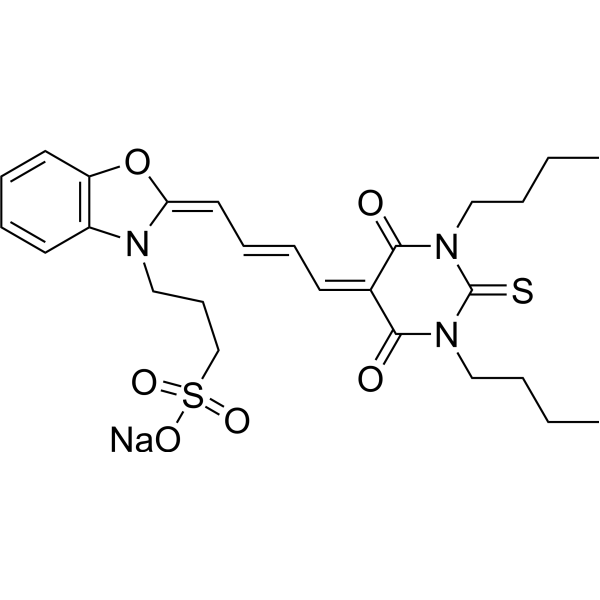
Physicochemical Properties
| Molecular Formula | C26H33N3O6S2.NA |
| Molecular Weight | 569.66900 |
| Exact Mass | 569.163 |
| CAS # | 62796-23-0 |
| PubChem CID | 5702743 |
| Appearance | Dark purple to black solid powder |
| Melting Point | 285ºC (dec.)(lit.) |
| LogP | 4.226 |
| Hydrogen Bond Donor Count | 0 |
| Hydrogen Bond Acceptor Count | 8 |
| Rotatable Bond Count | 12 |
| Heavy Atom Count | 38 |
| Complexity | 1020 |
| Defined Atom Stereocenter Count | 0 |
| SMILES | CCCCN1C(=O)C(=C/C=C/C=C\2/N(C3=CC=CC=C3O2)CCCS(=O)(=O)[O-])C(=O)N(C1=S)CCCC.[Na+] |
| InChi Key | OSQUFVVXNRMSHL-LTHRDKTGSA-M |
| InChi Code | InChI=1S/C26H33N3O6S2.Na/c1-3-5-16-28-24(30)20(25(31)29(26(28)36)17-6-4-2)12-7-10-15-23-27(18-11-19-37(32,33)34)21-13-8-9-14-22(21)35-23;/h7-10,12-15H,3-6,11,16-19H2,1-2H3,(H,32,33,34);/q;+1/p-1/b10-7+,23-15-; |
| Chemical Name | sodium;3-[(2Z)-2-[(E)-4-(1,3-dibutyl-4,6-dioxo-2-sulfanylidene-1,3-diazinan-5-ylidene)but-2-enylidene]-1,3-benzoxazol-3-yl]propane-1-sulfonate |
| HS Tariff Code | 2934.99.9001 |
| Storage |
Powder-20°C 3 years 4°C 2 years In solvent -80°C 6 months -20°C 1 month |
| Shipping Condition | Room temperature (This product is stable at ambient temperature for a few days during ordinary shipping and time spent in Customs) |
Biological Activity
| ln Vitro | Advice[1] (This is our suggested protocol, which should be adjusted to meet your unique requirements as it simply offers assistance). Labeling of cells: 1. Rinse cell monolayers with isotonic saline buffered with 5 mM Tris-Cl (pH 7.4) or isotonic sucrose (0.25 M) with or without 1–5 mM CaCl2. 2. Cells should be exposed to Merocyanin 540 (1.6 x 10⁻⁵ M) in the suitable buffer for ten minutes at room temperature in the presence of ambient light. 3. After a thorough cleaning, use fluorescence microscopy to examine. 4. A 0.05 mL aliquot of the washed culture containing 100–200 organisms should be placed on a microscope slide for protozoa. 5. To get a final concentration of 1.0–10 μg/mL, add merocyanine 540. 6. Utilize fluorescence microscopy to examine the cells. 7. Use Merocyanin 540 (1.75–5.25 x 10⁻⁵ M) to incubate single cell suspensions or tissue sections, and then use fluorescence microscopy to assess the results as explained for adherent cells. |
| References |
[1]. Merocyanine 540 as a fluorescent probe of membranes: staining of electrically excitable cells. Cell. 1978 Mar;13(3):475-86. [2]. Factors affecting the amount and the mode of merocyanine 540 binding to the membrane of human erythrocytes. A comparison with the binding to leukemia cells. Biochim Biophys Acta. 1995 May 4;1235(2):428-36. |
Solubility Data
| Solubility (In Vitro) | May dissolve in DMSO (in most cases), if not, try other solvents such as H2O, Ethanol, or DMF with a minute amount of products to avoid loss of samples |
| Solubility (In Vivo) |
Note: Listed below are some common formulations that may be used to formulate products with low water solubility (e.g. < 1 mg/mL), you may test these formulations using a minute amount of products to avoid loss of samples. Injection Formulations (e.g. IP/IV/IM/SC) Injection Formulation 1: DMSO : Tween 80: Saline = 10 : 5 : 85 (i.e. 100 μL DMSO stock solution → 50 μL Tween 80 → 850 μL Saline) *Preparation of saline: Dissolve 0.9 g of sodium chloride in 100 mL ddH ₂ O to obtain a clear solution. Injection Formulation 2: DMSO : PEG300 :Tween 80 : Saline = 10 : 40 : 5 : 45 (i.e. 100 μL DMSO → 400 μLPEG300 → 50 μL Tween 80 → 450 μL Saline) Injection Formulation 3: DMSO : Corn oil = 10 : 90 (i.e. 100 μL DMSO → 900 μL Corn oil) Example: Take the Injection Formulation 3 (DMSO : Corn oil = 10 : 90) as an example, if 1 mL of 2.5 mg/mL working solution is to be prepared, you can take 100 μL 25 mg/mL DMSO stock solution and add to 900 μL corn oil, mix well to obtain a clear or suspension solution (2.5 mg/mL, ready for use in animals). Injection Formulation 4: DMSO : 20% SBE-β-CD in saline = 10 : 90 [i.e. 100 μL DMSO → 900 μL (20% SBE-β-CD in saline)] *Preparation of 20% SBE-β-CD in Saline (4°C,1 week): Dissolve 2 g SBE-β-CD in 10 mL saline to obtain a clear solution. Injection Formulation 5: 2-Hydroxypropyl-β-cyclodextrin : Saline = 50 : 50 (i.e. 500 μL 2-Hydroxypropyl-β-cyclodextrin → 500 μL Saline) Injection Formulation 6: DMSO : PEG300 : castor oil : Saline = 5 : 10 : 20 : 65 (i.e. 50 μL DMSO → 100 μLPEG300 → 200 μL castor oil → 650 μL Saline) Injection Formulation 7: Ethanol : Cremophor : Saline = 10: 10 : 80 (i.e. 100 μL Ethanol → 100 μL Cremophor → 800 μL Saline) Injection Formulation 8: Dissolve in Cremophor/Ethanol (50 : 50), then diluted by Saline Injection Formulation 9: EtOH : Corn oil = 10 : 90 (i.e. 100 μL EtOH → 900 μL Corn oil) Injection Formulation 10: EtOH : PEG300:Tween 80 : Saline = 10 : 40 : 5 : 45 (i.e. 100 μL EtOH → 400 μLPEG300 → 50 μL Tween 80 → 450 μL Saline) Oral Formulations Oral Formulation 1: Suspend in 0.5% CMC Na (carboxymethylcellulose sodium) Oral Formulation 2: Suspend in 0.5% Carboxymethyl cellulose Example: Take the Oral Formulation 1 (Suspend in 0.5% CMC Na) as an example, if 100 mL of 2.5 mg/mL working solution is to be prepared, you can first prepare 0.5% CMC Na solution by measuring 0.5 g CMC Na and dissolve it in 100 mL ddH2O to obtain a clear solution; then add 250 mg of the product to 100 mL 0.5% CMC Na solution, to make the suspension solution (2.5 mg/mL, ready for use in animals). Oral Formulation 3: Dissolved in PEG400 Oral Formulation 4: Suspend in 0.2% Carboxymethyl cellulose Oral Formulation 5: Dissolve in 0.25% Tween 80 and 0.5% Carboxymethyl cellulose Oral Formulation 6: Mixing with food powders Note: Please be aware that the above formulations are for reference only. InvivoChem strongly recommends customers to read literature methods/protocols carefully before determining which formulation you should use for in vivo studies, as different compounds have different solubility properties and have to be formulated differently. (Please use freshly prepared in vivo formulations for optimal results.) |
| Preparing Stock Solutions | 1 mg | 5 mg | 10 mg | |
| 1 mM | 1.7554 mL | 8.7770 mL | 17.5540 mL | |
| 5 mM | 0.3511 mL | 1.7554 mL | 3.5108 mL | |
| 10 mM | 0.1755 mL | 0.8777 mL | 1.7554 mL |