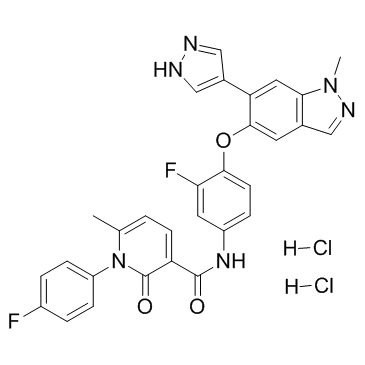
Merestinib dihydrochloride (LY-2801653) is a novel, potent, orally bioavailable, type-II ATP competitive, slow-off small molecule inhibitor of MET tyrosine kinase with a dissociation constant (Ki) of 2 nM, a pharmacodynamic residence time (Koff) of 0.00132 min(-1) and t1/2 of 525 min. According to an in vitro study, c-MET kinase activity was shown to be inhibited as 0.01–10 μM LY2801653, which was able to totally block HGF-induced DU–145 cell scattering. LY2801653 exhibited more potent anti-proliferative activity against cell lines expressing the MET gene than against cell lines lacking the gene expression, according to the results of a panel of cell lines screening for the drug.
Physicochemical Properties
| Molecular Formula | C₃₀H₂₄CL₂F₂N₆O₃ |
| Molecular Weight | 625.45 |
| Exact Mass | 624.126 |
| Elemental Analysis | C, 57.61; H, 3.87; Cl, 11.34; F, 6.08; N, 13.44; O, 7.67 |
| CAS # | 1206801-37-7 |
| Related CAS # | Merestinib;1206799-15-6 |
| PubChem CID | 71604306 |
| Appearance | White to light yellow solid powder |
| LogP | 7.422 |
| Hydrogen Bond Donor Count | 4 |
| Hydrogen Bond Acceptor Count | 7 |
| Rotatable Bond Count | 6 |
| Heavy Atom Count | 43 |
| Complexity | 1050 |
| Defined Atom Stereocenter Count | 0 |
| SMILES | Cl[H].Cl[H].FC1C([H])=C(C([H])=C([H])C=1OC1C([H])=C2C([H])=NN(C([H])([H])[H])C2=C([H])C=1C1C([H])=NN([H])C=1[H])N([H])C(C1=C([H])C([H])=C(C([H])([H])[H])N(C2C([H])=C([H])C(=C([H])C=2[H])F)C1=O)=O |
| InChi Key | NNYNNMGUBHQQLZ-UHFFFAOYSA-N |
| InChi Code | InChI=1S/C30H22F2N6O3.2ClH/c1-17-3-9-23(30(40)38(17)22-7-4-20(31)5-8-22)29(39)36-21-6-10-27(25(32)12-21)41-28-11-18-16-35-37(2)26(18)13-24(28)19-14-33-34-15-19;;/h3-16H,1-2H3,(H,33,34)(H,36,39);2*1H |
| Chemical Name | N-[3-fluoro-4-[1-methyl-6-(1H-pyrazol-4-yl)indazol-5-yl]oxyphenyl]-1-(4-fluorophenyl)-6-methyl-2-oxopyridine-3-carboxamide;dihydrochloride |
| Synonyms | LY2801653 dihydrochloride; LY-2801653 dihydrochloride; LY 2801653 dihydrochloride |
| HS Tariff Code | 2934.99.9001 |
| Storage |
Powder-20°C 3 years 4°C 2 years In solvent -80°C 6 months -20°C 1 month Note: Please store this product in a sealed and protected environment, avoid exposure to moisture. |
| Shipping Condition | Room temperature (This product is stable at ambient temperature for a few days during ordinary shipping and time spent in Customs) |
Biological Activity
| Targets | c-Met (Ki = 2 nM); MST1R (IC50 = 11 nM); FLT3 (IC50 = 7 nM); AXL (IC50 = 2 nM); MERTK (IC50 = 10 nM); TEK (IC50 = 63 nM); DDR1/2 (IC50 = 0.1/7 nM); MKNK1/2 (IC50 = 7 nM) |
| ln Vitro |
Merestinib (LY2801653) also inhibits MST1R (IC50=11 nM), AXL (IC50=2 nM), MERTK (IC50=10 nM), TYRO3 (IC50=28 nM), ROS1, PDGFRA (IC50=41 nM), FLT3 (IC50=7 nM), TEK (IC50=63 nM), DDR1/2 (IC50=0.1/7 nM) and MKNK1/2 (IC50=7 nM)[1]. Merestinib exhibits effects on cell proliferation and scattering that are dependent on the MET pathway. Merestinib inhibits MET auto-phosphorylation in HGF-stimulated H460 cells with an average IC50 value of 35.2±6.9 nM (n=6 determinations), while in S114 cells, the IC50 is 59.2 nM. Growth-factor independence is conferred by transfection with the MET variants, and these MET variant clones are inhibited in their growth by Merestinib treatment, with an IC50 ranging from approximately 6-fold less potent (L1195V) to 3-fold more potent (V1092I) when compared to cells with the MET wild-type sequence[1]. Merestinib (2, 5, and 10 μM) significantly inhibits wound healing for TFK-1 and SZ-1 cell lines and decreases the number of viable TFK-1 and SZ-1 cells in a dose and time dependent manner. In TFK-1 and SZ-1 cells, merestinib inhibits cell invasion in a concentration-dependent manner[2]. |
| ln Vivo | Merestinib (LY2801653) exhibits anti-tumor effects in xenograft models with MET overexpressed (H441), MET autocrine (U-87MG and KP4), and MET amplified (MKN45); also shows in vivo vessel normalization effects. Merestinib (LY2801653) is a slow-off inhibitor of MET tyrosine kinase, type-II ATP competitive, with a pharmacodynamic residence time (Koff) of 0.00132 min-1 and a t1/2 of 525 min. At a composite TED50 (50 percent target inhibition dose) of 1.2 mg/kg and a composite TED90 (90 percent target inhibition dose) of 7.4 mg/kg, merestinib (LY2801653) treatment inhibits MET phosphorylation[1]. Compared to vehicle control, TFK-1 tumor growth is significantly reduced by merestinib (LY2801653) (20 mg/kg). Merestinib (LY2801653) prevents the growth of CCC xenograft tumors that are both intra- and extrahepatic[2]. |
| Enzyme Assay | An assay known as radiometric filter-binding is used to determine the Ki value and mechanism of inhibition of LY2801653, with regard to the MET kinase activity. The reactions take place in 96-well plates using Enzyme Dilution Buffer (EDB), which contains 50 mM Tris HCl pH 7.5, 2 mM DTT, 0.005% Triton X-100, 10 mM MgCl2, and 250 μM EDTA respectively. After LY2801653, which has been serially diluted to a final concentration of 250 to 0 nM, eight concentrations of 33P-γ-ATP (with a final concentration of 400 to 10 μM ATP) and 5 nM enzyme (final concentration) are added. The 30-minute kinase reaction is started by adding the final 150 μg/mL of PolyGluTyr synthetic protein substrate after a 2-hour incubation. A scintillation counter is used to measure radioactivity after reactions are quenched with 10% H3PO4, transferred, and cleaned on a Multiscreen anionic phosphocellulose 96-well filter plate that has been pre-wetted. GraphPad Prism software is used to fit the experimental data to an inhibition equation for a global mix model, producing an alpha value that can be used to identify the mode of inhibition and get the Ki value for LY2801653[1]. |
| Cell Assay | H460 cells are cultivated in RPMI media supplemented with 10% FBS, plated at 20,000 cells/well in 96-well plates before they reach 70% confluency, and then incubated at 37°C for the entire night. Before receiving Merestinib treatment the following day, the cells are cultured with RPMI-1640 in low serum (0.5% FBS) for two hours. HGF is added thirty minutes after Merestinib (LY2801653), with a final concentration of 100ng/mL. Following a 10-minute incubation period, pMET is measured and cell lysates are prepared. By determining the percentage of inhibition with respect to on-plate MIN (unstimulated) and MAX controls, relative IC50 values are calculated using MSD activity units. The percentage-of-inhibition values and 10-point dose response data are then fitted to a 4-parameter logistic equation using ActivityBase[1]. |
| Animal Protocol | Subcutaneous implants of S114 cells are made in female athymic nude mice. On the eighth day post-implantation, Merestinib (LY2801653) is administered at a dose range of 0.75 mg/kg to 100 mg/kg (n = 8 per dose group) for the purpose of evaluating the dose response. Blood samples and tumors are taken and flash frozen two hours after the dose. Merestinib (LY2801653) is administered at a dose of 12 mg/kg (n=10 per time point) for the time course study. Blood samples and tumor samples are taken after the animals are sacrificed 2, 8, 16, and 24 hours after the dose. The MSD ELISA assay is used to quantify pMET in the S114 tumor lysates. Pulverized frozen tumor tissue is used to create lysates, which are then homogenized using Lysing Matrix D beads and RIPA lysis buffer that contains protease and phosphatase inhibitors. The DC protein assay kit is used to measure protein concentration. It is done using the pMET MSD ELISA assay. |
| References |
[1]. LY2801653 is an orally bioavailable multi-kinase inhibitor with potent activity against MET, MST1R, and other oncoproteins, and displays anti-tumor activities in mouse xenograft models. Invest New Drugs. 2013 Aug;31(4):833-44. [2]. Targeting c-MET by LY2801653 for treatment of cholangiocarcinoma. Mol Carcinog. 2016 Jan 12. |
Solubility Data
| Solubility (In Vitro) | DMSO: ≥ 100 mg/mL (~159.9 mM) |
| Solubility (In Vivo) |
Solubility in Formulation 1: ≥ 2.5 mg/mL (4.00 mM) (saturation unknown) in 10% DMSO + 40% PEG300 + 5% Tween80 + 45% Saline (add these co-solvents sequentially from left to right, and one by one), clear solution. For example, if 1 mL of working solution is to be prepared, you can add 100 μL of 25.0 mg/mL clear DMSO stock solution to 400 μL PEG300 and mix evenly; then add 50 μL Tween-80 to the above solution and mix evenly; then add 450 μL normal saline to adjust the volume to 1 mL. Preparation of saline: Dissolve 0.9 g of sodium chloride in 100 mL ddH₂ O to obtain a clear solution. Solubility in Formulation 2: ≥ 2.5 mg/mL (4.00 mM) (saturation unknown) in 10% DMSO + 90% (20% SBE-β-CD in Saline) (add these co-solvents sequentially from left to right, and one by one), clear solution. For example, if 1 mL of working solution is to be prepared, you can add 100 μL of 25.0 mg/mL clear DMSO stock solution to 900 μL of 20% SBE-β-CD physiological saline solution and mix evenly. Preparation of 20% SBE-β-CD in Saline (4°C,1 week): Dissolve 2 g SBE-β-CD in 10 mL saline to obtain a clear solution. Solubility in Formulation 3: ≥ 2.5 mg/mL (4.00 mM) (saturation unknown) in 10% DMSO + 90% Corn Oil (add these co-solvents sequentially from left to right, and one by one), clear solution. For example, if 1 mL of working solution is to be prepared, you can add 100 μL of 25.0 mg/mL clear DMSO stock solution to 900 μL of corn oil and mix evenly. (Please use freshly prepared in vivo formulations for optimal results.) |
| Preparing Stock Solutions | 1 mg | 5 mg | 10 mg | |
| 1 mM | 1.5988 mL | 7.9942 mL | 15.9885 mL | |
| 5 mM | 0.3198 mL | 1.5988 mL | 3.1977 mL | |
| 10 mM | 0.1599 mL | 0.7994 mL | 1.5988 mL |