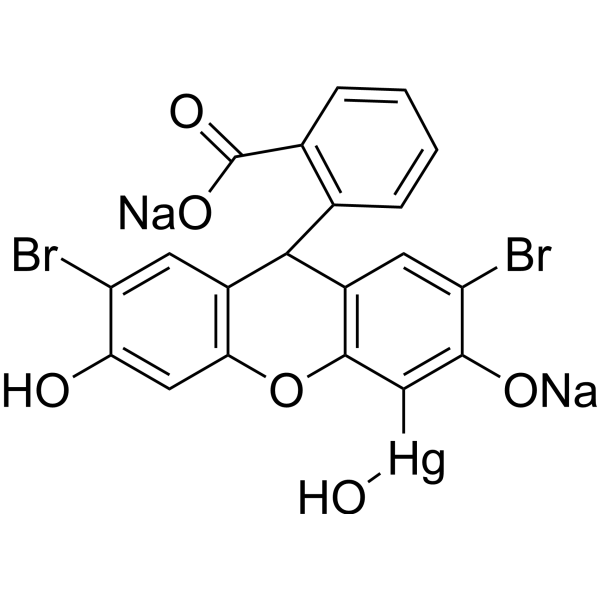
Physicochemical Properties
| Molecular Formula | C20H8BR2HGNA2O6 |
| Molecular Weight | 750.65 |
| Exact Mass | 752.824 |
| CAS # | 129-16-8 |
| PubChem CID | 441373 |
| Appearance | Light brown to black solid powder |
| Melting Point | ≥300 °C |
| LogP | 3.592 |
| Hydrogen Bond Donor Count | 1 |
| Hydrogen Bond Acceptor Count | 6 |
| Rotatable Bond Count | 2 |
| Heavy Atom Count | 31 |
| Complexity | 801 |
| Defined Atom Stereocenter Count | 0 |
| InChi Key | KQSRXDXJGUJRKE-UHFFFAOYSA-L |
| InChi Code | InChI=1S/C20H9Br2O5.Hg.2Na.H2O/c21-13-5-11-17(7-15(13)23)27-18-8-16(24)14(22)6-12(18)19(11)9-3-1-2-4-10(9)20(25)26;;;;/h1-7,24H,(H,25,26);;;;1H2/q;;2*+1;/p-2 |
| Chemical Name | disodium;[2,7-dibromo-9-(2-carboxylatophenyl)-3-oxido-6-oxoxanthen-4-yl]mercury;hydrate |
| HS Tariff Code | 2934.99.9001 |
| Storage |
Powder-20°C 3 years 4°C 2 years In solvent -80°C 6 months -20°C 1 month Note: Please store this product in a sealed and protected environment (e.g. under nitrogen), avoid exposure to moisture and light. |
| Shipping Condition | Room temperature (This product is stable at ambient temperature for a few days during ordinary shipping and time spent in Customs) |
Biological Activity
| Targets |
Zika virus NS2B-NS3 protease (ZIKVpro). The compound showed >50% inhibition of ZIKVpro activity at 20 µM. It was confirmed to directly bind to ZIKVpro at 50 µM in an Octet binding assay [1] |
| ln Vitro |
Merbromin inhibited the enzymatic activity of Zika virus NS2B-NS3 protease (ZIKVpro) in a dose-dependent manner in a fluorescence-based assay. It was identified as a hit from a primary screen of a natural compound library, showing >50% inhibition at 20 µM. A subsequent Octet binding assay using biotinylated ZIKVpro confirmed that Merbromin directly binds to the protease at a concentration of 50 µM. However, in a cell-based cytopathic effect (CPE) protection assay using ZIKV-infected Vero E6 cells, Merbromin did not show appreciable anti-ZIKV replication activity (e.g., less than 30% CPE protection at 10 µM) [1] |
| Enzyme Assay |
1) Fluorescence-based Protease Activity Assay: The Zika virus NS2B-NS3 protease (ZIKVpro) was expressed and purified. For screening and confirmation, the protease (150 nM) was incubated with compounds (e.g., at 20 µM for screening) in assay buffer for 1 hour at 37°C. The proteolytic reaction was then initiated by adding the fluorogenic substrate Bz-nKKR-AMC (50 µM). The fluorescence increase was monitored over time. The inhibition activity was calculated relative to a DMSO control [1] 2) Bio-Layer Interferometry (BLI) Binding Assay: Biotinylated ZIKVpro was immobilized on super streptavidin biosensors. The biosensors were then dipped into wells containing the test compound (e.g., 50 µM for initial binding check). Binding interactions were measured in real-time, and sensorgrams were analyzed to confirm direct binding [1] |
| Cell Assay |
Cytopathic Effect (CPE) Protection Assay: African green monkey kidney cells (Vero E6) were seeded and grown. The cells were treated with the compound and then infected with Zika virus (ZIKV) at a low multiplicity of infection (MOI). After incubation, cell viability was measured using a cell counting kit to assess the compound's ability to protect cells from virus-induced CPE. Ribavirin and DMSO were used as positive and negative controls, respectively [1] |
| ADME/Pharmacokinetics |
Metabolism / Metabolites Organic mercury is absorbed mainly by the gastrointestinal tract, then distributed throughout the body via the bloodstream. Organic mercury complexes with free cysteine and the cysteine and sulfhydryl groups on proteins such as haemoglobin. These complexes are able to mimic methionine and thus be transported throughout the body, including through the blood-brain barrier and placenta. Organic mercury is metabolized into inorganic mercury, which is eventually excreted in the urine and faeces. Bromine is mainly absorbed via inhalation, but may also enter the body through dermal contact. Bromine salts can be ingested. Due to its reactivity, bromine quickly forms bromide and may be deposited in the tissues, displacing other halogens. (L626, T11) |
| Toxicity/Toxicokinetics |
Toxicity Summary High-affinity binding of the divalent mercuric ion to thiol or sulfhydryl groups of proteins is believed to be the major mechanism for the activity of mercury. Through alterations in intracellular thiol status, mercury can promote oxidative stress, lipid peroxidation, mitochondrial dysfunction, and changes in heme metabolism. Mercury is known to bind to microsomal and mitochondrial enzymes, resulting in cell injury and death. For example, mercury is known to inhibit aquaporins, halting water flow across the cell membrane. It also inhibits the protein LCK, which causes decreased T-cell signalling and immune system depression. Mercury is also believed to inhibit neuronal excitability by acting on the postsynaptic neuronal membrane. It also affects the nervous system by inhibiting protein kinase C and alkaline phosphatase, which impairs brain microvascular formation and function, as well as alters the blood-brain barrier. Organic mercury exerts developmental effects by binding to tubulin, preventing microtubule assembly and causing mitotic inhibition. Mercury also produces an autoimmune response, likely by modification of major histocompatibility complex (MHC) class II molecules, self peptides, T-cell receptors, or cell-surface adhesion molecules. Bromine is a powerful oxidizing agent and is able to release oxygen free radicals from the water in mucous membranes. These free radicals are also potent oxidizers and produce tissue damage. In additon, the formation of hydrobromic and bromic acids will result in secondary irritation. The bromide ion is also known to affect the central nervous system, causing bromism. This is believed to be a result of bromide ions substituting for chloride ions in the in actions of neurotransmitters and transport systems, thus affecting numerous synaptic processes. (L626, L627, A543, L7, A8, A25, A26) Toxicity Data LD50: 50 mg/kg (Intravenous, Mouse) (L330) |
| References |
[1]. Identification of Theaflavin-3,3'-Digallate as a Novel Zika Virus Protease Inhibitor. Front Pharmacol. 2020 Oct 21;11:514313. |
| Additional Infomation |
Merbromin is an organic sodium salt that is 2,7-dibromo-4-hydroxymercurifluorescein in which the carboxy group and the phenolic hydroxy group have been deprotonated and the resulting charge is neutralised by two sodium ions. It has a role as an antiseptic drug, a fluorochrome and a histological dye. It contains a 2,7-dibromo-4-hydroxymercurifluorescein(2-). Mercurochrome is a trade name of merbromin commonly used as a topical first-aid antiseptic agent. It is an organomercuric disodium salt compound and a fluorescein that is available in many countries, except Switzerland, France, Germany, and the United States where the drug was withdrawn from market due to the possibility of mercury poisoning. Merbromin is an organomercuric disodium salt compound and a fluorescein. It is used as a topical antiseptic for minor cuts and scrapes. Merbromin is also used as a biological dye to mark tissue margins, and as a metal dye in industrial dye penetrant inspection to detect metal fractures. Due to its mercury content, is is not available in some countries, such as the United States. Mercury is a heavy, silvery d-block metal and one of six elements that are liquid at or near room temperature and pressure. It is a naturally occuring substance, and combines with other elements such as chlorine, sulfur, or oxygen to form inorganic mercury compounds (salts). Mercury also combines with carbon to make organic mercury compounds. Bromine is a halogen element with the symbol Br and atomic number 35. Diatomic bromine does not occur naturally, but bromine salts can be found in crustal rock. (L625, L1, L264) A once-popular mercury containing topical antiseptic. Merbromin (also known as ZP1 in this study) is one of the initial hits identified from a high-throughput screen of a natural compound library targeting the Zika virus NS2B-NS3 protease. It belongs to a group of four compounds (including tannic acid, 1,2,3,4,6-O-pentagalloylglucose, and theaflavin-3,3'-digallate) that were found to both inhibit the protease activity and directly bind to the ZIKVpro, suggesting potential for further development as ZIKVpro inhibitors [1] |
Solubility Data
| Solubility (In Vitro) | DMSO : ~6.67 mg/mL (~8.86 mM) |
| Solubility (In Vivo) |
Solubility in Formulation 1: ≥ 0.67 mg/mL (0.89 mM) (saturation unknown) in 10% DMSO + 40% PEG300 + 5% Tween80 + 45% Saline (add these co-solvents sequentially from left to right, and one by one), clear solution. For example, if 1 mL of working solution is to be prepared, you can add 100 μL of 6.7 mg/mL clear DMSO stock solution to 400 μL PEG300 and mix evenly; then add 50 μL Tween-80 to the above solution and mix evenly; then add 450 μL normal saline to adjust the volume to 1 mL. Preparation of saline: Dissolve 0.9 g of sodium chloride in 100 mL ddH₂ O to obtain a clear solution. Solubility in Formulation 2: ≥ 0.67 mg/mL (0.89 mM) (saturation unknown) in 10% DMSO + 90% (20% SBE-β-CD in Saline) (add these co-solvents sequentially from left to right, and one by one), clear solution. For example, if 1 mL of working solution is to be prepared, you can add 100 μL of 6.7 mg/mL clear DMSO stock solution to 900 μL of 20% SBE-β-CD physiological saline solution and mix evenly. Preparation of 20% SBE-β-CD in Saline (4°C,1 week): Dissolve 2 g SBE-β-CD in 10 mL saline to obtain a clear solution. (Please use freshly prepared in vivo formulations for optimal results.) |
| Preparing Stock Solutions | 1 mg | 5 mg | 10 mg | |
| 1 mM | 1.3322 mL | 6.6609 mL | 13.3218 mL | |
| 5 mM | 0.2664 mL | 1.3322 mL | 2.6644 mL | |
| 10 mM | 0.1332 mL | 0.6661 mL | 1.3322 mL |