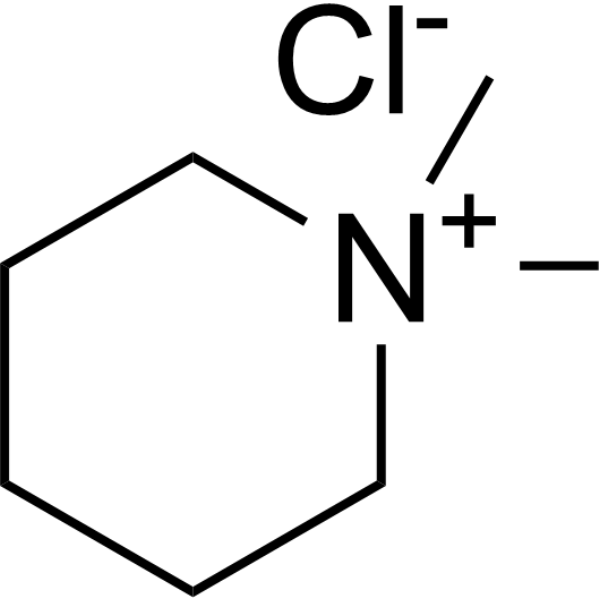
Physicochemical Properties
| Molecular Formula | C7H16CLN |
| Molecular Weight | 149.66 |
| Exact Mass | 149.097 |
| CAS # | 24307-26-4 |
| Related CAS # | 15302-91-7 (Parent) |
| PubChem CID | 62781 |
| Appearance | Colorless hygroscopic crystals |
| Melting Point | 285°C |
| Hydrogen Bond Donor Count | 0 |
| Hydrogen Bond Acceptor Count | 1 |
| Rotatable Bond Count | 0 |
| Heavy Atom Count | 9 |
| Complexity | 68.5 |
| Defined Atom Stereocenter Count | 0 |
| SMILES | [Cl-].[N+]1(C([H])([H])[H])(C([H])([H])[H])C([H])([H])C([H])([H])C([H])([H])C([H])([H])C1([H])[H] |
| InChi Key | VHOVSQVSAAQANU-UHFFFAOYSA-M |
| InChi Code | InChI=1S/C7H16N.ClH/c1-8(2)6-4-3-5-7-8;/h3-7H2,1-2H3;1H/q+1;/p-1 |
| Chemical Name | 1,1-dimethylpiperidin-1-ium;chloride |
| Synonyms | N,N-Dimethylpiperidinium chloride; PIX |
| HS Tariff Code | 2934.99.9001 |
| Storage |
Powder-20°C 3 years 4°C 2 years In solvent -80°C 6 months -20°C 1 month |
| Shipping Condition | Room temperature (This product is stable at ambient temperature for a few days during ordinary shipping and time spent in Customs) |
Biological Activity
| ADME/Pharmacokinetics |
Absorption, Distribution and Excretion In a metabolism study, mepiquat chloride, labeled with 14C in the 2,6-carbon atoms of the ring structure (radiochemical purity: 98%), was administered to young adult Sprague-Dawley rats (5/sex/group) either iv or orally. During the study, the rats received a standard diet (pellets) as follows: for body weight 150 g: 10% of body weight + 3 g; for body weight 150 g, 10% of body weight + 2 g. Water was provided ad libitum. Mepiquat chloride was absorbed rapidly from the stomach, distributed evenly in the intra and extracellular compartments of the blood, demonstrated high bioavailability via the oral route, was excreted mostly in urine, and did not accumulate in tissues. Other excretions of the administered radioactivity were as follows: feces, 2-15%; exhaled air, (14CO2 ), 0.20%; and bile, 0.23-0.31%. The bioavailability of mepiquat chloride appears to depend on the presence of food in the GI tract. In the two male rats used in the study of pulmonary elimination of mepiquat chloride as C-volatiles, which had access to food immediately after dosing, the bioavailability was much lower (58%) than that of a similar treatment group in which food was withheld until 4 hours after dosing (79%). Mepiquat chloride did not accumulate in tissues. In a metabolism study, mepiquat chloride, labeled with 14C in the 2,6-carbon atoms of the ring structure (radiochemical purity: 98%), was administered to young adult Sprague-Dawley rats (5/sex/group) either iv or orally. ... Urine, feces and bile samples from various treatments were used for studies of the metabolic fate of mepiquat chloride. In all cases, only the unchanged compound could be detected. Therefore, there was no biotransformation of mepiquat chloride in vivo. The potential metabolites, such as 1-methylpiperidine or piperidine, were not detected. The plant growth regulators chlormequat and/or mepiquat were investigated in cereals from the Danish harvest of 1999 where 83% of the samples contained chlormequat (n = 46) compared with 87% of the samples from the 1997 harvest (n = 52). The average concentration of chlormequat in 1999 was 0.32 mg/kg compared with 0.23 mg/kg in 1997. At 2.9 mg/kg, one sample of wheat bran was exceeding the MRL of 2 mg/kg for wheat. The intakes of the pesticides through the diet of cereals were estimated to comprise 1% of the ADI for chlormequat for an adult Dane. |
| Toxicity/Toxicokinetics |
Toxicity Data LC50 (rat) > 4,890 mg/m3 Non-Human Toxicity Values LD50 Mouse oral 780 mg/kg LD50 Rat (male and female) oral 464 mg/kg LD50 Rat dermal >2000 mg/kg |
| References |
[1]. Mepiquat chloride (PIX)-induced changes in photosynthesis and growth of cotton. Plant Growth Regulation. 1996, 20(3):179-183. |
| Additional Infomation |
Mepiquat chloride is a quaternary ammonium salt consisting of equimolar amounts of mepiquat cations and chloride anions. A plant growth regulator, it is used in agriculture to reduce vegetative growth including sprout suppression in garlic, leeks and onions. It has a role as a plant growth retardant and an agrochemical. It is a quaternary ammonium salt and a chloride salt. It contains a mepiquat. Mepiquat chloride is a plant growth regulator used exclusively on cotton. It is intended to increase yield by inhibiting gibberellic acid synthesis. Mepiquat chloride was first registered as a pesticide in the U.S. in 1980. In studies using laboratory animals, mepiquat chloride generally has been shown to be of low acute toxicity. Testing has also indicated that mepiquat chloride is of low chronic toxicity and that it is negative for mutagenic effects. |
Solubility Data
| Solubility (In Vitro) | May dissolve in DMSO (in most cases), if not, try other solvents such as H2O, Ethanol, or DMF with a minute amount of products to avoid loss of samples |
| Solubility (In Vivo) |
Note: Listed below are some common formulations that may be used to formulate products with low water solubility (e.g. < 1 mg/mL), you may test these formulations using a minute amount of products to avoid loss of samples. Injection Formulations (e.g. IP/IV/IM/SC) Injection Formulation 1: DMSO : Tween 80: Saline = 10 : 5 : 85 (i.e. 100 μL DMSO stock solution → 50 μL Tween 80 → 850 μL Saline) *Preparation of saline: Dissolve 0.9 g of sodium chloride in 100 mL ddH ₂ O to obtain a clear solution. Injection Formulation 2: DMSO : PEG300 :Tween 80 : Saline = 10 : 40 : 5 : 45 (i.e. 100 μL DMSO → 400 μLPEG300 → 50 μL Tween 80 → 450 μL Saline) Injection Formulation 3: DMSO : Corn oil = 10 : 90 (i.e. 100 μL DMSO → 900 μL Corn oil) Example: Take the Injection Formulation 3 (DMSO : Corn oil = 10 : 90) as an example, if 1 mL of 2.5 mg/mL working solution is to be prepared, you can take 100 μL 25 mg/mL DMSO stock solution and add to 900 μL corn oil, mix well to obtain a clear or suspension solution (2.5 mg/mL, ready for use in animals). Injection Formulation 4: DMSO : 20% SBE-β-CD in saline = 10 : 90 [i.e. 100 μL DMSO → 900 μL (20% SBE-β-CD in saline)] *Preparation of 20% SBE-β-CD in Saline (4°C,1 week): Dissolve 2 g SBE-β-CD in 10 mL saline to obtain a clear solution. Injection Formulation 5: 2-Hydroxypropyl-β-cyclodextrin : Saline = 50 : 50 (i.e. 500 μL 2-Hydroxypropyl-β-cyclodextrin → 500 μL Saline) Injection Formulation 6: DMSO : PEG300 : castor oil : Saline = 5 : 10 : 20 : 65 (i.e. 50 μL DMSO → 100 μLPEG300 → 200 μL castor oil → 650 μL Saline) Injection Formulation 7: Ethanol : Cremophor : Saline = 10: 10 : 80 (i.e. 100 μL Ethanol → 100 μL Cremophor → 800 μL Saline) Injection Formulation 8: Dissolve in Cremophor/Ethanol (50 : 50), then diluted by Saline Injection Formulation 9: EtOH : Corn oil = 10 : 90 (i.e. 100 μL EtOH → 900 μL Corn oil) Injection Formulation 10: EtOH : PEG300:Tween 80 : Saline = 10 : 40 : 5 : 45 (i.e. 100 μL EtOH → 400 μLPEG300 → 50 μL Tween 80 → 450 μL Saline) Oral Formulations Oral Formulation 1: Suspend in 0.5% CMC Na (carboxymethylcellulose sodium) Oral Formulation 2: Suspend in 0.5% Carboxymethyl cellulose Example: Take the Oral Formulation 1 (Suspend in 0.5% CMC Na) as an example, if 100 mL of 2.5 mg/mL working solution is to be prepared, you can first prepare 0.5% CMC Na solution by measuring 0.5 g CMC Na and dissolve it in 100 mL ddH2O to obtain a clear solution; then add 250 mg of the product to 100 mL 0.5% CMC Na solution, to make the suspension solution (2.5 mg/mL, ready for use in animals). Oral Formulation 3: Dissolved in PEG400 Oral Formulation 4: Suspend in 0.2% Carboxymethyl cellulose Oral Formulation 5: Dissolve in 0.25% Tween 80 and 0.5% Carboxymethyl cellulose Oral Formulation 6: Mixing with food powders Note: Please be aware that the above formulations are for reference only. InvivoChem strongly recommends customers to read literature methods/protocols carefully before determining which formulation you should use for in vivo studies, as different compounds have different solubility properties and have to be formulated differently. (Please use freshly prepared in vivo formulations for optimal results.) |
| Preparing Stock Solutions | 1 mg | 5 mg | 10 mg | |
| 1 mM | 6.6818 mL | 33.4091 mL | 66.8181 mL | |
| 5 mM | 1.3364 mL | 6.6818 mL | 13.3636 mL | |
| 10 mM | 0.6682 mL | 3.3409 mL | 6.6818 mL |