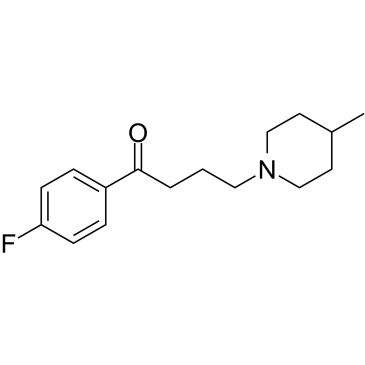
Melperone (Bunil; FG-5111) is a potent and butyrophenone-based antipsychotic drug and a neuroleptic, acting as an inhibitor of the CYP2D6 catalyzed O-demethylation of venlafaxine. It can be used for sleep induction which is frequently prescribed in psychiatric setting. It has also been used for a variety of other indications, including the treatment of schizophrenia, but also for agitation in the elderly.
Physicochemical Properties
| Molecular Formula | C16H22FNO |
| Molecular Weight | 263.3504 |
| Exact Mass | 263.169 |
| CAS # | 3575-80-2 |
| Related CAS # | Melperone-d4 hydrochloride;1219798-80-7 |
| PubChem CID | 15387 |
| Appearance | White to off-white solid powder |
| Density | 1.046g/cm3 |
| Boiling Point | 376.1ºC at 760mmHg |
| Melting Point | 78-82°C |
| Flash Point | 181.3ºC |
| LogP | 3.458 |
| Hydrogen Bond Donor Count | 0 |
| Hydrogen Bond Acceptor Count | 3 |
| Rotatable Bond Count | 5 |
| Heavy Atom Count | 19 |
| Complexity | 279 |
| Defined Atom Stereocenter Count | 0 |
| SMILES | FC1C([H])=C([H])C(=C([H])C=1[H])C(C([H])([H])C([H])([H])C([H])([H])N1C([H])([H])C([H])([H])C([H])(C([H])([H])[H])C([H])([H])C1([H])[H])=O |
| InChi Key | DKMFBWQBDIGMHM-UHFFFAOYSA-N |
| InChi Code | InChI=1S/C16H22FNO/c1-13-8-11-18(12-9-13)10-2-3-16(19)14-4-6-15(17)7-5-14/h4-7,13H,2-3,8-12H2,1H3 |
| Chemical Name | 1-(4-fluorophenyl)-4-(4-methylpiperidin-1-yl)butan-1-one |
| HS Tariff Code | 2934.99.9001 |
| Storage |
Powder-20°C 3 years 4°C 2 years In solvent -80°C 6 months -20°C 1 month |
| Shipping Condition | Room temperature (This product is stable at ambient temperature for a few days during ordinary shipping and time spent in Customs) |
Biological Activity
| ADME/Pharmacokinetics |
Absorption, Distribution and Excretion Oral doses are rapidly absorbed (Tmax 1.5–3.0 hours post oral ingestion). Excreted mainly in the urine, with small amounts of unchanged drug. Metabolism / Metabolites Mainly hepatic. Biological Half-Life Approximately 3-4 hours after oral administration. After intramuscular injection, the half-life has been found to be approximately 6 hours. |
| Toxicity/Toxicokinetics |
Protein Binding Melperone has a bioavailability of 50-70%. |
| References |
[1].Hefner G, et al. Melperone but not bisoprolol or metoprolol is a clinically relevant inhibitor of CYP2D6: evidence from a therapeutic drug monitoring survey. J Neural Transm (Vienna). 2015 Nov;122(11):1609-17. [2].Bobo WV, et al. Melperone, an aytpical antipsychotic drug with clozapine-like effect on plasma prolactin: contrast with typical neuroleptics. Hum Psychopharmacol. 2009 Jul;24(5):415-22. |
| Additional Infomation |
1-(4-fluorophenyl)-4-(4-methyl-1-piperidinyl)-1-butanone is an aromatic ketone. Melperone is an atypical antipsychotic of the butyrophenone chemical class, making it structurally related to the typical antipsychotic haloperidol. Melperone has been used for a span of greater than 30 years in the European Union. It has been well established in the treatment of confusion, anxiety, restlessness (particularly in the elderly) and schizophrenia as It is known to be well-tolerated with an excellent safety profile. Recently, it has been studied as a treatment of psychosis related to Parkinson's disease. Drug Indication For the treatment of schizophrenia, sleep, disorders, agitation and mentally confused states. Mechanism of Action Melperone demonstrates antagonist activity at D2 dopaminergic and 5HT2A serotonergic receptors. It has a weak affinity to D2 receptors and possesses less risk of inducing dopamine receptor supersensitivity after both acute and chronic administration. In addition, the ratio of dopamine D4/D2 occupancy for melperone has been shown to resemble the binding profile of clozapine. |
Solubility Data
| Solubility (In Vitro) | DMSO : ~41.67 mg/mL (~158.23 mM) |
| Solubility (In Vivo) |
Solubility in Formulation 1: ≥ 2.08 mg/mL (7.90 mM) (saturation unknown) in 10% DMSO + 40% PEG300 + 5% Tween80 + 45% Saline (add these co-solvents sequentially from left to right, and one by one), clear solution. For example, if 1 mL of working solution is to be prepared, you can add 100 μL of 20.8 mg/mL clear DMSO stock solution to 400 μL PEG300 and mix evenly; then add 50 μL Tween-80 to the above solution and mix evenly; then add 450 μL normal saline to adjust the volume to 1 mL. Preparation of saline: Dissolve 0.9 g of sodium chloride in 100 mL ddH₂ O to obtain a clear solution. Solubility in Formulation 2: ≥ 2.08 mg/mL (7.90 mM) (saturation unknown) in 10% DMSO + 90% (20% SBE-β-CD in Saline) (add these co-solvents sequentially from left to right, and one by one), clear solution. For example, if 1 mL of working solution is to be prepared, you can add 100 μL of 20.8 mg/mL clear DMSO stock solution to 900 μL of 20% SBE-β-CD physiological saline solution and mix evenly. Preparation of 20% SBE-β-CD in Saline (4°C,1 week): Dissolve 2 g SBE-β-CD in 10 mL saline to obtain a clear solution. Solubility in Formulation 3: ≥ 2.08 mg/mL (7.90 mM) (saturation unknown) in 10% DMSO + 90% Corn Oil (add these co-solvents sequentially from left to right, and one by one), clear solution. For example, if 1 mL of working solution is to be prepared, you can add 100 μL of 20.8 mg/mL clear DMSO stock solution to 900 μL of corn oil and mix evenly. (Please use freshly prepared in vivo formulations for optimal results.) |
| Preparing Stock Solutions | 1 mg | 5 mg | 10 mg | |
| 1 mM | 3.7972 mL | 18.9861 mL | 37.9723 mL | |
| 5 mM | 0.7594 mL | 3.7972 mL | 7.5945 mL | |
| 10 mM | 0.3797 mL | 1.8986 mL | 3.7972 mL |