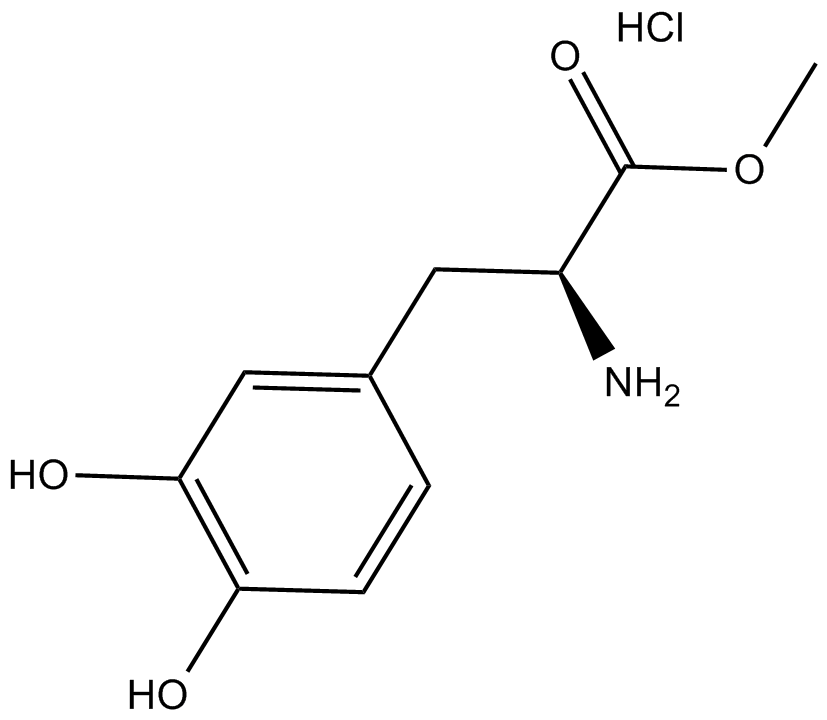
Melevodopa HCl (ST-41769; ST 41769; trade name Levomet), the hydrochloride salt of Melevodopa which is the methyl ester and prodrug form of levodopa, is a dopaminergic agent used as an anti-Dyskinesia drug. It has also been used in combination with carbidopa for the treatment of PD/Parkinson's disease.
Physicochemical Properties
| Molecular Formula | C10H14CLNO4 |
| Molecular Weight | 247.68 |
| Exact Mass | 247.061 |
| Elemental Analysis | C, 48.50; H, 5.70; Cl, 14.31; N, 5.66; O, 25.84 |
| CAS # | 1421-65-4 |
| Related CAS # | 1421-65-4 (HCl);7101-51-1; |
| PubChem CID | 10131132 |
| Appearance | Typically exists as solid at room temperature |
| Density | 1.322g/cm3 |
| Boiling Point | 384.4ºC at 760mmHg |
| Flash Point | 186.3ºC |
| Vapour Pressure | 1.86E-06mmHg at 25°C |
| LogP | 1.642 |
| Hydrogen Bond Donor Count | 4 |
| Hydrogen Bond Acceptor Count | 5 |
| Rotatable Bond Count | 4 |
| Heavy Atom Count | 16 |
| Complexity | 222 |
| Defined Atom Stereocenter Count | 1 |
| SMILES | Cl[H].O(C([H])([H])[H])C([C@]([H])(C([H])([H])C1C([H])=C([H])C(=C(C=1[H])O[H])O[H])N([H])[H])=O |
| InChi Key | WFGNJLMSYIJWII-FJXQXJEOSA-N |
| InChi Code | InChI=1S/C10H13NO4.ClH/c1-15-10(14)7(11)4-6-2-3-8(12)9(13)5-6;/h2-3,5,7,12-13H,4,11H2,1H3;1H/t7-;/m0./s1 |
| Chemical Name | methyl (2S)-2-amino-3-(3,4-dihydroxyphenyl)propanoate;hydrochloride |
| Synonyms | ST-41769; ST 41769; (S)-Methyl 2-amino-3-(3,4-dihydroxyphenyl)propanoate hydrochloride; L-3,4-Dihydroxyphenylalanine methyl ester hydrochloride; Melevodopa hydrochloride; L-Dopa methyl ester hydrochloride; levodopa methyl ester hydrochloride; Methyl L-DOPA hydrochloride; L-Tyrosine, 3-hydroxy-, methyl ester, hydrochloride (1:1); Melevodopa hydrochloride |
| HS Tariff Code | 2934.99.9001 |
| Storage |
Powder-20°C 3 years 4°C 2 years In solvent -80°C 6 months -20°C 1 month |
| Shipping Condition | Room temperature (This product is stable at ambient temperature for a few days during ordinary shipping and time spent in Customs) |
Biological Activity
| Targets | Dopamine receptor |
| ln Vitro | Methyl-L-DOPA, an antihypertensive agent, has significant in vitro activity against a variety of atypical mycobacteria such as the Mycobacterium avium complex, M. scrofulaceum, M. xenopi and M. marinum, and rare pathogens like M. fortuitum. In the present investigation, the screening of the in vitro activity was further extended by testing the in vitro activity against a total of 53 different strains of mycobacteria, including 34 clinical isolates of both drug-sensitive and drug-resistant Mycobacterium tuberculosis. Most of the strains were inhibited at 10-25 microg/mL concentrations of the drug[1]. |
| ln Vivo |
When methyl-L-DOPA was injected into male mice at a concentration of 10 microg/g body weight (20 g each), methyl-L-DOPA significantly protected them when challenged with a 50 median lethal dose of M. tuberculosis H37Rv102. According to the chi2 test, the in vivo data were highly significant (p<0.01)[1]. In the present study, we aimed to assess the potential anti-amblyopic effects of L-dopa methyl ester (LDME) on visual cortex area 17 in an amblyopic feline model induced by monocular vision deprivation. After LDME administration, pathophysiologic and ultrastructural observations were utilized to examine the morphological changes of nerve cells in visual cortex area 17. Dopamine (DA) and its metabolite contents in visual cortex area 17 were investigated through HPLC analysis. Apoptotic cells in visual cortex area 17 were evaluated by TUNEL assay. Additionally, the c-fos expression both at gene and protein levels was assessed using RT-PCR and immunohistochemistry analyses, respectively. The contents of DA and its metabolites were elevated in visual cortex area 17. Neuronal rejuvenation which occurred in visual cortex area 17 was observed through anatomical and physiological assessments. Similarly, TUNEL results showed that neuronal apoptosis was inhibited in the visual cortex of amblyopic cats by both L-dopa and LDME therapies. Meanwhile, the c-fos expression was notably up-regulated at both the mRNA and protein levels by the treatments. These findings suggested that LDME treatment could effectively increase DA and its metabolite contents, and restrain the apoptotic process, as well as elevate the c-fos expression in nerve cells of visual cortex area 17. Taken together, LDME might ameliorate the functional cytoarchitecture in visual cortex area 17 through mechanisms that elevate DA content and increase endogenous c-fos expression, as well as inhibit neuronal lesion in visual cortex tissue[2]. |
| Animal Protocol | A total of 90 kittens (2-week-old) with weights ranging from 200 to 300 g were purchased from the Medical Laboratory Animal Center of Guangxi Medical University, China (Certificate No. SCXK-Gui-2010-0001). The normality of extraocular areas, refracting media and eye fundus was confirmed by routine eye examinations. Cats were randomly assigned into six groups with 15 animals in each group as follows: normal control group, model control group, positive control group and three treatment groups with low-, moderate- and high-doses of LDME. In order to induce amblyopia, left eyelids of all cats except those in the normal control group were sutured following the classic method (Hubel and Wiesel, 1970). After 12 weeks, cats in the LDME treatment groups were intragastrically perfused with 20, 40 and 80 mg/kg LDME dissolved in physiological saline for 30 consecutive days, respectively. In parallel, cats in the positive control group were administered with 40 mg/kg l-dopa, whereas the same volume of normal saline was given to those in the normal and model control groups. All animal protocols were according to the US guidelines (NIH publication #85-23, revised in 1985) for laboratory animal use and care.[2] |
| References |
[1]. In vitro and in vivo antimycobacterial activity of an antihypertensive agent methyl-L-DOPA. In Vivo . 2005 May-Jun;19(3):539-45. [2]. L-dopa methyl ester attenuates amblyopia-induced neuronal injury in visual cortex of amblyopic cat. Gene . 2013 Sep 15;527(1):115-22. |
| Additional Infomation |
LDME increases DA content in the visual cortex. LDME therapy inhibits neural apoptosis. LDME increases endogenous c-fos expression in the visual cortex. LDME attenuates neuronal lesions in the visual cortex. LDME is a potential candidate for amblyopic therapy.[2] |
Solubility Data
| Solubility (In Vitro) | May dissolve in DMSO (in most cases), if not, try other solvents such as H2O, Ethanol, or DMF with a minute amount of products to avoid loss of samples |
| Solubility (In Vivo) |
Note: Listed below are some common formulations that may be used to formulate products with low water solubility (e.g. < 1 mg/mL), you may test these formulations using a minute amount of products to avoid loss of samples. Injection Formulations (e.g. IP/IV/IM/SC) Injection Formulation 1: DMSO : Tween 80: Saline = 10 : 5 : 85 (i.e. 100 μL DMSO stock solution → 50 μL Tween 80 → 850 μL Saline) *Preparation of saline: Dissolve 0.9 g of sodium chloride in 100 mL ddH ₂ O to obtain a clear solution. Injection Formulation 2: DMSO : PEG300 :Tween 80 : Saline = 10 : 40 : 5 : 45 (i.e. 100 μL DMSO → 400 μLPEG300 → 50 μL Tween 80 → 450 μL Saline) Injection Formulation 3: DMSO : Corn oil = 10 : 90 (i.e. 100 μL DMSO → 900 μL Corn oil) Example: Take the Injection Formulation 3 (DMSO : Corn oil = 10 : 90) as an example, if 1 mL of 2.5 mg/mL working solution is to be prepared, you can take 100 μL 25 mg/mL DMSO stock solution and add to 900 μL corn oil, mix well to obtain a clear or suspension solution (2.5 mg/mL, ready for use in animals). Injection Formulation 4: DMSO : 20% SBE-β-CD in saline = 10 : 90 [i.e. 100 μL DMSO → 900 μL (20% SBE-β-CD in saline)] *Preparation of 20% SBE-β-CD in Saline (4°C,1 week): Dissolve 2 g SBE-β-CD in 10 mL saline to obtain a clear solution. Injection Formulation 5: 2-Hydroxypropyl-β-cyclodextrin : Saline = 50 : 50 (i.e. 500 μL 2-Hydroxypropyl-β-cyclodextrin → 500 μL Saline) Injection Formulation 6: DMSO : PEG300 : castor oil : Saline = 5 : 10 : 20 : 65 (i.e. 50 μL DMSO → 100 μLPEG300 → 200 μL castor oil → 650 μL Saline) Injection Formulation 7: Ethanol : Cremophor : Saline = 10: 10 : 80 (i.e. 100 μL Ethanol → 100 μL Cremophor → 800 μL Saline) Injection Formulation 8: Dissolve in Cremophor/Ethanol (50 : 50), then diluted by Saline Injection Formulation 9: EtOH : Corn oil = 10 : 90 (i.e. 100 μL EtOH → 900 μL Corn oil) Injection Formulation 10: EtOH : PEG300:Tween 80 : Saline = 10 : 40 : 5 : 45 (i.e. 100 μL EtOH → 400 μLPEG300 → 50 μL Tween 80 → 450 μL Saline) Oral Formulations Oral Formulation 1: Suspend in 0.5% CMC Na (carboxymethylcellulose sodium) Oral Formulation 2: Suspend in 0.5% Carboxymethyl cellulose Example: Take the Oral Formulation 1 (Suspend in 0.5% CMC Na) as an example, if 100 mL of 2.5 mg/mL working solution is to be prepared, you can first prepare 0.5% CMC Na solution by measuring 0.5 g CMC Na and dissolve it in 100 mL ddH2O to obtain a clear solution; then add 250 mg of the product to 100 mL 0.5% CMC Na solution, to make the suspension solution (2.5 mg/mL, ready for use in animals). Oral Formulation 3: Dissolved in PEG400 Oral Formulation 4: Suspend in 0.2% Carboxymethyl cellulose Oral Formulation 5: Dissolve in 0.25% Tween 80 and 0.5% Carboxymethyl cellulose Oral Formulation 6: Mixing with food powders Note: Please be aware that the above formulations are for reference only. InvivoChem strongly recommends customers to read literature methods/protocols carefully before determining which formulation you should use for in vivo studies, as different compounds have different solubility properties and have to be formulated differently. (Please use freshly prepared in vivo formulations for optimal results.) |
| Preparing Stock Solutions | 1 mg | 5 mg | 10 mg | |
| 1 mM | 4.0375 mL | 20.1873 mL | 40.3747 mL | |
| 5 mM | 0.8075 mL | 4.0375 mL | 8.0749 mL | |
| 10 mM | 0.4037 mL | 2.0187 mL | 4.0375 mL |