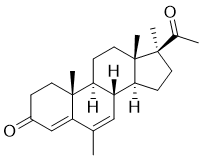
Medrogestone(also known as AY-62022) is a novel and potent progestin.
Physicochemical Properties
| Molecular Formula | C23H32O2 |
| Molecular Weight | 340.5 |
| Exact Mass | 340.24 |
| CAS # | 977-79-7 |
| PubChem CID | 9949848 |
| Appearance | Typically exists as solid at room temperature |
| Density | 1.08g/cm3 |
| Boiling Point | 467.2ºC at 760mmHg |
| Melting Point | 144-146ºC |
| Flash Point | 173.7ºC |
| Index of Refraction | 1.549 |
| LogP | 5.279 |
| Hydrogen Bond Donor Count | 0 |
| Hydrogen Bond Acceptor Count | 2 |
| Rotatable Bond Count | 1 |
| Heavy Atom Count | 25 |
| Complexity | 714 |
| Defined Atom Stereocenter Count | 6 |
| SMILES | O=C1C=C2C(C)=C[C@H]3[C@@H]4CC[C@@](C(C)=O)(C)[C@@]4(C)CC[C@@H]3[C@@]2(C)CC1 |
| InChi Key | HCFSGRMEEXUOSS-JXEXPEPMSA-N |
| InChi Code | InChI=1S/C23H32O2/c1-14-12-17-18(21(3)9-6-16(25)13-20(14)21)7-11-23(5)19(17)8-10-22(23,4)15(2)24/h12-13,17-19H,6-11H2,1-5H3/t17-,18+,19+,21-,22-,23+/m1/s1 |
| Chemical Name | (8R,9S,10R,13S,14S,17S)-17-acetyl-6,10,13,17-tetramethyl-2,8,9,11,12,14,15,16-octahydro-1H-cyclopenta[a]phenanthren-3-one |
| Synonyms | AY-62022 Medrogesterone Medrogestone |
| HS Tariff Code | 2934.99.9001 |
| Storage |
Powder-20°C 3 years 4°C 2 years In solvent -80°C 6 months -20°C 1 month |
| Shipping Condition | Room temperature (This product is stable at ambient temperature for a few days during ordinary shipping and time spent in Customs) |
Biological Activity
| ADME/Pharmacokinetics |
Absorption, Distribution and Excretion When administered, medrogestone presents a very rapid gastrointestinal absorption with a bioavailability of 100%. The maximum serum concentration of medrogestone is 10-15 ng/ml. The elimination time of medrogestone is of 36 hours. Metabolism / Metabolites The non-protein bound fraction of medrogestoneis available for metabolism. The main route in the metabolism of medrogestone is hydroxylation. Biological Half-Life The half-life of medrogestone is reported to be of 4 hours. |
| Toxicity/Toxicokinetics |
Protein Binding Medrogestone, as presented for all progestogens, is highly bound to plasma proteins. It is mainly bound to albumin but it also binds to other plasma proteins like sex hormone binding globulin or corticosteroid-binding globulin. The pharmacokinetics of medrogestone will depend on the degree of plasma protein bindind which makes this characteristic the main regulator of the tissue availability of medrogestone. |
| References | Breast cancer and steroid metabolizing enzymes: the role of progestogens; |
| Additional Infomation |
Medrogestone is a corticosteroid hormone. Medrogestone (INN), also known as 6,17α-dimethyl-6-dehydroprogesterone, is a progestational agent derived from 17-methylprogesterone. It was conceived as an alternative for an orally effective contraceptive option. It was developed by Ayerst, approved in Canada in 1969 and its current status is cancelled post-marketing. It was never approved by the FDA. 6,17-Dimethylpregna-4,6-diene-3,20-dione. A synthetic progestational hormone with actions similar to those of progesterone. It is used in the treatment of menstrual irregularities and has also been employed in the treatment of prostatic hypertrophy and endometrial carcinoma. Drug Indication Medrogestone is indicated as adjunct to treat endometial shedding in menopausal women, to treat secondary amenorrhea, to induce menses and to treat dysfunctional uterine bleeding in adult and adolescent women. Mechanism of Action Medrogestone is a progestogen, thus its action is done under the same profile. These type of molecules are steroid hormones that bind and activate the progesterone receptor. Its action may involve the suppression of gonadotropic hormones from the anterior portion of the pituitary gland and secondary suppression of testosterone. Medrogestone presents structural similarities to testosterone which allows it to compete for the androgen-receptor-protein receptor sites in prostatic cells. Administration of medrogestone diminishes the response to endogenous hormones in tumor cells due to a reduction in hormone steroid receptors; this effect will translate into cytotoxic or antiproliferative effects. Pharmacodynamics Medrogestone was created as a more potent and orally active option of progesterone. In pre-clinical trials, medrogestone was proven to have four times more progestational activity than progesterone with a similar duration effect than the one found for 17-hydroxyprogesterone. Medrogestone was also able to maintain pregnancy and prevented ovulation in ovariectomized rats. Administration of medrogestone, alone or with premarin, prevented pregnancy, as well as it suppressed ovarian weight increase by nearly 100% of the tested individuals. Medrogestone does not produce any androgenic effect but it presented a marked anti-androgenic effect. It did not present an oestrogenic effect, nor changes in organ weight or histological appearance in adrenal glands or thymus and it does not present any anti-inflammatory effects. |
Solubility Data
| Solubility (In Vitro) | May dissolve in DMSO (in most cases), if not, try other solvents such as H2O, Ethanol, or DMF with a minute amount of products to avoid loss of samples |
| Solubility (In Vivo) |
Note: Listed below are some common formulations that may be used to formulate products with low water solubility (e.g. < 1 mg/mL), you may test these formulations using a minute amount of products to avoid loss of samples. Injection Formulations (e.g. IP/IV/IM/SC) Injection Formulation 1: DMSO : Tween 80: Saline = 10 : 5 : 85 (i.e. 100 μL DMSO stock solution → 50 μL Tween 80 → 850 μL Saline) *Preparation of saline: Dissolve 0.9 g of sodium chloride in 100 mL ddH ₂ O to obtain a clear solution. Injection Formulation 2: DMSO : PEG300 :Tween 80 : Saline = 10 : 40 : 5 : 45 (i.e. 100 μL DMSO → 400 μLPEG300 → 50 μL Tween 80 → 450 μL Saline) Injection Formulation 3: DMSO : Corn oil = 10 : 90 (i.e. 100 μL DMSO → 900 μL Corn oil) Example: Take the Injection Formulation 3 (DMSO : Corn oil = 10 : 90) as an example, if 1 mL of 2.5 mg/mL working solution is to be prepared, you can take 100 μL 25 mg/mL DMSO stock solution and add to 900 μL corn oil, mix well to obtain a clear or suspension solution (2.5 mg/mL, ready for use in animals). Injection Formulation 4: DMSO : 20% SBE-β-CD in saline = 10 : 90 [i.e. 100 μL DMSO → 900 μL (20% SBE-β-CD in saline)] *Preparation of 20% SBE-β-CD in Saline (4°C,1 week): Dissolve 2 g SBE-β-CD in 10 mL saline to obtain a clear solution. Injection Formulation 5: 2-Hydroxypropyl-β-cyclodextrin : Saline = 50 : 50 (i.e. 500 μL 2-Hydroxypropyl-β-cyclodextrin → 500 μL Saline) Injection Formulation 6: DMSO : PEG300 : castor oil : Saline = 5 : 10 : 20 : 65 (i.e. 50 μL DMSO → 100 μLPEG300 → 200 μL castor oil → 650 μL Saline) Injection Formulation 7: Ethanol : Cremophor : Saline = 10: 10 : 80 (i.e. 100 μL Ethanol → 100 μL Cremophor → 800 μL Saline) Injection Formulation 8: Dissolve in Cremophor/Ethanol (50 : 50), then diluted by Saline Injection Formulation 9: EtOH : Corn oil = 10 : 90 (i.e. 100 μL EtOH → 900 μL Corn oil) Injection Formulation 10: EtOH : PEG300:Tween 80 : Saline = 10 : 40 : 5 : 45 (i.e. 100 μL EtOH → 400 μLPEG300 → 50 μL Tween 80 → 450 μL Saline) Oral Formulations Oral Formulation 1: Suspend in 0.5% CMC Na (carboxymethylcellulose sodium) Oral Formulation 2: Suspend in 0.5% Carboxymethyl cellulose Example: Take the Oral Formulation 1 (Suspend in 0.5% CMC Na) as an example, if 100 mL of 2.5 mg/mL working solution is to be prepared, you can first prepare 0.5% CMC Na solution by measuring 0.5 g CMC Na and dissolve it in 100 mL ddH2O to obtain a clear solution; then add 250 mg of the product to 100 mL 0.5% CMC Na solution, to make the suspension solution (2.5 mg/mL, ready for use in animals). Oral Formulation 3: Dissolved in PEG400 Oral Formulation 4: Suspend in 0.2% Carboxymethyl cellulose Oral Formulation 5: Dissolve in 0.25% Tween 80 and 0.5% Carboxymethyl cellulose Oral Formulation 6: Mixing with food powders Note: Please be aware that the above formulations are for reference only. InvivoChem strongly recommends customers to read literature methods/protocols carefully before determining which formulation you should use for in vivo studies, as different compounds have different solubility properties and have to be formulated differently. (Please use freshly prepared in vivo formulations for optimal results.) |
| Preparing Stock Solutions | 1 mg | 5 mg | 10 mg | |
| 1 mM | 2.9369 mL | 14.6843 mL | 29.3686 mL | |
| 5 mM | 0.5874 mL | 2.9369 mL | 5.8737 mL | |
| 10 mM | 0.2937 mL | 1.4684 mL | 2.9369 mL |