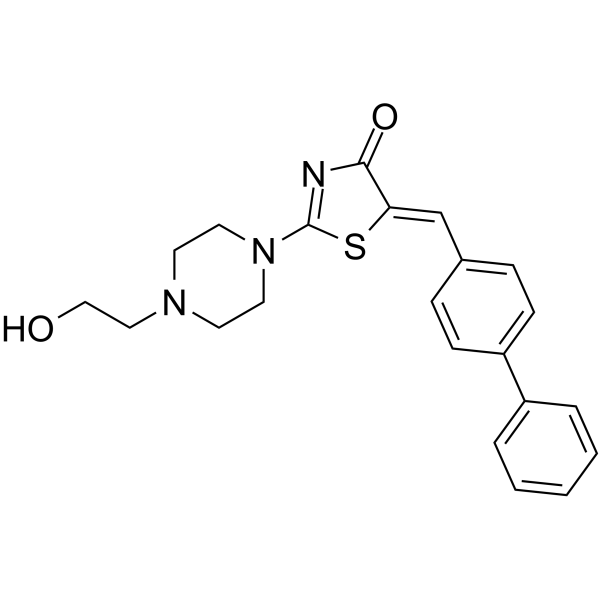
Physicochemical Properties
| Molecular Formula | C22H23N3O2S |
| Molecular Weight | 393.5019 |
| Exact Mass | 393.151 |
| CAS # | 678158-55-9 |
| PubChem CID | 988971 |
| Appearance | Light yellow to yellow solid powder |
| LogP | 3.2 |
| Hydrogen Bond Donor Count | 1 |
| Hydrogen Bond Acceptor Count | 4 |
| Rotatable Bond Count | 5 |
| Heavy Atom Count | 28 |
| Complexity | 599 |
| Defined Atom Stereocenter Count | 0 |
| SMILES | S1/C(=C(/[H])\C2C([H])=C([H])C(C3C([H])=C([H])C([H])=C([H])C=3[H])=C([H])C=2[H])/C(N=C1N1C([H])([H])C([H])([H])N(C([H])([H])C([H])([H])O[H])C([H])([H])C1([H])[H])=O |
| InChi Key | IBEWMFVUBLAYJT-SILNSSARSA-N |
| InChi Code | InChI=1S/C22H23N3O2S/c26-15-14-24-10-12-25(13-11-24)22-23-21(27)20(28-22)16-17-6-8-19(9-7-17)18-4-2-1-3-5-18/h1-9,16,26H,10-15H2/b20-16- |
| Chemical Name | (5Z)-2-[4-(2-hydroxyethyl)piperazin-1-yl]-5-[(4-phenylphenyl)methylidene]-1,3-thiazol-4-one |
| HS Tariff Code | 2934.99.9001 |
| Storage |
Powder-20°C 3 years 4°C 2 years In solvent -80°C 6 months -20°C 1 month |
| Shipping Condition | Room temperature (This product is stable at ambient temperature for a few days during ordinary shipping and time spent in Customs) |
Biological Activity
| ln Vitro | CLZ-8 (compound 8) (0-160 μM, 48 h) strongly suppresses apoptosis that is dependent on PUMA [1]. In a dose-dependent way, CLZ-8 (0–1 μM, 2 hours) markedly increased the vitality of irradiation cells, considerably shielded HUVEC, and suppressed overexpressed PUMA [2]. Radiation-induced apoptosis is attenuated by CLZ-8 (0-1 μM, 24 hours) [2]. HUVEC is protected against DNA fragmentation by CLZ-8 (1 μM, 2 hours) [2]. |
| ln Vivo | Mice treated with CLZ-8 (0-400 mg/kg; ig; once) have strong anti-radiation effects [2]. |
| Cell Assay |
Apoptosis analysis[1][2] Cell Types: DLD-1 cells or HUVEC Cell Tested Concentrations: 0-160 μM (DLD-1) or 0.01, 0.1 and 1 μM (HUVEC) Incubation Duration: 48 hrs (hours) (DLD-1 ) or 24 hrs (hours) (HUVEC) Experimental Results: Dramatically inhibited PUMA-dependent apoptosis with an IC50 of 38.93 ± 0.91 μM. Attenuates radiation-induced apoptosis. Western Blot Analysis [2] Cell Types: HUVEC Cell Tested Concentrations: 0.001, 0.01, 0.1 and 1 μM Incubation Duration: 2 h Experimental Results: PUMA induction was inhibited and p53 levels were Dramatically diminished after radiation. Dramatically diminished MCL-1 levels and increased Bcl-XL levels. |
| Animal Protocol |
Animal/Disease Models: 6-8 weeks old male balb/c (Bagg ALBino) mouse [2] Doses: 100, 200 and 400 mg/kg Route of Administration: intragastric (po) (po)administration once 30 minutes before irradiation. Experimental Results: Improved survival rate of irradiated mice. |
| References |
[1]. Targeting the apoptotic Mcl-1-PUMA interface with a dual-acting compound. Oncotarget. 2017 Apr 20;8(33):54236-54242. [2]. CLZ-8, a potent small-molecular compound, protects radiation-induced damages both in vitro and in vivo. Environ Toxicol Pharmacol. 2018 Jul;61:44-51. |
Solubility Data
| Solubility (In Vitro) | DMSO : ~50 mg/mL (~127.06 mM) |
| Solubility (In Vivo) |
Solubility in Formulation 1: ≥ 0.83 mg/mL (2.11 mM) (saturation unknown) in 10% DMSO + 90% Corn Oil (add these co-solvents sequentially from left to right, and one by one), clear solution. For example, if 1 mL of working solution is to be prepared, you can add 100 μL of 8.3 mg/mL clear DMSO stock solution to 900 μL of corn oil and mix evenly. (Please use freshly prepared in vivo formulations for optimal results.) |
| Preparing Stock Solutions | 1 mg | 5 mg | 10 mg | |
| 1 mM | 2.5413 mL | 12.7065 mL | 25.4130 mL | |
| 5 mM | 0.5083 mL | 2.5413 mL | 5.0826 mL | |
| 10 mM | 0.2541 mL | 1.2706 mL | 2.5413 mL |