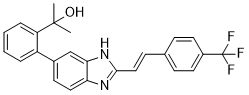
Mavatrep (formerly known as JNJ-39439335) is a novel, orally bioavailable, potent and selective TRPV1 antagonist (Ki = 6.5 nM) with a potential to manage inflammatory pain. It exhibits minimal effect on the enzymatic activity (IC50 > 25 μM) of CYP isoforms 3A4, 1A2, and 2D6. In a TRPV1 functional assay, using cells expressing recombinant human TRPV1 channels, Mavatrep antagonized capsaicin-induced Ca(2+) influx, with an IC50 value of 4.6 nM. In the complete Freund's adjuvant- and carrageenan-induced thermal hypersensitivity models, Mavatrep exhibited full efficacy, with ED80 values of 7.8 and 0.5 mg/kg, respectively, corresponding to plasma levels of 270.8 and 9.2 ng/mL, respectively. On the basis of its superior pharmacologic and safety profile, Mavatrep was selected for clinical development for the treatment of pain.
Physicochemical Properties
| Molecular Formula | C25H21N2OF3 |
| Molecular Weight | 422.442 |
| Exact Mass | 422.161 |
| CAS # | 956274-94-5 |
| PubChem CID | 17751090 |
| Appearance | White to off-white solid powder |
| LogP | 6.646 |
| Hydrogen Bond Donor Count | 2 |
| Hydrogen Bond Acceptor Count | 5 |
| Rotatable Bond Count | 4 |
| Heavy Atom Count | 31 |
| Complexity | 627 |
| Defined Atom Stereocenter Count | 0 |
| SMILES | CC(C)(C1=CC=CC=C1C2=CC3=C(C=C2)N=C(N3)/C=C/C4=CC=C(C=C4)C(F)(F)F)O |
| InChi Key | ORDHXXHTBUZRCN-NTEUORMPSA-N |
| InChi Code | InChI=1S/C25H21F3N2O/c1-24(2,31)20-6-4-3-5-19(20)17-10-13-21-22(15-17)30-23(29-21)14-9-16-7-11-18(12-8-16)25(26,27)28/h3-15,31H,1-2H3,(H,29,30)/b14-9+ |
| Chemical Name | (E)-2-(2-(2-(4-(trifluoromethyl)styryl)-1H-benzo[d]imidazol-6-yl)phenyl)propan-2-ol |
| Synonyms | JNJ39439335; JNJ 39439335; JNJ-39439335 |
| HS Tariff Code | 2934.99.9001 |
| Storage |
Powder-20°C 3 years 4°C 2 years In solvent -80°C 6 months -20°C 1 month |
| Shipping Condition | Room temperature (This product is stable at ambient temperature for a few days during ordinary shipping and time spent in Customs) |
Biological Activity
| Targets |
TRPV1 (transient receptor potential vanilloid 1) antagonist Human TRPV1 (hTRPV1): IC₅₀ = 4.6 nM in capsaicin-induced Ca²⁺ influx assay; Ki = 6.5 nM for [[³H]](+)-resiniferatoxin binding; IC₅₀ = 23 nM for capsaicin-induced activation; IC₅₀ = 6.8 nM for pH-induced activation; 74% inhibition of heat-evoked currents at 0.1 µM. Rat TRPV1 (rTRPV1): IC₅₀ = 21 nM in capsaicin-induced Ca²⁺ influx assay. No activity against TRPM8, TRPV2, or TRPA1 at concentrations up to 10 µM.[1] |
| ln Vitro |
In HEK293 cells expressing TRPV1 channels, mavatrep (a series of decreasing doses commencing at 1 μM; 25 minutes) suppresses the Ca2+ influx caused by capsaicin [1]. In a recombinant human TRPV1 functional assay using HEK293 cells, Mavatrep inhibited capsaicin-induced Ca²⁺ influx with an IC₅₀ of 4.6 nM.[1] In whole-cell patch clamp electrophysiology studies, Mavatrep blocked capsaicin-induced (1 µM) and pH-induced (pH 5.0) activation of hTRPV1 in a concentration-dependent manner with IC₅₀ values of 23 nM and 6.8 nM, respectively.[1] At 0.1 µM, Mavatrep produced 74 ± 8.1% inhibition of heat-evoked currents mediated by hTRPV1.[1] In metabolic stability studies using rat and human liver microsomes, 93% and 100% of Mavatrep remained after 10 min incubation, respectively.[1] Mavatrep showed minimal inhibition of CYP isoforms 3A4, 1A2, and 2D6 (IC₅₀ > 25 µM) in human liver microsomes.[1] No significant inhibition (>50% at 1 µM) was observed in a panel of 50 GPCR and ion channel binding assays, 190 kinase assays, or in a recombinant hERG channel binding assay (10 µM).[1] |
| ln Vivo |
Mavatrep (0.1, 0.3, 1, 3, 10 mg/kg; oral; single dosage) exhibits complete reversal of pain in the carrageenan inflammation model and thermal hypersensitivity in the CFA pain inflammation model [1]. In rats, Mavatrep (10 mg/kg; oral; single dosage) shows a notable bioavailability of 51% [1]. In the complete Freund’s adjuvant (CFA)-induced thermal hypersensitivity model in rats, oral administration of Mavatrep (10 mg/kg) produced significant reversal of hypersensitivity starting at 30 min and lasting for at least 3 h.[1] The ED₅₀ and ED₉₀ values for reversal of CFA-induced thermal hypersensitivity were 1.8 mg/kg and 7.8 mg/kg, respectively, corresponding to plasma concentrations of 41.9 ng/mL and 270.8 ng/mL.[1] In the carrageenan-induced thermal hypersensitivity model, Mavatrep exhibited ED₅₀ and ED₉₀ values of 0.18 mg/kg and 0.48 mg/kg, respectively, with corresponding plasma levels of 3.8 ng/mL and 9.2 ng/mL.[1] Mavatrep reversed thermal hypersensitivity to a similar extent as celecoxib (30 mg/kg) in the CFA model.[1] Oral administration of Mavatrep at 100 mg/kg induced a transient increase in core body temperature in rats (peak +0.86°C at 30 min), which returned to baseline within 1.5 h.[1] No significant hemodynamic or ECG changes were observed in anesthetized guinea pigs at cumulative intravenous doses up to 10 mg/kg.[1] No substantial behavioral or physiological effects were observed in rats following single oral doses of 30 or 300 mg/kg over a 14-day observation period.[1] |
| Enzyme Assay |
The binding affinity of Mavatrep for hTRPV1 was assessed using a radioligand competition assay with [[³H]](+)-resiniferatoxin. Membrane preparations from TRPV1-expressing cells were incubated with the radioligand and varying concentrations of Mavatrep to determine Ki values.[1] Cytochrome P450 inhibition assays were conducted using human liver microsomes incubated with probe substrates for CYP3A4, CYP1A2, and CYP2D6 in the presence of Mavatrep to evaluate potential drug–drug interactions.[1] |
| Cell Assay |
Cell viability assay [1] Cell Types: HEK293 cells (stably expressing TRPV1 channel) Tested Concentrations: A series of decreasing concentrations starting from 1 μM Incubation Duration: 25 minutes Experimental Results: Inhibited capsaicin-induced Ca2+ influx, IC50 value was 4.6 nM. TRPV1 functional assays were performed using HEK293 cells stably expressing human or rat TRPV1. Cells were loaded with a Ca²⁺-sensitive fluorescent dye and exposed to test compounds before stimulation with capsaicin. Intracellular Ca²⁺ flux was measured using FLIPR or FDSS systems to determine IC₅₀ values.[1] Electrophysiological studies were conducted using whole-cell patch clamp recordings on hTRPV1-HEK293 cells. Cells were exposed to capsaicin, acidic pH, or heat stimuli in the presence or absence of Mavatrep to assess channel blockade.[1] Metabolic stability was evaluated by incubating Mavatrep with rat or human liver microsomes for 10 min, followed by quantification of the remaining compound.[1] |
| Animal Protocol |
Animal/Disease Models: Male SD (SD (Sprague-Dawley)) rat (195-350 g; CFA pain inflammation model) [1]. Doses: 10 mg/kg Route of Administration: po (po (oral gavage)) single dose. Experimental Results: Significant reversal of CFA-induced thermal hypersensitivity, which started 30 minutes after administration and lasted for at least 3 hrs (hrs (hours)). Animal/Disease Models: Male SD (SD (Sprague-Dawley)) rat (195-350 g; CFA pain inflammation model) [1]. Doses: 1, 3, 10, 30 mg/kg Route of Administration: po (po (oral gavage)) single dose. Experimental Results: The thermal hypersensitivity reaction was completely reversed, with ED50 and ED80 values of 1.8 and 7.8 mg/kg, respectively, and corresponding plasma levels of 41.9 and 270.8 ng/mL, respectively. Animal/Disease Models: Male SD (SD (Sprague-Dawley)) rat (195-350 g; carrageenan inflammatory pain model) [1]. Doses: 0.1, 0.3, 1, 3, 10 mg/kg Route of Administration: po (po (oral gavage)) single dose. Experimental Results: The thermal hypersensitivity reaction induced by carrageenan was completely reversed, with ED50 and ED80 values of 0.18 and 0.48 mg/kg, respectively, and the corresponding plasma levels were 3.8 For the CFA-induced inflammatory pain model, male Sprague-Dawley rats received an intraplantar injection of CFA (100 µL, 1:1 in saline). Thermal hypersensitivity was assessed 24 h later using a radiant heat stimulus. Test compounds were administered orally, and withdrawal latencies were measured at multiple time points post-dosing.[1] For the carrageenan-induced inflammatory pain model, rats received an intraplantar injection of λ-carrageenan (200 µL, 10 mg/mL). Thermal hypersensitivity was assessed 3 h later, and compounds were administered orally prior to testing.[1] Core body temperature studies were conducted in male Sprague-Dawley rats implanted with telemetry probes. Animals were administered Mavatrep orally (0.1–100 mg/kg), and temperature was recorded before and at scheduled intervals after dosing.[1] A subchronic temperature study involved daily oral administration of Mavatrep (10 mg/kg) for 5 days, with core temperature measured before and after dosing each day.[1] For pharmacokinetic studies, Mavatrep was administered intravenously (2 mg/kg) or orally (10 mg/kg) as a sodium salt solution in 20% hydroxypropyl-β-cyclodextrin to rats, dogs, monkeys, and mice. Blood samples were collected at various time points for plasma concentration analysis.[1] |
| ADME/Pharmacokinetics |
In rats, Mavatrep showed moderate clearance (33 mL/min/kg), a volume of distribution of 3.4 L/kg, and an oral bioavailability of 51%.[1] In dogs, clearance was higher (29 mL/min/kg), with an oral bioavailability of 25%.[1] In monkeys, clearance was lower (7 mL/min/kg), with an oral bioavailability of 70%.[1] In mice, clearance was low (10.5 mL/min/kg), with an oral bioavailability of 83%.[1] The half-life after oral administration ranged from 1.3 h in dogs to 5.8 h in mice.[1] Metabolic stability in liver microsomes was high in humans (100% remaining at 10 min), moderate in rats (93%), and lower in dogs (36%).[1] |
| Toxicity/Toxicokinetics |
Mavatrep induced a transient, dose-dependent increase in core body temperature in rats, with a maximal average increase of 1.18 ± 0.21°C observed after repeated dosing (10 mg/kg/day for 5 days). No tolerance to this effect developed.[1] No significant inhibition of hERG channel binding was observed at 10 µM.[1] No notable hemodynamic or electrocardiographic effects were seen in guinea pigs at intravenous doses up to 10 mg/kg.[1] No changes in core body temperature were observed at 1 or 4 h after single oral doses of 30 or 300 mg/kg in a general observational test battery.[1] The compound showed good selectivity across a broad panel of GPCRs, ion channels, and kinases.[1] |
| References |
[1]. Benzo [d] imidazole Transient Receptor Potential Vanilloid 1 Antagonists for the Treatment of Pain: Discovery of trans-2-(2-{2-[2-(4-Trifluoromethyl-phenyl)-vinyl]-1 H-benzimidazol-5-yl}-phenyl)-propan-2-ol (Mavatrep). Journal of medic. |
| Additional Infomation |
Mavatrep has been used in trials studying the treatment of Osteoarthritis, Knee. Mavatrep is a selective, high-affinity TRPV1 antagonist developed for the treatment of pain, particularly inflammatory and neuropathic pain conditions.[1] It evolved from a biarylamide scaffold to a benzo[d]imidazole-based design, incorporating a trans-vinyl tether and optimized head/tail substituents for potency and metabolic stability.[1] The compound exhibits robust oral efficacy in preclinical pain models at low plasma concentrations and has been advanced to Phase 2 clinical trials.[1] Its hyperthermic effect is modest, transient, and not associated with other systemic toxicities in preclinical species.[1] |
Solubility Data
| Solubility (In Vitro) | DMSO : ~16.67 mg/mL (~39.46 mM) |
| Solubility (In Vivo) |
Solubility in Formulation 1: ≥ 2.5 mg/mL (5.92 mM) (saturation unknown) in 10% DMSO + 40% PEG300 + 5% Tween80 + 45% Saline (add these co-solvents sequentially from left to right, and one by one), clear solution. For example, if 1 mL of working solution is to be prepared, you can add 100 μL of 25.0 mg/mL clear DMSO stock solution to 400 μL PEG300 and mix evenly; then add 50 μL Tween-80 to the above solution and mix evenly; then add 450 μL normal saline to adjust the volume to 1 mL. Preparation of saline: Dissolve 0.9 g of sodium chloride in 100 mL ddH₂ O to obtain a clear solution. Solubility in Formulation 2: 2.5 mg/mL (5.92 mM) in 10% DMSO + 90% (20% SBE-β-CD in Saline) (add these co-solvents sequentially from left to right, and one by one), suspension solution; with ultrasonication. For example, if 1 mL of working solution is to be prepared, you can add 100 μL of 25.0 mg/mL clear DMSO stock solution to 900 μL of 20% SBE-β-CD physiological saline solution and mix evenly. Preparation of 20% SBE-β-CD in Saline (4°C,1 week): Dissolve 2 g SBE-β-CD in 10 mL saline to obtain a clear solution. (Please use freshly prepared in vivo formulations for optimal results.) |
| Preparing Stock Solutions | 1 mg | 5 mg | 10 mg | |
| 1 mM | 2.3672 mL | 11.8360 mL | 23.6720 mL | |
| 5 mM | 0.4734 mL | 2.3672 mL | 4.7344 mL | |
| 10 mM | 0.2367 mL | 1.1836 mL | 2.3672 mL |