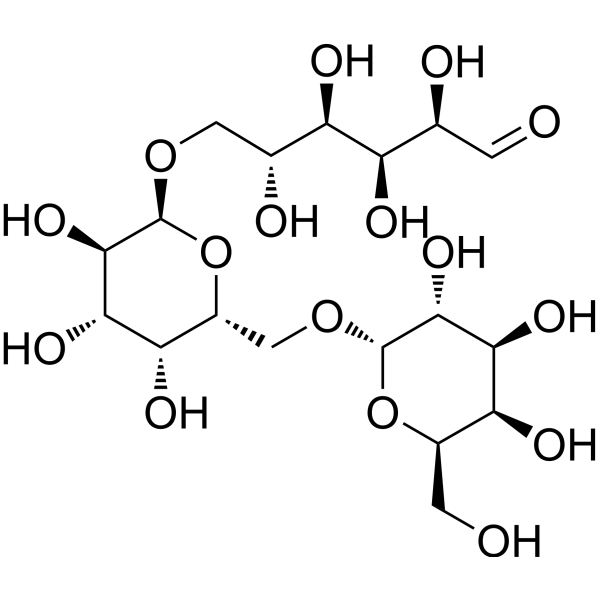
Physicochemical Properties
| Molecular Formula | C18H32O16 |
| Molecular Weight | 504.4371 |
| Exact Mass | 504.169 |
| CAS # | 13382-86-0 |
| Related CAS # | Isomaltotriose;3371-50-4 |
| PubChem CID | 5461026 |
| Appearance | White to off-white solid powder |
| Density | 1.8±0.1 g/cm3 |
| Boiling Point | 952.8±65.0 °C at 760 mmHg |
| Flash Point | 327.7±27.8 °C |
| Vapour Pressure | 0.0±0.6 mmHg at 25°C |
| Index of Refraction | 1.652 |
| LogP | -4.26 |
| Hydrogen Bond Donor Count | 11 |
| Hydrogen Bond Acceptor Count | 16 |
| Rotatable Bond Count | 11 |
| Heavy Atom Count | 34 |
| Complexity | 625 |
| Defined Atom Stereocenter Count | 14 |
| SMILES | C([C@@H]1[C@@H]([C@@H]([C@H]([C@H](O1)OC[C@@H]2[C@@H]([C@@H]([C@H]([C@H](O2)OC[C@H]([C@H]([C@@H]([C@H](C=O)O)O)O)O)O)O)O)O)O)O)O |
| InChi Key | FZWBNHMXJMCXLU-YRBKNLIBSA-N |
| InChi Code | InChI=1S/C18H32O16/c19-1-5(21)9(23)10(24)6(22)3-31-17-16(30)14(28)12(26)8(34-17)4-32-18-15(29)13(27)11(25)7(2-20)33-18/h1,5-18,20-30H,2-4H2/t5-,6+,7+,8+,9+,10+,11-,12-,13-,14-,15+,16+,17-,18-/m0/s1 |
| Chemical Name | (2R,3S,4R,5R)-2,3,4,5-tetrahydroxy-6-[(2S,3R,4S,5R,6R)-3,4,5-trihydroxy-6-[[(2S,3R,4S,5R,6R)-3,4,5-trihydroxy-6-(hydroxymethyl)oxan-2-yl]oxymethyl]oxan-2-yl]oxyhexanal |
| HS Tariff Code | 2934.99.9001 |
| Storage |
Powder-20°C 3 years 4°C 2 years In solvent -80°C 6 months -20°C 1 month |
| Shipping Condition | Room temperature (This product is stable at ambient temperature for a few days during ordinary shipping and time spent in Customs) |
Biological Activity
| Targets |
Based on computational molecular docking studies, manninotriose is predicted to bind to human dihydrofolate reductase (DHFR) and thymidylate synthase (TS), which are key enzymes in the folate metabolism pathway and targets for acute lymphoblastic leukemia (ALL) treatment. The docking score for DHFR was 129.787 and for TS was 114.603. [2] |
| Enzyme Assay |
The susceptibility of manninotriose to enzymatic hydrolysis was tested. Manninotriose was found to be degraded by α-galactosidase but not by (vacuolar) invertase. This enzymatic profiling helped confirm its identity as a stachyose derivative lacking the terminal fructose. [1] Detailed Protocol: Raffinose, stachyose, and manninotriose were subjected to enzymatic hydrolysis. Wheat vacuolar invertase and green coffee bean α-galactosidase were used as described in previous work. The degradation products were analyzed to determine substrate specificity. [1] |
| ADME/Pharmacokinetics |
The pharmacokinetic properties of manninotriose were predicted using computational ADMET protocols. The predictions indicate: Human intestinal absorption level is predicted to be 3 (very poor absorption). Solubility level is predicted to be 3 (good solubility). Plasma protein binding (PPB) is predicted to be less than 90% (level 0). [2] |
| Toxicity/Toxicokinetics |
The hepatotoxicity of manninotriose was predicted using computational ADMET protocols. The prediction indicates a hepatotoxicity level of 0 (nontoxic). [2] |
| References |
[1]. Manninotriose is a major carbohydrate in red deadnettle (Lamium purpureum, Lamiaceae). Ann Bot. 2013 Mar;111(3):385-93. [2]. Treatment of acute lymphoblastic leukemia from traditional chinese medicine. Evid Based Complement Alternat Med. 2014;2014:601064. |
| Additional Infomation |
Manninotriose is a trisaccharide. Manninotriose has been reported in Rehmannia glutinosa with data available. Manninotriose (Galα1,6Galα1,6Glc) is a reducing trisaccharide identified as a major water-soluble carbohydrate in the stems and roots of early-spring red deadnettle (Lamium purpureum). It is derived from the hydrolysis of stachyose (a raffinose family oligosaccharide, RFO) via β-fructosidase activity. [1] Its accumulation pattern, along with stachyose and melibiose, in different plant parts (roots, stems, leaves, veins) suggests that stachyose is the main transport sugar in the phloem, and manninotriose is likely formed along the transport path. It is proposed to function as a temporary storage carbohydrate and potentially as a membrane protector and/or antioxidant in the plant, similar to other RFOs and fructans. [1] The compound was purified from plant stems and its structure was confirmed by NMR spectroscopy (1H, 13C, COSY, HSQC, HMBC, NOESY). [1] The study mentions that manninotriose derivatives have been reported by other researchers (outside this paper) to show antibacterial activities, and that its increased levels in processed Rehmannia glutinosa roots were associated with enhanced pharmacological activities of extracts. However, these are cited as background from other literature, not as findings of the current study. [1] Manninotriose was identified as a potential candidate from Traditional Chinese Medicine (TCM) for the treatment of acute lymphoblastic leukemia (ALL) through a computational screening approach. [2] The study aimed to find compounds with lower toxicity than methotrexate (MTX). Virtual screening of a TCM compound library against DHFR and TS proteins ranked manninotriose among the top hits. [2] Molecular docking analysis suggests that manninotriose may form hydrogen bonds with Arg28 of DHFR and with Arg50 of TS. [2] The predicted biological activity (pIC50) for manninotriose against DHFR varied across different QSAR models: Multiple Linear Regression (MLR) predicted 29.1034, Bayesian network predicted 5.1934, Support Vector Machine (SVM) predicted 5.9247, Comparative Molecular Field Analysis (CoMFA) predicted 7.6470, and Comparative Molecular Similarity Indices Analysis (CoMSIA) models predicted 6.2450 (EHDA model) and 5.3700 (EHA model). These values are model predictions and not experimentally determined. [2] Contour map analysis from 3D-QSAR models (CoMFA and CoMSIA) suggested that the structure of manninotriose fits well into steric and hydrophobic favoring regions of the DHFR binding site, supporting its predicted bioactivity. [2] The study concludes that manninotriose, along with adenosine triphosphate, raffinose, and stachyose, has the potential to improve the side effects of MTX for ALL treatment, based on computational predictions of binding and lower predicted hepatotoxicity. [2] |
Solubility Data
| Solubility (In Vitro) |
DMSO : ~100 mg/mL (~198.24 mM) H2O : ~83.3 mg/mL (~165.13 mM) |
| Solubility (In Vivo) |
Solubility in Formulation 1: ≥ 2.5 mg/mL (4.96 mM) (saturation unknown) in 10% DMSO + 40% PEG300 + 5% Tween80 + 45% Saline (add these co-solvents sequentially from left to right, and one by one), clear solution. For example, if 1 mL of working solution is to be prepared, you can add 100 μL of 25.0 mg/mL clear DMSO stock solution to 400 μL PEG300 and mix evenly; then add 50 μL Tween-80 to the above solution and mix evenly; then add 450 μL normal saline to adjust the volume to 1 mL. Preparation of saline: Dissolve 0.9 g of sodium chloride in 100 mL ddH₂ O to obtain a clear solution. Solubility in Formulation 2: ≥ 2.5 mg/mL (4.96 mM) (saturation unknown) in 10% DMSO + 90% (20% SBE-β-CD in Saline) (add these co-solvents sequentially from left to right, and one by one), clear solution. For example, if 1 mL of working solution is to be prepared, you can add 100 μL of 25.0 mg/mL clear DMSO stock solution to 900 μL of 20% SBE-β-CD physiological saline solution and mix evenly. Preparation of 20% SBE-β-CD in Saline (4°C,1 week): Dissolve 2 g SBE-β-CD in 10 mL saline to obtain a clear solution. Solubility in Formulation 3: ≥ 2.5 mg/mL (4.96 mM) (saturation unknown) in 10% DMSO + 90% Corn Oil (add these co-solvents sequentially from left to right, and one by one), clear solution. For example, if 1 mL of working solution is to be prepared, you can add 100 μL of 25.0 mg/mL clear DMSO stock solution to 900 μL of corn oil and mix evenly. Solubility in Formulation 4: 100 mg/mL (198.24 mM) in PBS (add these co-solvents sequentially from left to right, and one by one), clear solution; with ultrasonication. (Please use freshly prepared in vivo formulations for optimal results.) |
| Preparing Stock Solutions | 1 mg | 5 mg | 10 mg | |
| 1 mM | 1.9824 mL | 9.9120 mL | 19.8240 mL | |
| 5 mM | 0.3965 mL | 1.9824 mL | 3.9648 mL | |
| 10 mM | 0.1982 mL | 0.9912 mL | 1.9824 mL |