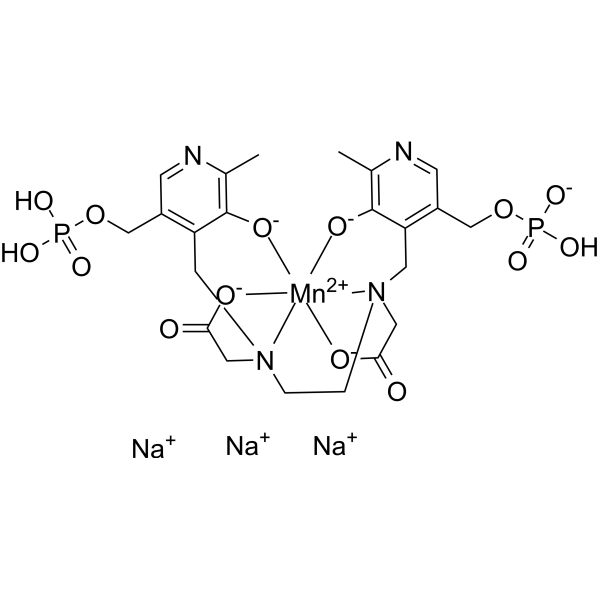
Physicochemical Properties
| Molecular Formula | C22H24N4O14P2-8.MN+2.3[NA+] |
| Molecular Weight | 754.299360000001 |
| Exact Mass | 757.007 |
| CAS # | 140678-14-4 |
| Related CAS # | Mangafodipir;155319-91-8 |
| PubChem CID | 160036 |
| Appearance | Brown to reddish brown solid powder |
| Boiling Point | 1049.1ºC at 760 mmHg |
| Flash Point | 588.3ºC |
| Vapour Pressure | 0mmHg at 25°C |
| Hydrogen Bond Donor Count | 3 |
| Hydrogen Bond Acceptor Count | 18 |
| Rotatable Bond Count | 13 |
| Heavy Atom Count | 46 |
| Complexity | 873 |
| Defined Atom Stereocenter Count | 0 |
| SMILES | O=C1[O-][Mn+2]([N]2(C3)CC4=C5COP(O)(O)=O)([O-]C6=C(N=C7)C)([O-]C4=C(N=C5)C)([O-]C3=O)[N](CC6=C7COP([O-])(O)=O)(CC2)C1.[Na+].[Na+].[Na+] |
| InChi Key | BENFPBJLMUIGGD-UHFFFAOYSA-I |
| InChi Code | InChI=1S/C22H32N4O14P2.Mn.3Na/c1-13-21(31)17(15(5-23-13)11-39-41(33,34)35)7-25(9-19(27)28)3-4-26(10-20(29)30)8-18-16(12-40-42(36,37)38)6-24-14(2)22(18)32;;;;/h5-6,31-32H,3-4,7-12H2,1-2H3,(H,27,28)(H,29,30)(H2,33,34,35)(H2,36,37,38);;;;/q;+2;3*+1/p-5 |
| Chemical Name | trisodium;2-[2-[carboxylatomethyl-[[2-methyl-3-oxido-5-(phosphonatooxymethyl)pyridin-4-yl]methyl]amino]ethyl-[[2-methyl-3-oxido-5-(phosphonatooxymethyl)pyridin-4-yl]methyl]amino]acetate;hydron;manganese(2+) |
| HS Tariff Code | 2934.99.9001 |
| Storage |
Powder-20°C 3 years 4°C 2 years In solvent -80°C 6 months -20°C 1 month Note: Please store this product in a sealed and protected environment, avoid exposure to moisture. |
| Shipping Condition | Room temperature (This product is stable at ambient temperature for a few days during ordinary shipping and time spent in Customs) |
Biological Activity
| ln Vitro | Mangafodipir trisodium (40, 200, and 1000 μM) inhibits H2O2's effect on the viability of HGrC cells [3]. At 200 and 1000 μM, mangafodipir trisodium mitigates the effects of cisplatin-induced HGrC cell viability [3]. |
| ln Vivo | Mice treated with manfodipir trisodium (10 mg/kg; intraperitoneal injection, once) did not exhibit skin injury from paclitaxel or cisplatin [3]. |
| Animal Protocol |
Animal/Disease Models: Female CD-1 (ICR) mice cisplatin and paclitaxel-induced ovarian injury [3] Doses: 10 mg/kg Route of Administration: intraperitoneal (ip) injection; 10 mg/kg, once Experimental Results: Reduce the loss of primordial follicles, Decrease in secondary follicles and increase in antral follicles. Prevent changes in primary follicles caused by cisplatin and paclitaxel. Reduces the increase in caspase-3 levels induced by cisplatin and paclitaxel. |
| ADME/Pharmacokinetics |
Metabolism / Metabolites Metabolism of organophosphates occurs principally by oxidation, by hydrolysis via esterases and by reaction with glutathione. Demethylation and glucuronidation may also occur. Oxidation of organophosphorus pesticides may result in moderately toxic products. In general, phosphorothioates are not directly toxic but require oxidative metabolism to the proximal toxin. The glutathione transferase reactions produce products that are, in most cases, of low toxicity. Paraoxonase (PON1) is a key enzyme in the metabolism of organophosphates. PON1 can inactivate some organophosphates through hydrolysis. PON1 hydrolyzes the active metabolites in several organophosphates insecticides as well as, nerve agents such as soman, sarin, and VX. The presence of PON1 polymorphisms causes there to be different enzyme levels and catalytic efficiency of this esterase, which in turn suggests that different individuals may be more susceptible to the toxic effect of organophosphate exposure. |
| Toxicity/Toxicokinetics |
Toxicity Summary Manganese is a cellular toxicant that can impair transport systems, enzyme activities, and receptor functions. It primarily targets the central nervous system, particularily the globus pallidus of the basal ganglia. It is believed that the manganese ion, Mn(II), enhances the autoxidation or turnover of various intracellular catecholamines, leading to increased production of free radicals, reactive oxygen species, and other cytotoxic metabolites, along with a depletion of cellular antioxidant defense mechanisms, leading to oxidative damage and selective destruction of dopaminergic neurons. In addition to dopamine, manganese is thought to perturbations other neurotransmitters, such as GABA and glutamate. In order to produce oxidative damage, manganese must first overwhelm the antioxidant enzyme manganese superoxide dismutase. The neurotoxicity of Mn(II) has also been linked to its ability to substitute for Ca(II) under physiological conditions. It can enter mitochondria via the calcium uniporter and inhibit mitochondrial oxidative phosphorylation. It may also inhibit the efflux of Ca(II), which can result in a loss of mitochondrial membrane integrity. Mn(II) has been shown to inhibit mitochondrial aconitase activity to a significant level, altering amino acid metabolism and cellular iron homeostasis. (L228) |
| References |
[1]. Karlsson JOG, et al. Mangafodipir a Selective Cytoprotectant - with Special Reference to Oxaliplatin and Its Association to Chemotherapy-Induced Peripheral Neuropathy (CIPN). Transl Oncol. 2017 Aug;10(4):641-649. [2]. Wang C. Mangafodipir trisodium (MnDPDP)-enhanced magnetic resonance imaging of the liver and pancreas. Acta Radiol Suppl. 1998;415:1-31. [3]. Qin Y, et al. Protective effects of mangafodipir against chemotherapy-induced ovarian damage in mice. Reprod Biol Endocrinol. 2018 Oct 27;16(1):106. |
| Additional Infomation |
Mangafodipir Trisodium is the trisodium salt of mangafodipir with potential antioxidant and chemoprotective activities. Consisting of manganese (II) ions chelated to fodipir (dipyridoxyl diphosphate or DPDP), mangafodipir scavenges oxygen free radicals such as superoxide anion, hydrogen peroxide, and hydroxyl radical, potentially preventing oxygen free radical damage to macromolecules such as DNA and minimizing oxygen free radical-related chemotoxicity in normal tissues. However, this agent may potentiate the chemotherapy-induced generation of oxygen free radicals in tumor cells, resulting in the potentiation of chemotherapy-induced cytotoxicity; tumor cells, with higher levels of reactive oxygen species than normal cells, possess a lower threshold for oxygen free radical-mediated cytotoxicity. Mangafodipir is traditionally used as an imaging agent in magnetic resonance imaging (MRI). Mangafodipir is a contrast agent delivered intravenously to enhance contrast in magnetic resonance imaging (MRI) of the liver. It has two parts, paramagnetic manganese (II) ions and the chelating agent fodipir (dipyridoxyl diphosphate, DPDP). Normal liver tissue absorbs the manganese more than abnormal or cancerous tissue. The manganese shortens the longitudinal relaxation time (called T1), making the normal tissue appear brighter in MRIs. This enhanced contrast allows lesions to be more easily identified. Acute toxicity studies in mice, rats and dogs using IV administration showed mangafodipir to have low to moderate toxicity. Repeat dose toxicity studies were conducted in rats, cynomologous monkeys and dogs. The liver and to a lesser extent the kidney were target organs of toxicity. Drug Indication This medicinal product is for diagnostic use only. Contrast medium for diagnostic magnetic resonance imaging (MRI) for the detection of lesions of the liver suspected to be due to metastatic disease or hepatocellular carcinomas. As an adjunct to MRI to aid in the investigation of focal pancreatic lesions. |
Solubility Data
| Solubility (In Vitro) | H2O : ~33.33 mg/mL (~44.01 mM) |
| Solubility (In Vivo) |
Solubility in Formulation 1: 100 mg/mL (132.04 mM) in PBS (add these co-solvents sequentially from left to right, and one by one), clear solution; with sonication. (Please use freshly prepared in vivo formulations for optimal results.) |
| Preparing Stock Solutions | 1 mg | 5 mg | 10 mg | |
| 1 mM | 1.3257 mL | 6.6287 mL | 13.2573 mL | |
| 5 mM | 0.2651 mL | 1.3257 mL | 2.6515 mL | |
| 10 mM | 0.1326 mL | 0.6629 mL | 1.3257 mL |