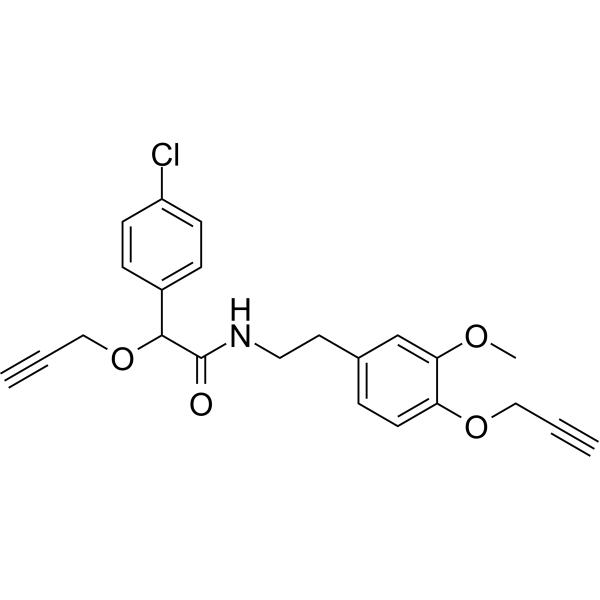
Physicochemical Properties
| Molecular Formula | C23H22NO4CL |
| Molecular Weight | 411.87808 |
| Exact Mass | 411.123 |
| CAS # | 374726-62-2 |
| PubChem CID | 11292824 |
| Appearance | Light beige powder |
| Density | 1.2±0.1 g/cm3 |
| Boiling Point | 608.6±55.0 °C at 760 mmHg |
| Melting Point | 96-97ºC |
| Flash Point | 321.9±31.5 °C |
| Vapour Pressure | 0.0±1.7 mmHg at 25°C |
| Index of Refraction | 1.575 |
| LogP | 4.16 |
| Hydrogen Bond Donor Count | 1 |
| Hydrogen Bond Acceptor Count | 4 |
| Rotatable Bond Count | 10 |
| Heavy Atom Count | 29 |
| Complexity | 599 |
| Defined Atom Stereocenter Count | 0 |
| SMILES | C#CCOC(C1C=CC(Cl)=CC=1)C(NCCC1C=CC(OCC#C)=C(OC)C=1)=O |
| InChi Key | KWLVWJPJKJMCSH-UHFFFAOYSA-N |
| InChi Code | InChI=1S/C23H22ClNO4/c1-4-14-28-20-11-6-17(16-21(20)27-3)12-13-25-23(26)22(29-15-5-2)18-7-9-19(24)10-8-18/h1-2,6-11,16,22H,12-15H2,3H3,(H,25,26) |
| Chemical Name | 2-(4-chlorophenyl)-N-[2-(3-methoxy-4-prop-2-ynoxyphenyl)ethyl]-2-prop-2-ynoxyacetamide |
| HS Tariff Code | 2934.99.9001 |
| Storage |
Powder-20°C 3 years 4°C 2 years In solvent -80°C 6 months -20°C 1 month |
| Shipping Condition | Room temperature (This product is stable at ambient temperature for a few days during ordinary shipping and time spent in Customs) |
Biological Activity
| ADME/Pharmacokinetics |
Absorption, Distribution and Excretion 3 male Alpk:APfSD (Wistar-derived) rats per group received (Methoxyphenyl-U-(14)C) NOA446510 /mandipropamide/ at 3 mg/kg/day for up to 14 days. Groups of 3 males were terminated 24 hours after 3, 7, 10, and 14 consecutive daily doses and 1, 4, 7, 14, 21, 28, and 49 days after the last of 14 consecutive daily doses. Adrenals, brain, heart, kidneys, liver, lungs, pancreas, spleen, thymus, thyroid, testes, along with samples of blood, plasma, bone (femur), fat (abdominal), and muscle were analyzed for radioactivity (LSC). Urine, feces, and cage wash were collected from 3 males 24 hours after the first dose and 24 hours after the 14th consecutive dose and analyzed for radioactivity (LSC). Tissue concentrations of radioactivity reached a steady state within 4 days of the initial dose and subsequently declined rapidly after the cessation of dosing. After 14 consecutive daily doses mean tissue (14)C concentrations were highest in liver (0.727 ug equivalents/g) and kidneys (0.234 ug equivalents/g). The elimination from liver was biphasic with terminal elimination half life calculated as 4.2 days and distribution half life calculated as 2.3 days. In kidneys, the elimination half life was 8.7 days. Bone elimination half life was 12.8 days. All other tissue concentrations at steady state were generally low (0.1 ug equivalents/g or less) with radioactivity declining below the limit of detection a few days after the last dose. The majority of radioactivity was excreted in feces (79% of dose after 1 dose and 66% after 14 consecutive doses). Urine contained 2.6% of dose after 1 dose and 7% after 14 consecutive doses. One or 4 Alpk:APfSD (Wistar-derived) rats per sex per group received a single oral gavage dose of (Chlorophenyl-U-(14)C) NOA446510 /mandipropamid/ or (Methoxyphenyl-U-(14)C) NOA446510 /mandipropamid/ at 3 and 300 mg/kg. Following dosing, exhaled carbon dioxide from 1 per sex per group (groups 2, 6, and 7) was collected in traps containing 2N sodium hydroxide solution and exhaled metabolites were collected in charcoal traps at 8 or 10 (females), 24, 36, and 48 hours. Residues in expired carbon dioxide and volatile metabolites were near or below the limit of detection at all time points for both (chlorophenyl-U-(14)C) NOA446510 and (methoxyphenyl-U-(14)C) NOA446510 radiolabels. At 3 mg/kg after 48 hours, the total radioactivity in expired air amounted to less than 0.1% of dose in males and females for (chlorophenyl-U-(14)C) NOA446510 and less than 0.2% of dose for both sexes for (methoxyphenyl-U-(14)C) NOA446510. No radioactivity (metabolites) was recovered in the charcoal traps. 48 hours after 300 mg/kg of (methoxyphenyl-U-(14)C) NOA446510, radioactivity in expired air amounted to less than 0.2% of dose in both sexes and no radioactivity was recovered in the charcoal traps. Following dosing of the excretion and tissue distribution phase animals (4 rats per sex per group in groups 3, 4, 8, and 9), urine was collected at 6 and 10 hours and urine and feces at 24, 48, 72, 96, 120, 144, and 168 hours post-treatment. The mean total percentages of radioactivity excreted in urine and feces over 168 hours were similar for the (chlorophenyl-U-(14)C) NOA446510 and methoxyphenyl-U-(14)C) NOA446510 radiolabels. The major route of excretion was feces at both dose levels, while a greater proportion of administered dose was excreted in urine at the low dose vs 300 mg/kg and for females compared to males. At 300 mg/kg, fecal excretion accounted for mean totals of 87%-91% in males and 81%-84% in females, while urinary excretion accounted for mean totals of 2.2%-3.3% for males and 6.4%-11.6% for females. At 3 mg/kg, mean totals for fecal excretion were 76%-81% in males and 42%-55% in females, and urinary excretion accounted for mean totals of 14%-15% in males and 29%-47% in females. Tissue distribution of radioactivity was similar for both radiolabels and both sexes seven days after treatment. At 3 mg/kg, radioactivity in tissues accounted for 0.06%-0.17% of dose in total and radioactivity remaining in the carcass was 0.08%-0.19% of dose. Highest radioactive concentrations were in liver (0.033-0.085 ug equivalents/g (0.05%-0.16% of dose)), kidney (0.007-0.019 ug equivalents/g (<0.01% of dose)), and thyroid (<0.010-0.030 ug equivalents/g (<0.01% of dose)). Concentrations in all other tissues were below 0.010 ug equivalents/g. At 300 mg/kg/day, radioactivity in tissues was 0.02%-0.04% of dose in total and radioactivity in residual carcass was 0.01%-0.11% of dose. Highest radioactive concentrations were also in liver (0.81-1.57 ug equivalents/g (0.01%-0.03% of dose)), kidney (0.12-0.35 ug equivalents/g (<0.01% of dose)), and thyroid (<0.17-1.20 ug equivalents/g (<0.01% of dose)). Radioactivity in whole blood and plasma was <0.08-0.24 ug equivalents/g and <0.01-0.04 ug equivalents/g respectively. Concentrations in all other tissues were below 0.10 ug equivalents/g. In the phase using bile duct cannulated rats (4 rats per sex per group in groups 10 and 11), urine was collected at 10 (females) or 12 , 24, and 48 hours after dosing, feces at 24 and 48 hours, and bile at 1, 2, 3, 4, 5, 6, 7, 8, 10 (females) or 12, 24, 36, and 48 hours post-dosing. In bile duct cannulated rats that received (methoxyphenyl-U-(14)C) NOA446510 at 3 mg/kg, the majority of administered dose was eliminated in bile (73% for males and 55% for females) after 48 hours; fecal excretion was 14% and 22% for males and females respectively; and urinary excretion was 1.4% for males and 9.5% for females. At 300 mg/kg, biliary excretion was 28% and 22% for males and females respectively; feces contained 39% (males) and 26% (females); and urine accounted for 0.8% (males) and 19% (females) of dose after 48 hours. Nine or 15 Alpk:APfSD (Wistar-derived) rats per sex per group received a single oral gavage dose of (Methoxyphenyl-U-(14)C) NOA446510 /mandipropamid/ at 3 and 300 mg/kg. In phase 1, serial blood samples were taken (tail veins) from 3 rats per sex per group at 2, 4.5, 6.5, 8-8.5, 9.5-10, 13, 18, 24, 34, 48, 72, and 96 hours after dosing at 3 mg/kg (group 1) and 300 mg/kg (group 2). Results were used to select termination times for phase 2 animals. In phase 2, three rats per sex per group were terminated 8, 24, 48, 72, and 96 hours after treatment at 3 mg/kg (group 3) and 300 mg/kg (group 4). Blood samples (separated into plasma and blood), adrenals, brain, heart, kidneys, liver, lungs, ovaries, pancreas, spleen, thymus, thyroid, testes, uterus, bone (femur), fat (abdominal), and muscle from each animal were analyzed (LSC) for radioactivity at each time point. In phase 1 , group mean peak blood radioactivity concentration times (Tmax) were 8.5 hours for males and 4.5 hours for females and half-lives of elimination of radioactivity (t1/2) were 18.4 hours (males) and 20.2 hours (females) after dosing at 3 mg/kg. At 300 mg/kg, group mean Tmax values were 24 hours (males) and 10 hours (females), while t1/2 values were 32.7 hours for males and 24.8 hours (females ). In phase 2, at both dose levels, tissue concentrations of radioactivity were slightly lower in females compared to males. Liver and kidney tissue residues were the only measurements consistently higher than plasma concentrations (plasma concentrations were 0.13 ug equivalents/g (males) and 0.10 ug equivalents/g (females) at 3 mg/kg and 5.12 ug equivalents/g (males) and 2.65 ug equivalents/g (females) at 300 mg/kg) for both sexes at both dose levels. All tissue concentrations declined to values that were low or below the the limit of detection by 96 hours post-treatment. Highest group mean concentrations of radioactivity were in liver at 8 hours: 1.25 ug equivalents/g (2.04% of dose) (males) and 0.64 ug equivalents/g (0.94% of dose) (females) at 3 mg/kg, and 46.4 ug equivalents/g (0.77% of dose) (males) and 27.1 ug equivalents/g (0.39% of dose) (females) at 300 mg/kg. Values for kidneys at 8 hours were 0.26 ug equivalents/g (0.08% of dose) for males and 0.25 ug equivalents/g (0.08% of dose) for females at 3 mg/kg, and 10.43 ug equivalents/g (0.04% of dose) for males and 6.9 ug equivalents/g (0.02% of dose) for females at 300 mg/kg. Group mean t1/2 values for liver at 3 mg/kg were: 23.6 and 23.1 hours for males and females respectively, and for kidney, were 22.2 and 21.5 hours for males and females respectively. At 300 mg/kg, group mean t1/2 values for liver were 19.1 and 17.7 hours for males and females respectively and, for kidneys, 19.5 hours (males) and 15.6 hours (females). Group mean t1/2 values for other tissues generally ranged from 18 to 24 hours (except for thymus (31.5 hours) and testes (30.0 hours) in males at 300 mg/kg). In an oral gavage study, 27 C57BL/10Jf/Alpk mice per sex per group received a single oral dose of (Methoxyphenyl-U-(14)C) NOA446510 /mandipropamid/ at 10, 50, and 500 mg/kg. In a preliminary dietary study, 55 C57BL/10Jf/Alpk mice per sex received (Methoxyphenyl-U-(14)C) NOA446510 in the diet at 800 ppm for 2 days. In the main dietary study, 28 C57BL/10Jf/Alpk mice per sex per group received (Methoxyphenyl-U-(14)C) NOA446510 in the diet at 300, 800, 2000, and 5000 ppm for 7 days. In an intravenous study, 5 C57BL/10Jf/Alpk mice per sex received a single intravenous dose of (Methoxyphenyl-U-(14)C) NOA446510 at 10 mg/kg. In the single dose oral gavage study, the majority of radioactivity was excreted within the first 24 hours after dosing with no sex differences in either route or rate. At 10 and 50 mg/kg, males excreted 29% of dose in urine at both levels and 32% (10 mg/kg) and 27% (50 mg/kg) in feces during 48 hours after treatment. Females excreted 29% and 47% of dose in urine and 21% and 24% in feces at 10 and 50 mg/kg respectively over the same time period. At 500 mg/kg, feces were the main route of excretion, accounting for 54% of dose in males and 40% in females. Radioactivity in urine represented 16% of dose in males and 11% in females. No sex differences and no dose level differences in the pharmacokinetics of plasma were indicated. At every time point and dose level, the concentration of radioactivity measured in whole blood was approximately half that measured in plasma. At 10 and 50 mg/kg, absorption was rapid with maximum plasma concentrations (Cmax) reached within 30 minutes of dosing (2 ug/mL (males) and 3 ug/mL (females) and 11 ug/mL (males) and 16 ug/mL (females) at 10 and 50 mg/kg respectively). The area under the plasma concentration vs time curve (AUC, h.ug equivalents/mL) at 50 mg/kg was approximately 5 times that at 10 mg/kg (88 vs 17 for males and 76 vs 17 for females), indicating a linear absorption increase. The absorption phase was slower at 500 mg/kg with plasma Cmax of 40 ug/mL (males) and 39 ug/mL (females) reached 6 hours (males) and 2 hours (females) after treatment. Additionally, at 500 mg/kg, AUC values were 6 fold (543 h.ug equivalents/mL) and 7 fold (535 h.ug equivalents/mL) in males and females respectively compared with the expected 10 fold differential vs 50 mg/kg. In urine, five principal metabolites were measured accounting for more than 90% of radioactivity in all samples. Metabolite 4 (NOA458422 glucuronide (the O-glucuronide of NOA458422 (2-(4-chloro-phenyl)-N- (2-(4-hydroxy-3-methoxy-phenyl)-ethyl)-2-prop-2-ynyloxy-acetamide)) was the main component and metabolite 2 (only a diagram was provided) the second, at all 3 dose levels. Unchanged NOA446510 was not present in urine. At 10 mg/kg, the metabolic profile of the 0-24 hour feces sample was similar to the urine profile and a small amount of NOA446510 was detected in males but not females. At 50 and 500 mg/kg, the major component in feces was unchanged NOA446510 in both sexes. In plasma, metabolite 4 was the major component in both sexes at all dose levels; metabolite 2 was a very minor component at 10 and 50 mg/kg; and a small amount of unchanged NOA446510 was detected at 500 mg/kg. In the 2 day dietary study at 800 ppm, Cmax in whole blood was reached at 38.5 hours (males) and 41.0 hours (females) after the start of dosing. In the 7 day dietary study, as with the oral gavage study, radioactivity was associated with the plasma compartment of blood and no sex differences were indicated and radioactivity was proportional to dose level (although specific plasma radioactivity concentration data were limited by lack of achieved dose calculations). Urinary metabolite profiles were qualitatively and quantitatively similar to those for oral gavage animals and were indicated to be independent of sex, dose level, and number of doses. Metabolite 4 was the major urinary component and no unchanged NOA446510 was detected in any samples. Fecal samples had unchanged NOA446510 in all samples. Metabolites 2 and 4 were present in all plasma samples and unchanged NOA446510 was not detected. In the single dose intravenous study (10 mg/kg), the majority of radiolabel was also excreted within 24 hours of dosing. Urine contained 58% (males) and 72% (females) of dose during 24 hours and feces had 25% (males) and 40% (females). Urinary metabolite profiles observed from the 0-24 hour and 24-48 hour post treatment collections were the same as those observed following oral gavage dosing with no qualitative sex differences. Loss of the propargyl groups and glucuronidation was suggested as the principal route of biotransformation. For more Absorption, Distribution and Excretion (Complete) data for Mandipropamid (8 total), please visit the HSDB record page. Metabolism / Metabolites Pooled samples of urine and feces from 4 rats per sex per group (Groups 3, 8, and 9 listed in table below) that received a single oral gavage dose of [Chlorophenyl-U-14C] NOA446510 at 300 mg/kg and [methoxyphenyl-U-14C] NOA446510 at 3 and 300 mg/kg were evaluated for metabolites/components. Additionally, urine, feces, and bile from 4 bile duct cannulated rats per sex per group (Groups 10 and 11) that received a single oral gavage dose of [methoxyphenyl-U- 14C] NOA446510 at 3 and 300 mg/kg were evaluated. In Report No. CTL/UR0786/REG/REPT (record 230447), pooled samples of urine and feces from 3 males were evaluated for metabolites/components 24 hours after a single oral gavage dose with 3 mg/kg of [methoxyphenyl-U-14C] NOA446510 and 24 hours after 14 consecutive doses at 3 mg/kg. All major metabolites/components, representing greater than 5% of administered dose were identified (high performance liquid chromatography (HPLC) and mass spectrometry (MS)). The proposed metabolic pathway was described: loss of one or both of the propargyl groups followed by glucuronidation and O-demethylation (a schematic was included). Differences in metabolism of the two radiolabeled species were not indicated. Metabolic profiles of excreta following administration of both the chlorophenyl and methoxyphenyl radiolabeled forms at the high dose level (300 mg/kg) were qualitatively and quantitatively similar. Single Dose of 3 mg/kg [Methoxyphenyl-U-14C] NOA446510 Females excreted 46% of the dose in urine and 41% in feces during 96 hours. The major urinary metabolite (40% of dose) was NOA458422 glucuronide (the O-glucuronide of NOA458422 (2-(4-chloro-phenyl)-N-[2-(4-hydroxy-3-methoxy-phenyl)-ethyl]- 2-prop-2-ynyloxy-acetamide)). In feces, NOA446510 was 12% of dose and NOA458422 was 19%. Males excreted 14% of dose in urine and 72.3% in feces during 96 hours. The major urinary metabolite (10% of dose) was SYN534133 (the glucuronide of CGA 380775 (2-4(chlorophenyl)- 2-hudroxy-N-[2-(4-hudroxy-3-methoxy-phenyl)-ethyl]acetamide)). In feces NOA458422, parent, and NOA458422 glucuronide accounted for 29.2%, 21.3%, and 12.9% of dose respectively. 14 Consecutive Daily Doses in Males at 3 mg/kg [Methoxyphenyl-U-14C] NOA446510 Component profiles of excreta were similar between samples taken 24 hours after the first and 14 doses and consistent with results in the single dose study above. Single Dose of 300 mg/kg [Chlorophenyl-U-14C] NOA446510 Females excreted 6% of dose in urine and 81% of dose in feces during 96 hours. NOA458422 glucuronide was the major urinary metabolite (3.7% of dose). NOA446510 accounted for 75% of dose in feces of females. Males excreted 2% of dose in urine and 86% of dose in feces during 96 hours. SYN534133, at 1% of dose, was the major urinary metabolite. NOA446510 accounted for 79% of dose in feces. Single Dose of 300 mg/kg [Methoxyphenyl-U-14C] NOA446510 Females excreted 11% of dose in urine and 82% of dose in feces during 96 hours. NOA458422 glucuronide (7% of dose) and NOA446510 (71% of dose) were the major components in urine and feces respectively. Males had 3% of dose in urine and 90% of dose in feces during 96 hours. SYN534133, accounting for 2% of dose, and NOA446510 (73% of dose) were the major components in urine and feces respectively. Single Dose of 3 mg/kg [Methoxyphenyl-U-14C] NOA446510 with Bile Duct Cannulated Rats During 48 hours, females excreted 15% of dose in urine, 46% of dose in bile, and 22% of dose in feces. The major component in urine and bile was NOA458422 glucuronide at 10% and 41% of dose respectively. NOA446510 was the major component in feces (22.3% of dose). Males excreted 1%, 73%, and 15% of dose in urine, bile, and feces respectively during 48 hours. NOA458422 glucuronide was the major component in urine (0.7% of dose) and bile (62.2% of dose). NOA446510 accounted for 13% of dose in feces. Single Dose of 300 mg/kg [Methoxyphenyl-U- 14C] NOA446510 with Bile Duct Cannulated Rats 28%, 12%, and 37% of administered radioactivity was excreted by females in urine, bile, and feces respectively during 48 hours. NOA458422 glucuronide was the major component in urine (25% of dose) and bile (10% of dose). NOA446510 accounted for 37% of dose in feces. Males excreted 1% of dose in urine, 28% in bile, and 39% in feces during 48 hours. NOA458422 glucuronide was the major component in urine (0.5% of dose) and bile (22.5% of dose). NOA446510 was 38.6% of dose in feces of males. In an oral gavage study, 27 C57BL/10Jf/Alpk mice per sex per group received a single oral dose of (Methoxyphenyl-U-(14)C) NOA446510 /mandipropamid/ at 10, 50, and 500 mg/kg. In a preliminary dietary study, 55 C57BL/10Jf/Alpk mice per sex received (Methoxyphenyl-U-(14)C) NOA446510 in the diet at 800 ppm for 2 days. In the main dietary study, 28 C57BL/10Jf/Alpk mice per sex per group received (Methoxyphenyl-U-(14)C) NOA446510 in the diet at 300, 800, 2000, and 5000 ppm for 7 days. In an intravenous study, 5 C57BL/10Jf/Alpk mice per sex received a single intravenous dose of (Methoxyphenyl-U-(14)C) NOA446510 at 10 mg/kg. ... In urine, five principal metabolites were measured accounting for more than 90% of radioactivity in all samples. Metabolite 4 (NOA458422 glucuronide (the O-glucuronide of NOA458422 (2-(4-chloro-phenyl)-N- (2-(4-hydroxy-3-methoxy-phenyl)-ethyl)-2-prop-2-ynyloxy-acetamide)) was the main component and metabolite 2 (only a diagram was provided) the second, at all 3 dose levels. Unchanged NOA446510 was not present in urine. At 10 mg/kg, the metabolic profile of the 0-24 hour feces sample was similar to the urine profile and a small amount of NOA446510 was detected in males but not females. At 50 and 500 mg/kg, the major component in feces was unchanged NOA446510 in both sexes. In plasma, metabolite 4 was the major component in both sexes at all dose levels; metabolite 2 was a very minor component at 10 and 50 mg/kg; and a small amount of unchanged NOA446510 was detected at 500 mg/kg. In the 2 day dietary study at 800 ppm, Cmax in whole blood was reached at 38.5 hours (males) and 41.0 hours (females) after the start of dosing. In the 7 day dietary study, as with the oral gavage study, radioactivity was associated with the plasma compartment of blood and no sex differences were indicated and radioactivity was proportional to dose level (although specific plasma radioactivity concentration data were limited by lack of achieved dose calculations). Urinary metabolite profiles were qualitatively and quantitatively similar to those for oral gavage animals and were indicated to be independent of sex, dose level, and number of doses. Metabolite 4 was the major urinary component and no unchanged NOA446510 was detected in any samples. Fecal samples had unchanged NOA446510 in all samples. Metabolites 2 and 4 were present in all plasma samples and unchanged NOA446510 was not detected. In the single dose intravenous study (10 mg/kg), the majority of radiolabel was also excreted within 24 hours of dosing. Urine contained 58% (males) and 72% (females) of dose during 24 hours and feces had 25% (males) and 40% (females). Urinary metabolite profiles observed from the 0-24 hour and 24-48 hour post treatment collections were the same as those observed following oral gavage dosing with no qualitative sex differences. Loss of the propargyl groups and glucuronidation was suggested as the principal route of biotransformation. In phase 1, three Alpk:APfSD (Wistar-derived) rats per sex per group (groups 1, 2, and 3) received unlabeled NOA446510 (/mandipropamid/ 96.5%) in the diet at 100, 500, and 5000 ppm for 11 consecutive days followed by radiolabeled diet at the corresponding levels on day 12. Additionally, in phase 1, three rats per sex per group (groups 4, 5, and 6) received unlabeled NOA446510 by oral gavage for 11 consecutive days at 10, 50, and 500 mg/kg/day followed by a single oral dose of (Methoxyphenyl-U-(14)C) NOA446510 on day 12 at the same levels. In phase 2, six rats per sex per group (groups 7, 8, and 9) received unlabeled NOA446510 in the diet for 11 consecutive days followed (14)C NOA446510 containing diets on the 12th day. ... Metabolites were identified (high performance liquid chromatography-mass spectrometry (HPLC-MS)) in urine and plasma. The urinary metabolite profile differed for males and females mainly due to the major metabolite found in female urine NOA458422 glucuronide (formed by glucuronidation of NOA446510 after loss of one of the propargyl groups) which was present in only negligible amounts (if at all) in male samples (may indicate a difference in the route and mechanism of clearance). All other male and female urinary metabolites were present in similar proportions. Plasma profiles were the same for males and females. The majority of metabolites were glucuronides. See study for proposed structures, diagrams, descriptions, mass spectra, HPLC chromatograms, etc. of metabolites/components. SYN 534133 (a glucuronide of NOA446510 after loss of both propargyl groups), present at similar concentrations in urine of both males and females, was the major metabolite in male samples. NOA458422 glucuronide was the major metabolite in both male and female plasma. Phase 2 Area under the plasma concentration vs time exposure curve values (AUC0-48(ug.h.g-1)) increased linearly with dietary dose level similarly for both sexes over 48 hours (9.5, 31.9, and 344.0 ug.h.g-1 for males and 8.0, 34.9, and 328.9 ug.h.g-1 for females at 100, 500, and 5000 ppm respectively). In phase 1, one Alderley Park Beagle dog per sex per group received a single oral (gelatin capsule) dose of (Chlorophenyl-U-(14)C) NOA446510 /mandipropamid/ at 100 and 800 mg/kg on days 1 and 15. The same animals also received unlabeled NOA446510 on days 5 through 14 at 100 and 800 mg/kg/day. In phase 2, one dog per sex per group received a single intravenous dose of (14)C NOA446510 at 3 mg/kg on day 1 and a subsequent single radiolabeled oral dose at 3 mg/kg on day 15. Following each radiolabeled dose, animals were placed into metabolism cages and urine and feces were collected (at room temperature) 6, 12, 24, 36, 48, and 72 hours after dosing. In phase 1, blood samples (5 mL) were collected at 1, 2, 3, 4, 6, 8, 12, 24, 36, 48, and 72 hours on day 1 after dosing, and at 1, 2, 3, 4, 5, 6, 7, 8, 10, 12, and 24 hours on day 15. In phase 2, blood sampling times on day 1 were 2, 5, 10, 20, and 30 minutes and 1, 2, 3, 4, 6, 12, and 24 hours post-treatment, and, on day 15, blood was sampled 1, 2, 3, 4, 5, 6, 7, 8, 10, 12, and 24 hours after dosing. Phase 1 In phase 1, after a single oral radiolabeled dose (gelatin capsule) at 100 mg/kg, 7% of dose for the male and 22% for the female respectively was excreted in urine over 72 hours. Feces contained 95% (male) and 63% (female) of dose over 72 hours. Maximum plasma concentrations (Cmax), 6.7 and 4.6 ug equivalents/g, were reached 4 and 8 hours after dosing (Tmax) for the male and female respectively. The area under the plasma concentration vs time exposure curve values (AUC0-24 (h.ug/g)) were 67 and 51 for the male and female respectively. Unchanged NOA446510 represented 73% (male) and 54% (female) of dose in feces (three other minor metabolites were found in feces). Six hour urine samples contained 5 major metabolites (no unchanged NOA446510 was found). Male and female pooled plasma contained unchanged NOA446510 and 5 other metabolites. ... After a single dose at 800 mg/kg, 4% of radioactive dose was excreted in urine of both sexes and 71% (male) and 18% (female) of dose was found in feces over 72 hours. Plasma Cmax concentrations were 25.0 and 17.5 ug equivalents/g reached at Tmax times of 6 and 10 hours after treatment for the male and female respectively. The resulting total exposure/time (AUC0-24) values were 98 h.ug/g (male) and 152 h.ug/g (female). In feces, the majority of recovered dose was unchanged NOA446510, 67% (male) and 12% (female). 5 major metabolites (4 were the same as at the100 mg/kg single dose) were found in the 6 hour urine samples (no unchanged NOA446510). Unchanged NOA446510 and 3 of the metabolites found in the 100 mg/kg single dose samples were identified in the 0-48 hour male and female plasma pools. Following the repeat (14)C NOA446510 dose at 100 mg/kg, 6% and 5% of dose was excreted in urine by the male and female dog respectively with 77% (male) and 79% (female) in feces over 72 hours. Cmax values of 6.0 and 4.3 ug equivalents/g were reached 4 and 10 hours after dosing (Tmax) in the male and female respectively, resulting in (AUC0-24) values of 72 and 48 h.ug/g respectively. Unchanged NOA446510 was identified as the major component in feces, 59% (males) and 70% females (3 minor metabolites were also found in feces). 6 hour urine samples contained the same 5 metabolites as the single dose 100 mg/kg plus 2 others and no unchanged NOA446510. The male and female plasma pool contained unchanged NOA446510, the same 3 metabolites found in the single dose 800 mg/kg samples, and an unidentified minor species. After the repeat oral 800 mg/kg radiolabeled dose, 3% (male) and 4% (female) of dose was found in urine, and feces contained 91% (male) and 94% (female) of dose during 72 hours. Cmax concentrations were 49.7 and 28.6 ug equivalents/g at 6 hours after treatment (Tmax for both sexes). AUC0-24 values for total exposure/time were 379 h.ug/g (male) and 410 h.ug/g (female). Unchanged NOA446510 accounted for 52% (male) and 93% (female) of dose in feces. Six hour urine samples contained the same 5 metabolites as the 800 mg/kg single dose group. 0-48 hour plasma samples contained NOA446510 and the same 3 metabolites as in the single dose 800 mg/kg samples (a fourth metabolite was also identified in female plasma). Phase 2 The male dog excreted 24% of dose and the female 31% in urine during 72 hours after the single intravenous radiolabeled 3 mg/kg dose with 45% (male) and 47% (female) of dose in feces. Major urinary metabolites were identified as the same 5 found in the single dose oral 100 mg/kg group samples in phase 1, plus one other. In male 0-24 hour plasma pools, unchanged NOA446510 and 5 of the metabolites identified in the phase one, 100 mg/kg single oral dose samples, plus one other, were detected. After the single radiolabeled oral dose (gelatin capsule) at 3 mg/kg on day 15, urine contained 14% (male) and 21% (female) of dose, and feces contained, 72% (male) and 66% (female) of dose during 72 hours. Major urinary metabolites for each sex were identified as the same 5 detected in the phase 1, single oral 100 mg/kg dose samples (female samples also contained a 6th species). In male and female 0-24 hour plasma pools, 2 of the 3 metabolites found in the phase 1 single oral dose 800 mg/kg samples plus one other were identified (other species were detected but at levels too low to identify). The proposed metabolic pathway was presented: loss of one or both propargyl groups followed by conjugation with glucuronic or sulphuric acid and O-demethylation with no cleavage of the molecule. Biological Half-Life 3 male Alpk:APfSD (Wistar-derived) rats per group received (Methoxyphenyl-U-(14)C) NOA446510 /mandipropamide/ at 3 mg/kg/day for up to 14 days. Groups of 3 males were terminated 24 hours after 3, 7, 10, and 14 consecutive daily doses and 1, 4, 7, 14, 21, 28, and 49 days after the last of 14 consecutive daily doses. ... The elimination from liver was biphasic with terminal elimination half life calculated as 4.2 days and distribution half life calculated as 2.3 days. In kidneys, the elimination half life was 8.7 days. Bone elimination half life was 12.8 days. ... Nine or 15 Alpk:APfSD (Wistar-derived) rats per sex per group received a single oral gavage dose of (Methoxyphenyl-U-(14)C) NOA446510 /mandipropamid/ at 3 and 300 mg/kg. In phase 1, serial blood samples were taken (tail veins) from 3 rats per sex per group at 2, 4.5, 6.5, 8-8.5, 9.5-10, 13, 18, 24, 34, 48, 72, and 96 hours after dosing at 3 mg/kg (group 1) and 300 mg/kg (group 2). Results were used to select termination times for phase 2 animals. In phase 2, three rats per sex per group were terminated 8, 24, 48, 72, and 96 hours after treatment at 3 mg/kg (group 3) and 300 mg/kg (group 4). Blood samples (separated into plasma and blood), adrenals, brain, heart, kidneys, liver, lungs, ovaries, pancreas, spleen, thymus, thyroid, testes, uterus, bone (femur), fat (abdominal), and muscle from each animal were analyzed (LSC) for radioactivity at each time point. In phase 1 , group mean peak blood radioactivity concentration times (Tmax) were 8.5 hours for males and 4.5 hours for females and half-lives of elimination of radioactivity (t1/2) were 18.4 hours (males) and 20.2 hours (females) after dosing at 3 mg/kg. At 300 mg/kg, group mean Tmax values were 24 hours (males) and 10 hours (females), while t1/2 values were 32.7 hours for males and 24.8 hours (females). In phase 2, ... group mean half life values for liver at 3 mg/kg were: 23.6 and 23.1 hours for males and females respectively, and for kidney, were 22.2 and 21.5 hours for males and females respectively. At 300 mg/kg, group mean half life values for liver were 19.1 and 17.7 hours for males and females respectively and, for kidneys, 19.5 hours (males) and 15.6 hours (females). Group mean half life values for other tissues generally ranged from 18 to 24 hours (except for thymus (31.5 hours) and testes (30.0 hours) in males at 300 mg/kg). |
| Toxicity/Toxicokinetics |
Non-Human Toxicity Values LC50 Rat inhalation > 5.19 +/- 0.55 mg/L/4 hr LD50 Rat dermal > 5,050 mg/kg LD50 Rat oral >5,000 mg/kg |
| Additional Infomation |
2-(4-chlorophenyl)-N-{2-[3-methoxy-4-(prop-2-yn-1-yloxy)phenyl]ethyl}-2-(prop-2-yn-1-yloxy)acetamide is a monocarboxylic acid amide resulting from the condensation of the carboxy group of p-chloromandelic acid propargyl ether with the amino group of 2-[3-methoxy-4-(prop-2-yn-1-yloxy)phenyl]ethylamine. It is a monocarboxylic acid amide, a terminal acetylenic compound, an aromatic ether and a member of monochlorobenzenes. Mechanism of Action ... This study /describes/ ... the molecular mechanism of resistance to a carboxylic acid amide (CAA) fungicide. ... A family of four cellulose synthase (CesA) genes containing conserved domains ... are found in all processive glycosyltransferases. Phylogenetic analysis revealed their close relationship to the cellulose synthases of Phytophthora sp. /a target species for mandipropamid/. Sequencing of the CesA genes in a CAA- resistant and -sensitive field isolate revealed five single nucleotide polymorphisms (SNPs) affecting the amino acid structure of the proteins. SNP inheritance in F(1)-, F(2)- and F(3)-progeny confirmed resistance to be correlated with one single SNP located in PvCesA3. Only if present in both alleles, this SNP led to the substitution of a glycine for a serine residue at position 1105 (G1105S) in the deduced amino acid sequence, thus conferring CAA- resistance. Our data demonstrate that the identified genes are putative cellulose synthases and that one recessive mutation in PvCesA3 causes inheritable resistance to the CAA fungicide mandipropamid. ... Mandipropamid (MPD) is a carboxylic acid amide (CAA) effective against downy mildews, such as Plasmopara viticola on grapes and potato late blight caused by Phytophthora infestans. ... Here, ... a combination of biochemical and genetic techniques has been utilized to identify the molecular target of MPD in P. infestans. Phytophthora infestans germinating cysts treated with MPD produced swelling symptoms typical of cell wall synthesis inhibitors, and these effects were reversible after washing with H(2)O. Uptake studies with (14)C-labelled MPD showed that this oomycete control agent acts on the cell wall and does not enter the cell. Furthermore, (14)C glucose incorporation into cellulose was perturbed in the presence of MPD which, taken together, suggests that the inhibition of cellulose synthesis is the primary effect of MPD. Laboratory mutants, insensitive to MPD, were raised by ethyl methane sulfonate (EMS) mutagenesis, and gene sequence analysis of cellulose synthase genes in these mutants revealed two point mutations in the PiCesA3 gene, known to be involved in cellulose synthesis. Both mutations in the PiCesA3 gene result in a change to the same amino acid (glycine-1105) in the protein. The transformation and expression of a mutated PiCesA3 allele was carried out in a sensitive wild-type isolate to demonstrate that the mutations in PiCesA3 were responsible for the MPD insensitivity phenotype. |
Solubility Data
| Solubility (In Vitro) | May dissolve in DMSO (in most cases), if not, try other solvents such as H2O, Ethanol, or DMF with a minute amount of products to avoid loss of samples |
| Solubility (In Vivo) |
Note: Listed below are some common formulations that may be used to formulate products with low water solubility (e.g. < 1 mg/mL), you may test these formulations using a minute amount of products to avoid loss of samples. Injection Formulations (e.g. IP/IV/IM/SC) Injection Formulation 1: DMSO : Tween 80: Saline = 10 : 5 : 85 (i.e. 100 μL DMSO stock solution → 50 μL Tween 80 → 850 μL Saline) *Preparation of saline: Dissolve 0.9 g of sodium chloride in 100 mL ddH ₂ O to obtain a clear solution. Injection Formulation 2: DMSO : PEG300 :Tween 80 : Saline = 10 : 40 : 5 : 45 (i.e. 100 μL DMSO → 400 μLPEG300 → 50 μL Tween 80 → 450 μL Saline) Injection Formulation 3: DMSO : Corn oil = 10 : 90 (i.e. 100 μL DMSO → 900 μL Corn oil) Example: Take the Injection Formulation 3 (DMSO : Corn oil = 10 : 90) as an example, if 1 mL of 2.5 mg/mL working solution is to be prepared, you can take 100 μL 25 mg/mL DMSO stock solution and add to 900 μL corn oil, mix well to obtain a clear or suspension solution (2.5 mg/mL, ready for use in animals). Injection Formulation 4: DMSO : 20% SBE-β-CD in saline = 10 : 90 [i.e. 100 μL DMSO → 900 μL (20% SBE-β-CD in saline)] *Preparation of 20% SBE-β-CD in Saline (4°C,1 week): Dissolve 2 g SBE-β-CD in 10 mL saline to obtain a clear solution. Injection Formulation 5: 2-Hydroxypropyl-β-cyclodextrin : Saline = 50 : 50 (i.e. 500 μL 2-Hydroxypropyl-β-cyclodextrin → 500 μL Saline) Injection Formulation 6: DMSO : PEG300 : castor oil : Saline = 5 : 10 : 20 : 65 (i.e. 50 μL DMSO → 100 μLPEG300 → 200 μL castor oil → 650 μL Saline) Injection Formulation 7: Ethanol : Cremophor : Saline = 10: 10 : 80 (i.e. 100 μL Ethanol → 100 μL Cremophor → 800 μL Saline) Injection Formulation 8: Dissolve in Cremophor/Ethanol (50 : 50), then diluted by Saline Injection Formulation 9: EtOH : Corn oil = 10 : 90 (i.e. 100 μL EtOH → 900 μL Corn oil) Injection Formulation 10: EtOH : PEG300:Tween 80 : Saline = 10 : 40 : 5 : 45 (i.e. 100 μL EtOH → 400 μLPEG300 → 50 μL Tween 80 → 450 μL Saline) Oral Formulations Oral Formulation 1: Suspend in 0.5% CMC Na (carboxymethylcellulose sodium) Oral Formulation 2: Suspend in 0.5% Carboxymethyl cellulose Example: Take the Oral Formulation 1 (Suspend in 0.5% CMC Na) as an example, if 100 mL of 2.5 mg/mL working solution is to be prepared, you can first prepare 0.5% CMC Na solution by measuring 0.5 g CMC Na and dissolve it in 100 mL ddH2O to obtain a clear solution; then add 250 mg of the product to 100 mL 0.5% CMC Na solution, to make the suspension solution (2.5 mg/mL, ready for use in animals). Oral Formulation 3: Dissolved in PEG400 Oral Formulation 4: Suspend in 0.2% Carboxymethyl cellulose Oral Formulation 5: Dissolve in 0.25% Tween 80 and 0.5% Carboxymethyl cellulose Oral Formulation 6: Mixing with food powders Note: Please be aware that the above formulations are for reference only. InvivoChem strongly recommends customers to read literature methods/protocols carefully before determining which formulation you should use for in vivo studies, as different compounds have different solubility properties and have to be formulated differently. (Please use freshly prepared in vivo formulations for optimal results.) |
| Preparing Stock Solutions | 1 mg | 5 mg | 10 mg | |
| 1 mM | 2.4279 mL | 12.1395 mL | 24.2789 mL | |
| 5 mM | 0.4856 mL | 2.4279 mL | 4.8558 mL | |
| 10 mM | 0.2428 mL | 1.2139 mL | 2.4279 mL |