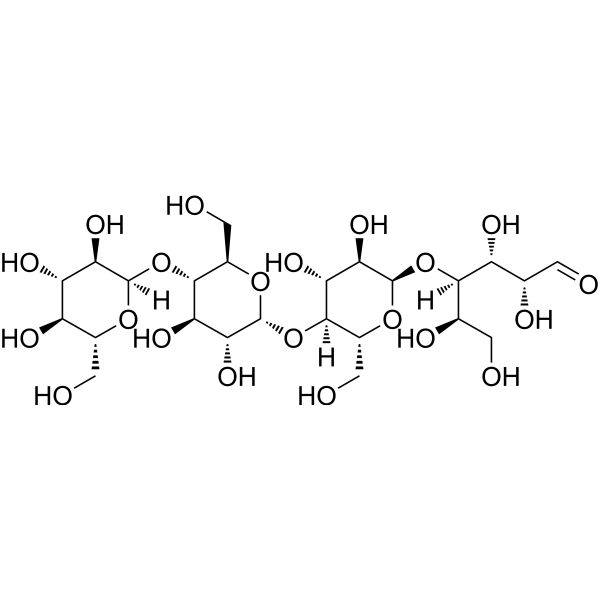
Physicochemical Properties
| Molecular Formula | C24H42O21 |
| Molecular Weight | 666.5777 |
| Exact Mass | 666.221 |
| CAS # | 34612-38-9 |
| PubChem CID | 439639 |
| Appearance | White to off-white solid powder |
| Density | 1.8±0.1 g/cm3 |
| Boiling Point | 1030.9±65.0 °C at 760 mmHg |
| Flash Point | 577.3±34.3 °C |
| Vapour Pressure | 0.0±0.6 mmHg at 25°C |
| Index of Refraction | 1.687 |
| LogP | -5.83 |
| Hydrogen Bond Donor Count | 14 |
| Hydrogen Bond Acceptor Count | 21 |
| Rotatable Bond Count | 10 |
| Heavy Atom Count | 45 |
| Complexity | 918 |
| Defined Atom Stereocenter Count | 19 |
| SMILES | C([C@@H]1[C@H]([C@@H]([C@H]([C@H](O1)O[C@@H]2[C@H](O[C@@H]([C@@H]([C@H]2O)O)O[C@@H]3[C@H](O[C@@H]([C@@H]([C@H]3O)O)O[C@@H]4[C@H](OC([C@@H]([C@H]4O)O)O)CO)CO)CO)O)O)O)O |
| InChi Key | LUEWUZLMQUOBSB-AYQJAVFRSA-N |
| InChi Code | InChI=1S/C24H42O21/c25-1-5-9(29)10(30)15(35)22(40-5)44-19-7(3-27)42-24(17(37)12(19)32)45-20-8(4-28)41-23(16(36)13(20)33)43-18-6(2-26)39-21(38)14(34)11(18)31/h5-38H,1-4H2/t5-,6-,7-,8-,9-,10+,11-,12-,13-,14-,15-,16-,17-,18-,19-,20-,21?,22-,23-,24-/m1/s1 |
| Chemical Name | (2R,3R,4S,5S,6R)-2-[(2R,3S,4R,5R,6R)-6-[(2R,3S,4R,5R,6R)-4,5-dihydroxy-2-(hydroxymethyl)-6-[(2R,3S,4R,5R)-4,5,6-trihydroxy-2-(hydroxymethyl)oxan-3-yl]oxyoxan-3-yl]oxy-4,5-dihydroxy-2-(hydroxymethyl)oxan-3-yl]oxy-6-(hydroxymethyl)oxane-3,4,5-triol |
| HS Tariff Code | 2934.99.9001 |
| Storage |
Powder-20°C 3 years 4°C 2 years In solvent -80°C 6 months -20°C 1 month Note: This product requires protection from light (avoid light exposure) during transportation and storage. |
| Shipping Condition | Room temperature (This product is stable at ambient temperature for a few days during ordinary shipping and time spent in Customs) |
Biological Activity
| Targets | Amylase [1] |
| ln Vitro |
- Maltotetraose serves as a specific substrate for amylase in vitro. It is hydrolyzed by amylase (from serum or urine) into smaller maltose units, which are further converted in the enzyme-coupled reaction system to generate a measurable signal [1] - The enzyme-coupled assay using Maltotetraose showed a linear relationship between amylase activity and the measured signal over a wide range (0-1000 U/L for serum amylase, 0-2000 U/L for urine amylase) [1] - The assay with Maltotetraose correlated well with the reference method (iodometric assay) for amylase activity determination, with a correlation coefficient (r) of 0.98 for serum and 0.97 for urine [1] - Maltotetraose is not hydrolyzed by non-amylase glycosidases present in serum or urine, ensuring the specificity of the amylase activity assay [1] |
| Enzyme Assay |
- Amylase activity assay (enzyme-coupled method): The reaction mixture contained Maltotetraose (final concentration 5 mM), auxiliary enzymes (maltase, glucose oxidase, peroxidase), and colorimetric substrate. Serum or urine samples (10 μL) were added to the reaction mixture to initiate the reaction [1] - The reaction was incubated at 37°C for 15 minutes. Amylase in the sample hydrolyzed Maltotetraose to maltose, which was further hydrolyzed by maltase to glucose. Glucose was oxidized by glucose oxidase to produce hydrogen peroxide, which reacted with the colorimetric substrate in the presence of peroxidase to form a colored product [1] - The absorbance of the colored product was measured at 405 nm using a spectrophotometer. Amylase activity was calculated based on a calibration curve constructed with standard amylase solutions [1] - For specificity verification, the assay was performed with samples spiked with non-amylase glycosidases, and no significant interference was observed [1] |
| References |
[1]. Maltotetraose as a substrate for enzyme-coupled assay of amylase activity in serum and urine. Clin Chem. 1979 Mar;25(3):481-3. |
| Additional Infomation |
Alpha-D-Glcp-(1->4)-alpha-D-Glcp-(1->4)-alpha-D-Glcp-(1->4)-D-Glcp is a maltotetraose tetrasaccharide consisting of three alpha-D-glucopyranose residues and a D-glucopyranose residue joined in sequence by (1->4) glycosidic bonds. Maltotetraose is a metabolite found in or produced by Escherichia coli (strain K12, MG1655). Amylotetraose has been reported in Streptomyces with data available. - Maltotetraose is a tetrasaccharide composed of four glucose units linked by α-1,4 glycosidic bonds [1] - Its key characteristic as a substrate for amylase assay lies in its high specificity for amylase and suitability for enzyme-coupled reactions, enabling rapid and accurate determination of amylase activity in clinical samples (serum and urine) [1] - The assay based on Maltotetraose offers advantages such as simplicity, short incubation time, and freedom from interference by other carbohydrates or enzymes, making it suitable for routine clinical laboratory use [1] |
Solubility Data
| Solubility (In Vitro) | H2O : ~125 mg/mL (~187.52 mM) |
| Solubility (In Vivo) |
Solubility in Formulation 1: 100 mg/mL (150.02 mM) in PBS (add these co-solvents sequentially from left to right, and one by one), clear solution; with sonication. (Please use freshly prepared in vivo formulations for optimal results.) |
| Preparing Stock Solutions | 1 mg | 5 mg | 10 mg | |
| 1 mM | 1.5002 mL | 7.5010 mL | 15.0020 mL | |
| 5 mM | 0.3000 mL | 1.5002 mL | 3.0004 mL | |
| 10 mM | 0.1500 mL | 0.7501 mL | 1.5002 mL |