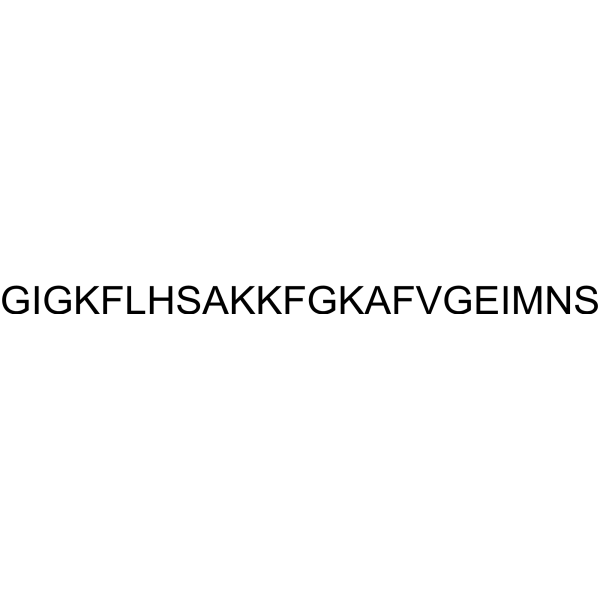
Physicochemical Properties
| Molecular Formula | C114H180N30O29S |
| Molecular Weight | 2466.8976 |
| Exact Mass | 2465.33 |
| CAS # | 108433-95-0 |
| PubChem CID | 16130189 |
| Appearance | White to off-white solid powder |
| LogP | 4.913 |
| Hydrogen Bond Donor Count | 33 |
| Hydrogen Bond Acceptor Count | 36 |
| Rotatable Bond Count | 86 |
| Heavy Atom Count | 174 |
| Complexity | 5180 |
| Defined Atom Stereocenter Count | 21 |
| SMILES | CC[C@H](C)[C@@H](C(=O)NCC(=O)N[C@@H](CCCCN)C(=O)N[C@@H](CC1=CC=CC=C1)C(=O)N[C@@H](CC(C)C)C(=O)N[C@@H](CC2=CN=CN2)C(=O)N[C@@H](CO)C(=O)N[C@@H](C)C(=O)N[C@@H](CCCCN)C(=O)N[C@@H](CCCCN)C(=O)N[C@@H](CC3=CC=CC=C3)C(=O)NCC(=O)N[C@@H](CCCCN)C(=O)N[C@@H](C)C(=O)N[C@@H](CC4=CC=CC=C4)C(=O)N[C@@H](C(C)C)C(=O)NCC(=O)N[C@@H](CCC(=O)O)C(=O)N[C@@H]([C@@H](C)CC)C(=O)N[C@@H](CCSC)C(=O)N[C@@H](CC(=O)N)C(=O)N[C@@H](CO)C(=O)O)NC(=O)CN |
| InChi Key | MGIUUAHJVPPFEV-ABXDCCGRSA-N |
| InChi Code | InChI=1S/C114H180N30O29S/c1-12-65(7)94(142-88(148)55-119)112(170)124-59-90(150)129-74(38-24-28-45-116)100(158)137-81(51-70-33-19-15-20-34-70)106(164)135-79(49-63(3)4)105(163)138-83(53-72-56-121-62-125-72)107(165)140-85(60-145)110(168)127-67(9)96(154)131-75(39-25-29-46-117)101(159)132-76(40-26-30-47-118)102(160)136-80(50-69-31-17-14-18-32-69)98(156)122-57-89(149)128-73(37-23-27-44-115)99(157)126-68(10)97(155)134-82(52-71-35-21-16-22-36-71)109(167)143-93(64(5)6)111(169)123-58-91(151)130-77(41-42-92(152)153)104(162)144-95(66(8)13-2)113(171)133-78(43-48-174-11)103(161)139-84(54-87(120)147)108(166)141-86(61-146)114(172)173/h14-22,31-36,56,62-68,73-86,93-95,145-146H,12-13,23-30,37-55,57-61,115-119H2,1-11H3,(H2,120,147)(H,121,125)(H,122,156)(H,123,169)(H,124,170)(H,126,157)(H,127,168)(H,128,149)(H,129,150)(H,130,151)(H,131,154)(H,132,159)(H,133,171)(H,134,155)(H,135,164)(H,136,160)(H,137,158)(H,138,163)(H,139,161)(H,140,165)(H,141,166)(H,142,148)(H,143,167)(H,144,162)(H,152,153)(H,172,173)/t65-,66-,67-,68-,73-,74-,75-,76-,77-,78-,79-,80-,81-,82-,83-,84-,85-,86-,93-,94-,95-/m0/s1 |
| Chemical Name | (4S)-4-[[2-[[(2S)-2-[[(2S)-2-[[(2S)-2-[[(2S)-6-amino-2-[[2-[[(2S)-2-[[(2S)-6-amino-2-[[(2S)-6-amino-2-[[(2S)-2-[[(2S)-2-[[(2S)-2-[[(2S)-2-[[(2S)-2-[[(2S)-6-amino-2-[[2-[[(2S,3S)-2-[(2-aminoacetyl)amino]-3-methylpentanoyl]amino]acetyl]amino]hexanoyl]amino]-3-phenylpropanoyl]amino]-4-methylpentanoyl]amino]-3-(1H-imidazol-5-yl)propanoyl]amino]-3-hydroxypropanoyl]amino]propanoyl]amino]hexanoyl]amino]hexanoyl]amino]-3-phenylpropanoyl]amino]acetyl]amino]hexanoyl]amino]propanoyl]amino]-3-phenylpropanoyl]amino]-3-methylbutanoyl]amino]acetyl]amino]-5-[[(2S,3S)-1-[[(2S)-1-[[(2S)-4-amino-1-[[(1S)-1-carboxy-2-hydroxyethyl]amino]-1,4-dioxobutan-2-yl]amino]-4-methylsulfanyl-1-oxobutan-2-yl]amino]-3-methyl-1-oxopentan-2-yl]amino]-5-oxopentanoic acid |
| HS Tariff Code | 2934.99.9001 |
| Storage |
Powder-20°C 3 years 4°C 2 years In solvent -80°C 6 months -20°C 1 month Note: Please store this product in a sealed and protected environment (e.g. under nitrogen), avoid exposure to moisture and light. |
| Shipping Condition | Room temperature (This product is stable at ambient temperature for a few days during ordinary shipping and time spent in Customs) |
Biological Activity
| ln Vitro | Magainin 2 causes morphological alterations during early apoptosis in E. coli and demonstrates bactericidal effects. coli. RecA's expression as a caspase-like protein is influenced by Magainin 2, which also causes the expression of bacterial proteins that have an affinity for caspase substrates [1]. By permeabilizing cell membranes, magainin 2 kills bacteria without posing a serious threat to mammalian cells. It is believed that the lipid matrix of the membrane is the primary target of the peptide. When natural Paramecium caudatum was exposed to 10 μg/mL magainin 2, it caused osmotic swelling and eventual cell rupture in the pond water. This suggests that the peptide may interfere with the membrane function that maintains osmotic balance [2]. Magainin 2 permeabilizes cell membranes in mammals and bacteria in distinctly different ways. In Bacillus megaterium, the peptide produces holes with a diameter of around 2.8 nm (less than 6.6 nm) and translocates into the cytoplasm. The CHO-K1 cell membrane, on the other hand, is severely disrupted by this peptide, allowing big molecules (greater than 23 nm) to enter the cytoplasm along with membrane budding and lipid flipping, which mostly causes the molecules to accumulate in the nucleus and mitochondria [3]. |
| References |
[1]. Magainins, a class of antimicrobial peptides from Xenopus skin: isolation, characterization of two active forms, and partial cDNA sequence of a precursor. Proc Natl Acad Sci U S A. 1987 Aug;84(15):5449-53. [2]. Magainins as paradigm for the mode of action of pore forming polypeptides. Biochim Biophys Acta. 1998 Nov 10;1376(3):391-400. |
| Additional Infomation | magainin 2 peptide, Xenopus has been reported in Xenopus laevis with data available. |
Solubility Data
| Solubility (In Vitro) | H2O : ~50 mg/mL (~20.27 mM) |
| Solubility (In Vivo) |
Note: Listed below are some common formulations that may be used to formulate products with low water solubility (e.g. < 1 mg/mL), you may test these formulations using a minute amount of products to avoid loss of samples. Injection Formulations (e.g. IP/IV/IM/SC) Injection Formulation 1: DMSO : Tween 80: Saline = 10 : 5 : 85 (i.e. 100 μL DMSO stock solution → 50 μL Tween 80 → 850 μL Saline) *Preparation of saline: Dissolve 0.9 g of sodium chloride in 100 mL ddH ₂ O to obtain a clear solution. Injection Formulation 2: DMSO : PEG300 :Tween 80 : Saline = 10 : 40 : 5 : 45 (i.e. 100 μL DMSO → 400 μLPEG300 → 50 μL Tween 80 → 450 μL Saline) Injection Formulation 3: DMSO : Corn oil = 10 : 90 (i.e. 100 μL DMSO → 900 μL Corn oil) Example: Take the Injection Formulation 3 (DMSO : Corn oil = 10 : 90) as an example, if 1 mL of 2.5 mg/mL working solution is to be prepared, you can take 100 μL 25 mg/mL DMSO stock solution and add to 900 μL corn oil, mix well to obtain a clear or suspension solution (2.5 mg/mL, ready for use in animals). Injection Formulation 4: DMSO : 20% SBE-β-CD in saline = 10 : 90 [i.e. 100 μL DMSO → 900 μL (20% SBE-β-CD in saline)] *Preparation of 20% SBE-β-CD in Saline (4°C,1 week): Dissolve 2 g SBE-β-CD in 10 mL saline to obtain a clear solution. Injection Formulation 5: 2-Hydroxypropyl-β-cyclodextrin : Saline = 50 : 50 (i.e. 500 μL 2-Hydroxypropyl-β-cyclodextrin → 500 μL Saline) Injection Formulation 6: DMSO : PEG300 : castor oil : Saline = 5 : 10 : 20 : 65 (i.e. 50 μL DMSO → 100 μLPEG300 → 200 μL castor oil → 650 μL Saline) Injection Formulation 7: Ethanol : Cremophor : Saline = 10: 10 : 80 (i.e. 100 μL Ethanol → 100 μL Cremophor → 800 μL Saline) Injection Formulation 8: Dissolve in Cremophor/Ethanol (50 : 50), then diluted by Saline Injection Formulation 9: EtOH : Corn oil = 10 : 90 (i.e. 100 μL EtOH → 900 μL Corn oil) Injection Formulation 10: EtOH : PEG300:Tween 80 : Saline = 10 : 40 : 5 : 45 (i.e. 100 μL EtOH → 400 μLPEG300 → 50 μL Tween 80 → 450 μL Saline) Oral Formulations Oral Formulation 1: Suspend in 0.5% CMC Na (carboxymethylcellulose sodium) Oral Formulation 2: Suspend in 0.5% Carboxymethyl cellulose Example: Take the Oral Formulation 1 (Suspend in 0.5% CMC Na) as an example, if 100 mL of 2.5 mg/mL working solution is to be prepared, you can first prepare 0.5% CMC Na solution by measuring 0.5 g CMC Na and dissolve it in 100 mL ddH2O to obtain a clear solution; then add 250 mg of the product to 100 mL 0.5% CMC Na solution, to make the suspension solution (2.5 mg/mL, ready for use in animals). Oral Formulation 3: Dissolved in PEG400 Oral Formulation 4: Suspend in 0.2% Carboxymethyl cellulose Oral Formulation 5: Dissolve in 0.25% Tween 80 and 0.5% Carboxymethyl cellulose Oral Formulation 6: Mixing with food powders Note: Please be aware that the above formulations are for reference only. InvivoChem strongly recommends customers to read literature methods/protocols carefully before determining which formulation you should use for in vivo studies, as different compounds have different solubility properties and have to be formulated differently. (Please use freshly prepared in vivo formulations for optimal results.) |
| Preparing Stock Solutions | 1 mg | 5 mg | 10 mg | |
| 1 mM | 0.4054 mL | 2.0268 mL | 4.0537 mL | |
| 5 mM | 0.0811 mL | 0.4054 mL | 0.8107 mL | |
| 10 mM | 0.0405 mL | 0.2027 mL | 0.4054 mL |