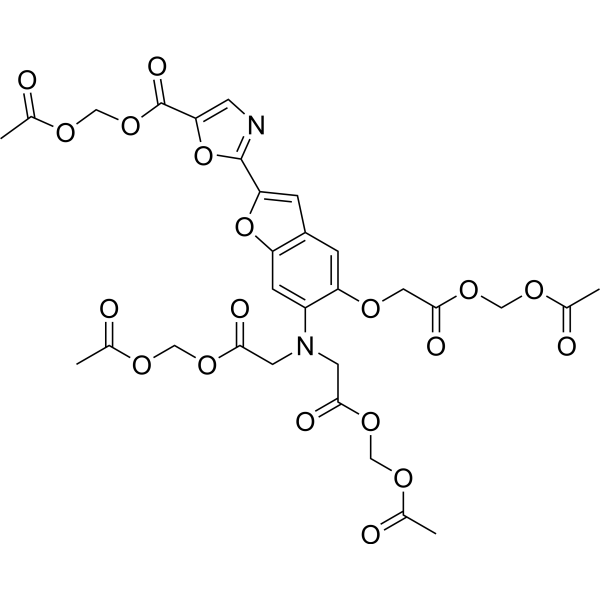
Physicochemical Properties
| Molecular Formula | C30H30N2O19 |
| Molecular Weight | 722.56 |
| Exact Mass | 985.26 |
| Elemental Analysis | C, 49.87; H, 4.19; N, 3.88; O, 42.07 |
| CAS # | 130100-20-8 |
| PubChem CID | 131176 |
| Appearance | Typically exists as solid at room temperature |
| Density | 1.436 g/cm3 |
| Boiling Point | 797.5ºC at 760 mmHg |
| Flash Point | 436.1ºC |
| Vapour Pressure | 1.96E-25mmHg at 25°C |
| Index of Refraction | 1.554 |
| LogP | 2.467 |
| Hydrogen Bond Donor Count | 0 |
| Hydrogen Bond Acceptor Count | 21 |
| Rotatable Bond Count | 26 |
| Heavy Atom Count | 51 |
| Complexity | 1240 |
| Defined Atom Stereocenter Count | 0 |
| SMILES | CC(=O)OCOC(=O)CN(CC(=O)OCOC(=O)C)C1=CC2=C(C=C1OCC(=O)OCOC(=O)C)C=C(C3=NC=C(C(=O)OCOC(=O)C)O3)O2 |
| InChi Key | PCDUVTXECKTHBH-UHFFFAOYSA-N |
| InChi Code | InChI=1S/C30H30N2O19/c1-16(33)42-12-46-26(37)9-32(10-27(38)47-13-43-17(2)34)21-7-22-20(5-23(21)41-11-28(39)48-14-44-18(3)35)6-24(50-22)29-31-8-25(51-29)30(40)49-15-45-19(4)36/h5-8H,9-15H2,1-4H3 |
| Chemical Name | acetyloxymethyl 2-[5-[2-(acetyloxymethoxy)-2-oxoethoxy]-6-[bis[2-(acetyloxymethoxy)-2-oxoethyl]amino]-1-benzofuran-2-yl]-1,3-oxazole-5-carboxylate |
| Synonyms | 130100-20-8; Mag-fura-2-acetoxymethyl ester; Mag-fura-2 AM; Mag-fura-2-AM; MFAME; MAG-FURA-2, AM; Magfura-2-AM; acetyloxymethyl 2-[5-[2-(acetyloxymethoxy)-2-oxoethoxy]-6-[bis[2-(acetyloxymethoxy)-2-oxoethyl]amino]-1-benzofuran-2-yl]-1,3-oxazole-5-carboxylate; |
| HS Tariff Code | 2934.99.9001 |
| Storage |
Powder-20°C 3 years 4°C 2 years In solvent -80°C 6 months -20°C 1 month |
| Shipping Condition | Room temperature (This product is stable at ambient temperature for a few days during ordinary shipping and time spent in Customs) |
Biological Activity
| Targets | Fluorescent dye |
| ln Vitro |
Preparation of Mag-Fura-2 AM Working Solution 1.1 Stock Solution Preparation Dissolve Mag-Fura-2 AM powder in anhydrous DMSO to prepare a 10 mM stock solution. Note: Aliquot and store the stock solution protected from light at -20°C or -80°C. 1.2 Working Solution Preparation Dilute the stock solution with pre-warmed HBSS buffer to obtain a 1-10 μM Mag-Fura-2 AM working solution. Note: Adjust the working solution concentration as needed, and prepare fresh before use. Staining Procedure for Suspension Cells 2.1 Cell Pre-treatment Centrifuge to collect cells, wash twice with PBS (5 min each), and adjust cell density to 1×10⁶/mL. 2.2 Dye Incubation Add 1 mL working solution and incubate at room temperature protected from light for 5-30 min. 2.3 Dye Removal Centrifuge at 400 g for 3-4 min and carefully remove the supernatant. 2.4 Washing Steps Wash cells twice with PBS (5 min each). 2.5 Detection Preparation Resuspend cells in 1 mL HBSS for analysis by fluorescence microscopy or flow cytometry. Staining Protocol for Adherent Cells 3.1 Cell Culture Seed cells on sterile coverslips and culture until ready. 3.2 Medium Removal Remove coverslips and aspirate residual medium. 3.3 Staining Add 100 μL working solution, gently rock to ensure full coverage, and incubate at room temperature for 5-30 min. 3.4 Washing and Observation Aspirate the dye, wash 2-3 times with fresh medium (5 min each), and observe under a fluorescence microscope. |
| Enzyme Assay | Synaptosomes can be loaded with mag-fura-2 without significant perturbation of their ATP content by incubation for 10 min at 37 degrees C with 10 microM mag-fura-2 acetoxymethyl ester in Hanks'-HEPES buffer (pH 7.45). The intrasynaptosomal free Mg2+ concentration ([Mg2+]i) was found to be dependent on external Mg2+ concentration, increasing from 0.8 to 1.25 mM when the concentration of Mg2+ in the incubation medium increased from 1 to 8 mM. Dissipation of the Na+ gradient across the plasma membrane of synaptosomes by treatment with the Na+ ionophore monensin (0.2 mM) or with veratridine (0.2 mM) and ouabain (0.6 mM) produced a moderate increase of [Mg2+]i, from 1.0 to 1.2-1.3 mM in an incubation medium containing 5 mM Mg2+. Plasma membrane depolarization by incubation of synaptosomes in a medium containing 68 mM KCl and 68 mM NaCl had no effect on [Mg2+]i. Reversal of the Na+ gradient by incubation of synaptosomes in a medium in which external Na+ was replaced by choline increased [Mg2+]i up to 1.6 and 2.2 mM for extrasynaptosomal Mg2+ concentrations of 1 and 8 mM, respectively. We conclude that a Na+/Mg2+ exchange operates in the plasma membrane of synaptosomes. In the presence of Mg2+ in the incubation medium, extrasynaptosomal ATP, but not ADP or adenosine, increased [Mg2+]i from 1.1 +/- 0.1 up to 1.6 +/- 0.1 mM. The nonhydrolyzable ATP analogue adenosine 5'-(beta gamma-imido)triphosphate antagonized the effect of ATP, but had no effect by itself on [Mg2+]i. It is concluded that Mg2+ transport across the plasma membrane of synaptosomes is modulated by the activity of an ecto-ATPase or an ecto-protein kinase [1]. |
| References |
[1]. Intrasynaptosomal free Mg2+ concentration measured with the fluorescent indicator mag-fura-2: modulation by Na+ gradient and by extrasynaptosomal ATP. J Neurochem. 1995 Dec;65(6):2757-64. |
Solubility Data
| Solubility (In Vitro) | May dissolve in DMSO (in most cases), if not, try other solvents such as H2O, Ethanol, or DMF with a minute amount of products to avoid loss of samples |
| Solubility (In Vivo) |
Note: Listed below are some common formulations that may be used to formulate products with low water solubility (e.g. < 1 mg/mL), you may test these formulations using a minute amount of products to avoid loss of samples. Injection Formulations (e.g. IP/IV/IM/SC) Injection Formulation 1: DMSO : Tween 80: Saline = 10 : 5 : 85 (i.e. 100 μL DMSO stock solution → 50 μL Tween 80 → 850 μL Saline) *Preparation of saline: Dissolve 0.9 g of sodium chloride in 100 mL ddH ₂ O to obtain a clear solution. Injection Formulation 2: DMSO : PEG300 :Tween 80 : Saline = 10 : 40 : 5 : 45 (i.e. 100 μL DMSO → 400 μLPEG300 → 50 μL Tween 80 → 450 μL Saline) Injection Formulation 3: DMSO : Corn oil = 10 : 90 (i.e. 100 μL DMSO → 900 μL Corn oil) Example: Take the Injection Formulation 3 (DMSO : Corn oil = 10 : 90) as an example, if 1 mL of 2.5 mg/mL working solution is to be prepared, you can take 100 μL 25 mg/mL DMSO stock solution and add to 900 μL corn oil, mix well to obtain a clear or suspension solution (2.5 mg/mL, ready for use in animals). Injection Formulation 4: DMSO : 20% SBE-β-CD in saline = 10 : 90 [i.e. 100 μL DMSO → 900 μL (20% SBE-β-CD in saline)] *Preparation of 20% SBE-β-CD in Saline (4°C,1 week): Dissolve 2 g SBE-β-CD in 10 mL saline to obtain a clear solution. Injection Formulation 5: 2-Hydroxypropyl-β-cyclodextrin : Saline = 50 : 50 (i.e. 500 μL 2-Hydroxypropyl-β-cyclodextrin → 500 μL Saline) Injection Formulation 6: DMSO : PEG300 : castor oil : Saline = 5 : 10 : 20 : 65 (i.e. 50 μL DMSO → 100 μLPEG300 → 200 μL castor oil → 650 μL Saline) Injection Formulation 7: Ethanol : Cremophor : Saline = 10: 10 : 80 (i.e. 100 μL Ethanol → 100 μL Cremophor → 800 μL Saline) Injection Formulation 8: Dissolve in Cremophor/Ethanol (50 : 50), then diluted by Saline Injection Formulation 9: EtOH : Corn oil = 10 : 90 (i.e. 100 μL EtOH → 900 μL Corn oil) Injection Formulation 10: EtOH : PEG300:Tween 80 : Saline = 10 : 40 : 5 : 45 (i.e. 100 μL EtOH → 400 μLPEG300 → 50 μL Tween 80 → 450 μL Saline) Oral Formulations Oral Formulation 1: Suspend in 0.5% CMC Na (carboxymethylcellulose sodium) Oral Formulation 2: Suspend in 0.5% Carboxymethyl cellulose Example: Take the Oral Formulation 1 (Suspend in 0.5% CMC Na) as an example, if 100 mL of 2.5 mg/mL working solution is to be prepared, you can first prepare 0.5% CMC Na solution by measuring 0.5 g CMC Na and dissolve it in 100 mL ddH2O to obtain a clear solution; then add 250 mg of the product to 100 mL 0.5% CMC Na solution, to make the suspension solution (2.5 mg/mL, ready for use in animals). Oral Formulation 3: Dissolved in PEG400 Oral Formulation 4: Suspend in 0.2% Carboxymethyl cellulose Oral Formulation 5: Dissolve in 0.25% Tween 80 and 0.5% Carboxymethyl cellulose Oral Formulation 6: Mixing with food powders Note: Please be aware that the above formulations are for reference only. InvivoChem strongly recommends customers to read literature methods/protocols carefully before determining which formulation you should use for in vivo studies, as different compounds have different solubility properties and have to be formulated differently. (Please use freshly prepared in vivo formulations for optimal results.) |
| Preparing Stock Solutions | 1 mg | 5 mg | 10 mg | |
| 1 mM | 1.3840 mL | 6.9198 mL | 13.8397 mL | |
| 5 mM | 0.2768 mL | 1.3840 mL | 2.7679 mL | |
| 10 mM | 0.1384 mL | 0.6920 mL | 1.3840 mL |