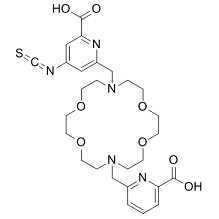
Physicochemical Properties
| Molecular Formula | C27H35N5O8S |
| Molecular Weight | 589.660505533218 |
| Exact Mass | 589.22 |
| CAS # | 2146095-31-8 |
| Related CAS # | Macropa-NH2 hydrochloride;2443966-86-5 |
| PubChem CID | 135349208 |
| Appearance | Typically exists as solid at room temperature |
| LogP | -3 |
| Hydrogen Bond Donor Count | 2 |
| Hydrogen Bond Acceptor Count | 14 |
| Rotatable Bond Count | 7 |
| Heavy Atom Count | 41 |
| Complexity | 816 |
| Defined Atom Stereocenter Count | 0 |
| InChi Key | PKCFWCMMZOUICG-UHFFFAOYSA-N |
| InChi Code | InChI=1S/C27H35N5O8S/c33-26(34)24-3-1-2-21(29-24)18-31-4-8-37-12-14-39-10-6-32(7-11-40-15-13-38-9-5-31)19-23-16-22(28-20-41)17-25(30-23)27(35)36/h1-3,16-17H,4-15,18-19H2,(H,33,34)(H,35,36) |
| Chemical Name | 6-[[16-[(6-carboxypyridin-2-yl)methyl]-1,4,10,13-tetraoxa-7,16-diazacyclooctadec-7-yl]methyl]-4-isothiocyanatopyridine-2-carboxylic acid |
| Synonyms | Macropa-NCS; 2146095-31-8; 6-((16-((6-Carboxypyridin-2-yl)methyl)-1,4,10,13-tetraoxa-7,16-diazacyclooctadecan-7-yl)methyl)-4-isothiocyanatopicolinic acid; SCHEMBL20524519; |
| HS Tariff Code | 2934.99.9001 |
| Storage |
Powder-20°C 3 years 4°C 2 years In solvent -80°C 6 months -20°C 1 month |
| Shipping Condition | Room temperature (This product is stable at ambient temperature for a few days during ordinary shipping and time spent in Customs) |
Biological Activity
| Targets | Prostate-specific membrane antigen |
| ln Vitro | Stock solutions were made in 0.1 M pH 9.1 NaHCO3 buffer containing 0.154 M NaCl and contained 4.4 mg/mL Macropa-NCS. They were then kept at -80 °C. Macropa-NCS (52 μL) and NaHCO buffer (266 μL) were added to a portion of Tmab in saline (74 μL) so that the final concentrations of Tmab and macropa-NCS were 5.1 mg/mL and 0.59 mg/mL, respectively. Macropa-NCS (tetra-TFA salt) is estimated to be 16 times molar excess over Tmab based on its molecular weight of 1045.76 g/mol [1]. |
| ln Vivo | The 18-membered macrocycle H2 macropa was investigated for 225 Ac chelation in targeted alpha therapy (TAT). Radiolabeling studies showed that macropa, at submicromolar concentration, complexed all 225 Ac (26 kBq) in 5 min at RT. [225 Ac(macropa)]+ remained intact over 7 to 8 days when challenged with either excess La3+ ions or human serum, and did not accumulate in any organ after 5 h in healthy mice. A bifunctional analogue, macropa-NCS, was conjugated to trastuzumab as well as to the prostate-specific membrane antigen-targeting compound RPS-070. Both constructs rapidly radiolabeled 225 Ac in just minutes at RT, and macropa-Tmab retained >99 % of its 225 Ac in human serum after 7 days. In LNCaP xenograft mice, 225 Ac-macropa-RPS-070 was selectively targeted to tumors and did not release free 225 Ac over 96 h. These findings establish macropa to be a highly promising ligand for 225 Ac chelation that will facilitate the clinical development of 225 Ac TAT for the treatment of soft-tissue metastases [1]. |
| References | [1]. An Eighteen-Membered Macrocyclic Ligand for Actinium-225 Targeted Alpha Therapy. Angew Chem Int Ed Engl. 2017 Nov 13;56(46):14712-14717. |
Solubility Data
| Solubility (In Vitro) | May dissolve in DMSO (in most cases), if not, try other solvents such as H2O, Ethanol, or DMF with a minute amount of products to avoid loss of samples |
| Solubility (In Vivo) |
Note: Listed below are some common formulations that may be used to formulate products with low water solubility (e.g. < 1 mg/mL), you may test these formulations using a minute amount of products to avoid loss of samples. Injection Formulations (e.g. IP/IV/IM/SC) Injection Formulation 1: DMSO : Tween 80: Saline = 10 : 5 : 85 (i.e. 100 μL DMSO stock solution → 50 μL Tween 80 → 850 μL Saline) *Preparation of saline: Dissolve 0.9 g of sodium chloride in 100 mL ddH ₂ O to obtain a clear solution. Injection Formulation 2: DMSO : PEG300 :Tween 80 : Saline = 10 : 40 : 5 : 45 (i.e. 100 μL DMSO → 400 μLPEG300 → 50 μL Tween 80 → 450 μL Saline) Injection Formulation 3: DMSO : Corn oil = 10 : 90 (i.e. 100 μL DMSO → 900 μL Corn oil) Example: Take the Injection Formulation 3 (DMSO : Corn oil = 10 : 90) as an example, if 1 mL of 2.5 mg/mL working solution is to be prepared, you can take 100 μL 25 mg/mL DMSO stock solution and add to 900 μL corn oil, mix well to obtain a clear or suspension solution (2.5 mg/mL, ready for use in animals). Injection Formulation 4: DMSO : 20% SBE-β-CD in saline = 10 : 90 [i.e. 100 μL DMSO → 900 μL (20% SBE-β-CD in saline)] *Preparation of 20% SBE-β-CD in Saline (4°C,1 week): Dissolve 2 g SBE-β-CD in 10 mL saline to obtain a clear solution. Injection Formulation 5: 2-Hydroxypropyl-β-cyclodextrin : Saline = 50 : 50 (i.e. 500 μL 2-Hydroxypropyl-β-cyclodextrin → 500 μL Saline) Injection Formulation 6: DMSO : PEG300 : castor oil : Saline = 5 : 10 : 20 : 65 (i.e. 50 μL DMSO → 100 μLPEG300 → 200 μL castor oil → 650 μL Saline) Injection Formulation 7: Ethanol : Cremophor : Saline = 10: 10 : 80 (i.e. 100 μL Ethanol → 100 μL Cremophor → 800 μL Saline) Injection Formulation 8: Dissolve in Cremophor/Ethanol (50 : 50), then diluted by Saline Injection Formulation 9: EtOH : Corn oil = 10 : 90 (i.e. 100 μL EtOH → 900 μL Corn oil) Injection Formulation 10: EtOH : PEG300:Tween 80 : Saline = 10 : 40 : 5 : 45 (i.e. 100 μL EtOH → 400 μLPEG300 → 50 μL Tween 80 → 450 μL Saline) Oral Formulations Oral Formulation 1: Suspend in 0.5% CMC Na (carboxymethylcellulose sodium) Oral Formulation 2: Suspend in 0.5% Carboxymethyl cellulose Example: Take the Oral Formulation 1 (Suspend in 0.5% CMC Na) as an example, if 100 mL of 2.5 mg/mL working solution is to be prepared, you can first prepare 0.5% CMC Na solution by measuring 0.5 g CMC Na and dissolve it in 100 mL ddH2O to obtain a clear solution; then add 250 mg of the product to 100 mL 0.5% CMC Na solution, to make the suspension solution (2.5 mg/mL, ready for use in animals). Oral Formulation 3: Dissolved in PEG400 Oral Formulation 4: Suspend in 0.2% Carboxymethyl cellulose Oral Formulation 5: Dissolve in 0.25% Tween 80 and 0.5% Carboxymethyl cellulose Oral Formulation 6: Mixing with food powders Note: Please be aware that the above formulations are for reference only. InvivoChem strongly recommends customers to read literature methods/protocols carefully before determining which formulation you should use for in vivo studies, as different compounds have different solubility properties and have to be formulated differently. (Please use freshly prepared in vivo formulations for optimal results.) |
| Preparing Stock Solutions | 1 mg | 5 mg | 10 mg | |
| 1 mM | 1.6959 mL | 8.4795 mL | 16.9589 mL | |
| 5 mM | 0.3392 mL | 1.6959 mL | 3.3918 mL | |
| 10 mM | 0.1696 mL | 0.8479 mL | 1.6959 mL |