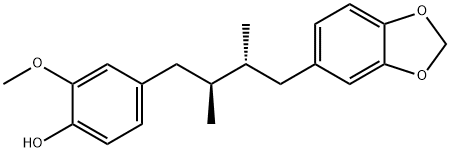
Physicochemical Properties
| Molecular Formula | C20H24O4 |
| Molecular Weight | 328.4022 |
| Exact Mass | 328.167 |
| CAS # | 107534-93-0 |
| PubChem CID | 10404245 |
| Appearance | White to off-white solid powder |
| Density | 1.159 |
| Boiling Point | 467.0±40.0 °C at 760 mmHg |
| Melting Point | 70-71℃ |
| Flash Point | 236℃ |
| Vapour Pressure | 0.0±1.2 mmHg at 25°C |
| Index of Refraction | 1.574 |
| LogP | 5.22 |
| Hydrogen Bond Donor Count | 1 |
| Hydrogen Bond Acceptor Count | 4 |
| Rotatable Bond Count | 6 |
| Heavy Atom Count | 24 |
| Complexity | 388 |
| Defined Atom Stereocenter Count | 2 |
| SMILES | C[C@H](CC1=CC2=C(C=C1)OCO2)[C@@H](C)CC3=CC(=C(C=C3)O)OC |
| InChi Key | QDDILOVMGWUNGD-UONOGXRCSA-N |
| InChi Code | InChI=1S/C20H24O4/c1-13(8-15-4-6-17(21)19(10-15)22-3)14(2)9-16-5-7-18-20(11-16)24-12-23-18/h4-7,10-11,13-14,21H,8-9,12H2,1-3H3/t13-,14+/m0/s1 |
| Chemical Name | 4-[(2S,3R)-4-(1,3-benzodioxol-5-yl)-2,3-dimethylbutyl]-2-methoxyphenol |
| HS Tariff Code | 2934.99.9001 |
| Storage |
Powder-20°C 3 years 4°C 2 years In solvent -80°C 6 months -20°C 1 month |
| Shipping Condition | Room temperature (This product is stable at ambient temperature for a few days during ordinary shipping and time spent in Customs) |
Biological Activity
| ln Vitro | Macelignan (1-50 μM; 72 h) did not decrease cell viability on its own; rather, UVB therapy decreased HaCaT cell viability in a dose-dependent manner, reducing it by about 80 percent. The control value in percentage of hacat cells is 100 μM [1]. COX-2 expression is lowered by myristolignan (0.1–1 μM; 24 hours) in a concentration-dependent manner. In hacat cells, COX-2 expression is about 50% reduced at the maximum myristolignan concentration (1 μM)[1]. |
| ln Vivo | Macelignan (oral; 15 mg/kg; once daily for three weeks) exhibits antidiabetic effects in vivo. There was no difference in baseline (day 0) fasting blood glucose levels between the groups; at the end of the experiment, the values in the Macelignan-treated group of C57BL/KsJ-db/db mice were significantly lower than those in the diabetic control group [2]. |
| Cell Assay |
Cell viability assay [1] Cell Types: Hacat Cell Tested Concentrations: 1 μM; 2.5 μM; 5 μM; 10 μM; 15 μM; 50 μM Incubation Duration: 72 hrs (hours) Experimental Results: Cell death was induced by UVB irradiation of 10 μM 30 mJ/cm2. Western Blot Analysis [1] Cell Types: Hacat Cell Tested Concentrations: 0.1 μM; 0.5 μM; 1 μM Incubation Duration: 24 hrs (hours) Experimental Results: UVB-induced COX-2 expression in cells was diminished. |
| Animal Protocol |
Animal/Disease Models: Male C57BL/KsJ-db/db mice [2] Doses: 15 mg/kg Route of Administration: po (po (oral gavage)) 15 mg/kg; one time/day for three weeks. Experimental Results: Dramatically diminished blood sugar levels in mice. |
| References |
[1]. Effects of macelignan isolated from Myristica fragrans Houtt. on UVB-induced matrix metalloproteinase-9 and cyclooxygenase-2 in HaCaT cells. J Dermatol Sci. [2]. Effects of a multi-herbal extract on type 2 diabetes. Chin Med. 2011 Mar 4;6:10. [3]. Macelignan attenuates LPS-induced inflammation and reduces LPS-induced spatial learning impairments in rats. Neurosci Lett. 2008 Dec 19;448(1):110-4. |
| Additional Infomation |
4-[(2S,3R)-4-(1,3-benzodioxol-5-yl)-2,3-dimethylbutyl]-2-methoxyphenol is a lignan. Macelignan is an NSAID with antioxidant, free radical scavenging, and neuroprotective activities. Macelignan has been reported in Schisandra sphenanthera, Magnolia ovata, and other organisms with data available. Macelignan is a lignan isolated from nutmeg with antimicrobial and anticariogenic activity against Streptococcus mutans and other streptococcus species. |
Solubility Data
| Solubility (In Vitro) | DMSO : ~100 mg/mL (~304.51 mM) |
| Solubility (In Vivo) |
Solubility in Formulation 1: ≥ 2.5 mg/mL (7.61 mM) (saturation unknown) in 10% DMSO + 40% PEG300 + 5% Tween80 + 45% Saline (add these co-solvents sequentially from left to right, and one by one), clear solution. For example, if 1 mL of working solution is to be prepared, you can add 100 μL of 25.0 mg/mL clear DMSO stock solution to 400 μL PEG300 and mix evenly; then add 50 μL Tween-80 to the above solution and mix evenly; then add 450 μL normal saline to adjust the volume to 1 mL. Preparation of saline: Dissolve 0.9 g of sodium chloride in 100 mL ddH₂ O to obtain a clear solution. Solubility in Formulation 2: ≥ 2.5 mg/mL (7.61 mM) (saturation unknown) in 10% DMSO + 90% (20% SBE-β-CD in Saline) (add these co-solvents sequentially from left to right, and one by one), clear solution. For example, if 1 mL of working solution is to be prepared, you can add 100 μL of 25.0 mg/mL clear DMSO stock solution to 900 μL of 20% SBE-β-CD physiological saline solution and mix evenly. Preparation of 20% SBE-β-CD in Saline (4°C,1 week): Dissolve 2 g SBE-β-CD in 10 mL saline to obtain a clear solution. Solubility in Formulation 3: ≥ 2.5 mg/mL (7.61 mM) (saturation unknown) in 10% DMSO + 90% Corn Oil (add these co-solvents sequentially from left to right, and one by one), clear solution. For example, if 1 mL of working solution is to be prepared, you can add 100 μL of 25.0 mg/mL clear DMSO stock solution to 900 μL of corn oil and mix evenly. (Please use freshly prepared in vivo formulations for optimal results.) |
| Preparing Stock Solutions | 1 mg | 5 mg | 10 mg | |
| 1 mM | 3.0451 mL | 15.2253 mL | 30.4507 mL | |
| 5 mM | 0.6090 mL | 3.0451 mL | 6.0901 mL | |
| 10 mM | 0.3045 mL | 1.5225 mL | 3.0451 mL |