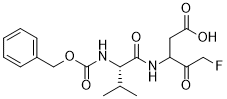
MX1013 (Z-VD-fmk) is a novel, a potent and irreversible dipeptide pan-caspase inhibitor which inhibits with IC50 values ranging from 5 to 20 nm that inhibits caspases 1, 3, 6, 7, 8, and 9. Caspases are thought to be important targets for the development of cytoprotective drugs because they play a significant role in apoptosis. Cathepsin B, calpain I, and factor Xa are examples of noncaspase proteases that MX1013 does not effectively inhibit (IC50 values >10 microm). MX1013 is more effective than tetrapeptide- and tripeptide-based caspase inhibitors in a number of cell culture models of apoptosis, such as caspase 3 processing, PARP cleavage, and DNA fragmentation, and it inhibited apoptosis at concentrations as low as 0.5 microm. Compared to caspase inhibitors based on tripeptides like Z-VAD-fmk, MX1013 is more soluble in water. In the anti-Fas mouse-liver apoptosis model, a commonly used liver failure model, MX1013 prevented liver damage and the lethality brought on by Fas death receptor activation at a dose of 1 mg kg-1 intravenously. In a model of brain ischemia/reperfusion injury, MX1013 reduced cortical damage by about 50% at a dose of 20 mg kg-1 (i.v. bolus followed by i.v. infusion for 6 or 12 h). At a dose of 20 mg kg-1 (i.v. bolus) followed by i.v. infusion for 12 h, MX1013 reduced heart damage by approximately 50% in a model of acute myocardial infarction. These studies lead to the conclusion that MX1013, a dipeptide pan-caspase inhibitor, has an effective combination of in vitro and in vivo characteristics. It is systemically active in three animal models of apoptosis, including brain ischemia, and has the capacity to defend cells from a variety of apoptotic insults.
Physicochemical Properties
| Molecular Formula | C18H23N2O6 |
| Molecular Weight | 382.38342 |
| Exact Mass | 382.154 |
| Elemental Analysis | C, 56.54; H, 6.06; F, 4.97; N, 7.33; O, 25.10 |
| CAS # | 582316-00-5 |
| Related CAS # | 582316-00-5 |
| PubChem CID | 9821317 |
| Appearance | White to off-white solid powder |
| Density | 1.258g/cm3 |
| Boiling Point | 639.809ºC at 760 mmHg |
| Flash Point | 340.745ºC |
| Index of Refraction | 1.523 |
| LogP | 2.217 |
| Hydrogen Bond Donor Count | 3 |
| Hydrogen Bond Acceptor Count | 7 |
| Rotatable Bond Count | 11 |
| Heavy Atom Count | 27 |
| Complexity | 534 |
| Defined Atom Stereocenter Count | 1 |
| SMILES | CC([C@H](NC(OCC1=CC=CC=C1)=O)C(NC(C(CF)=O)CC(O)=O)=O)C |
| InChi Key | LYBWGROBJJXCJJ-VYIIXAMBSA-N |
| InChi Code | InChI=1S/C18H23FN2O6/c1-11(2)16(17(25)20-13(8-15(23)24)14(22)9-19)21-18(26)27-10-12-6-4-3-5-7-12/h3-7,11,13,16H,8-10H2,1-2H3,(H,20,25)(H,21,26)(H,23,24)/t13?,16-/m0/s1 |
| Chemical Name | 5-fluoro-3-[[(2S)-3-methyl-2-(phenylmethoxycarbonylamino)butanoyl]amino]-4-oxopentanoic acid |
| Synonyms | MX1013; MX 1013; MX-1013 |
| HS Tariff Code | 2934.99.9001 |
| Storage |
Powder-20°C 3 years 4°C 2 years In solvent -80°C 6 months -20°C 1 month |
| Shipping Condition | Room temperature (This product is stable at ambient temperature for a few days during ordinary shipping and time spent in Customs) |
Biological Activity
| Targets | Caspase |
| ln Vitro |
MX1013 has an IC50 range of 5 to 20 nm and inhibits caspases 1, 3, 6, 7, 8, and 9. Cathepsin B, calpain I, and factor Xa are examples of noncaspase proteases that are poorly inhibited by MX1013 (IC50 values >10 μm)[1]. The maturation of caspase 3 through proteolysis, the cleavage of PARP by caspase, and the fragmentation of genomic DNA are the three primary indicators of apoptosis that MX1013 inhibits[1]. |
| ln Vivo | MX1013 is an effective antiapoptotic agent in vivo. MX1013 can shield animals from the deadly effects of local tissue apoptosis in addition to inhibiting it[1]. |
| Animal Protocol |
Female ND4 Swiss Webster mice (16.5-21 g)[1] 0, 0.25, 1, 10 mg/kg (formulated in an aqueous vehicle containing 50 mm Tris-HCl, pH 8.0) Injected i.v. |
| References |
[1]. MX1013, a dipeptide caspase inhibitor with potent in vivo antiapoptotic activity. Br J Pharmacol. 2003 Sep;140(2):402-12. |
Solubility Data
| Solubility (In Vitro) | DMSO: ~100 mg/mL (~261.5 mM) |
| Solubility (In Vivo) |
Note: Listed below are some common formulations that may be used to formulate products with low water solubility (e.g. < 1 mg/mL), you may test these formulations using a minute amount of products to avoid loss of samples. Injection Formulations (e.g. IP/IV/IM/SC) Injection Formulation 1: DMSO : Tween 80: Saline = 10 : 5 : 85 (i.e. 100 μL DMSO stock solution → 50 μL Tween 80 → 850 μL Saline) *Preparation of saline: Dissolve 0.9 g of sodium chloride in 100 mL ddH ₂ O to obtain a clear solution. Injection Formulation 2: DMSO : PEG300 :Tween 80 : Saline = 10 : 40 : 5 : 45 (i.e. 100 μL DMSO → 400 μLPEG300 → 50 μL Tween 80 → 450 μL Saline) Injection Formulation 3: DMSO : Corn oil = 10 : 90 (i.e. 100 μL DMSO → 900 μL Corn oil) Example: Take the Injection Formulation 3 (DMSO : Corn oil = 10 : 90) as an example, if 1 mL of 2.5 mg/mL working solution is to be prepared, you can take 100 μL 25 mg/mL DMSO stock solution and add to 900 μL corn oil, mix well to obtain a clear or suspension solution (2.5 mg/mL, ready for use in animals). Injection Formulation 4: DMSO : 20% SBE-β-CD in saline = 10 : 90 [i.e. 100 μL DMSO → 900 μL (20% SBE-β-CD in saline)] *Preparation of 20% SBE-β-CD in Saline (4°C,1 week): Dissolve 2 g SBE-β-CD in 10 mL saline to obtain a clear solution. Injection Formulation 5: 2-Hydroxypropyl-β-cyclodextrin : Saline = 50 : 50 (i.e. 500 μL 2-Hydroxypropyl-β-cyclodextrin → 500 μL Saline) Injection Formulation 6: DMSO : PEG300 : castor oil : Saline = 5 : 10 : 20 : 65 (i.e. 50 μL DMSO → 100 μLPEG300 → 200 μL castor oil → 650 μL Saline) Injection Formulation 7: Ethanol : Cremophor : Saline = 10: 10 : 80 (i.e. 100 μL Ethanol → 100 μL Cremophor → 800 μL Saline) Injection Formulation 8: Dissolve in Cremophor/Ethanol (50 : 50), then diluted by Saline Injection Formulation 9: EtOH : Corn oil = 10 : 90 (i.e. 100 μL EtOH → 900 μL Corn oil) Injection Formulation 10: EtOH : PEG300:Tween 80 : Saline = 10 : 40 : 5 : 45 (i.e. 100 μL EtOH → 400 μLPEG300 → 50 μL Tween 80 → 450 μL Saline) Oral Formulations Oral Formulation 1: Suspend in 0.5% CMC Na (carboxymethylcellulose sodium) Oral Formulation 2: Suspend in 0.5% Carboxymethyl cellulose Example: Take the Oral Formulation 1 (Suspend in 0.5% CMC Na) as an example, if 100 mL of 2.5 mg/mL working solution is to be prepared, you can first prepare 0.5% CMC Na solution by measuring 0.5 g CMC Na and dissolve it in 100 mL ddH2O to obtain a clear solution; then add 250 mg of the product to 100 mL 0.5% CMC Na solution, to make the suspension solution (2.5 mg/mL, ready for use in animals). Oral Formulation 3: Dissolved in PEG400 Oral Formulation 4: Suspend in 0.2% Carboxymethyl cellulose Oral Formulation 5: Dissolve in 0.25% Tween 80 and 0.5% Carboxymethyl cellulose Oral Formulation 6: Mixing with food powders Note: Please be aware that the above formulations are for reference only. InvivoChem strongly recommends customers to read literature methods/protocols carefully before determining which formulation you should use for in vivo studies, as different compounds have different solubility properties and have to be formulated differently. (Please use freshly prepared in vivo formulations for optimal results.) |
| Preparing Stock Solutions | 1 mg | 5 mg | 10 mg | |
| 1 mM | 2.6152 mL | 13.0760 mL | 26.1520 mL | |
| 5 mM | 0.5230 mL | 2.6152 mL | 5.2304 mL | |
| 10 mM | 0.2615 mL | 1.3076 mL | 2.6152 mL |