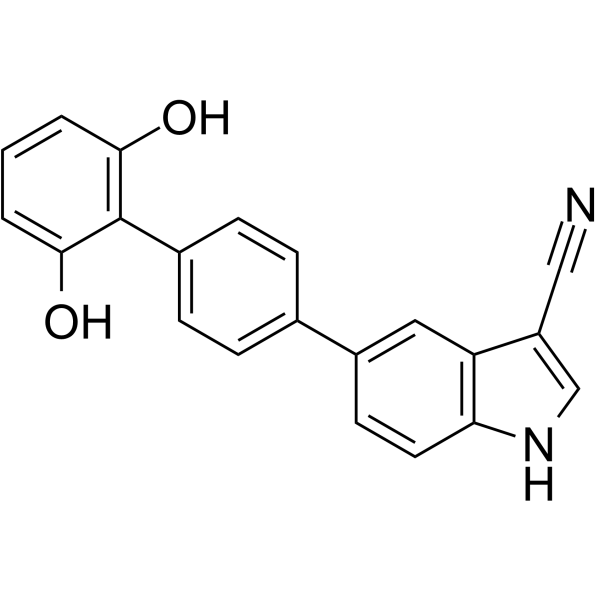
Physicochemical Properties
| Molecular Formula | C21H14N2O2 |
| Molecular Weight | 326.348064899445 |
| Exact Mass | 326.105 |
| CAS # | 1179347-65-9 |
| PubChem CID | 59145386 |
| Appearance | Light yellow to brown solid powder |
| LogP | 4.3 |
| Hydrogen Bond Donor Count | 3 |
| Hydrogen Bond Acceptor Count | 3 |
| Rotatable Bond Count | 2 |
| Heavy Atom Count | 25 |
| Complexity | 497 |
| Defined Atom Stereocenter Count | 0 |
| SMILES | OC1C=CC=C(C=1C1C=CC(=CC=1)C1C=CC2=C(C(C#N)=CN2)C=1)O |
| InChi Key | IGSYZPLXAFVMKY-UHFFFAOYSA-N |
| InChi Code | InChI=1S/C21H14N2O2/c22-11-16-12-23-18-9-8-15(10-17(16)18)13-4-6-14(7-5-13)21-19(24)2-1-3-20(21)25/h1-10,12,23-25H |
| Chemical Name | 5-[4-(2,6-dihydroxyphenyl)phenyl]-1H-indole-3-carbonitrile |
| Synonyms | MT63-78; MT63 78; MT6378 |
| HS Tariff Code | 2934.99.9001 |
| Storage |
Powder-20°C 3 years 4°C 2 years In solvent -80°C 6 months -20°C 1 month Note: This product requires protection from light (avoid light exposure) during transportation and storage. |
| Shipping Condition | Room temperature (This product is stable at ambient temperature for a few days during ordinary shipping and time spent in Customs) |
Biological Activity
| ln Vitro | LNCaP and PC3 cells treated with MT 63-78 (0-50 μM; 4 days) exhibit a dose-dependent decrease in cell number along with activation of AMPK signaling [1]. The G2/M population is significantly enriched when LNCaP and CRPC cells are treated with MT 63-78 (25 μM; 24 hours) [1]. Pro-apoptotic BH3 protein Puma accumulates in conjunction with a decrease in anti-apoptotic Mcl-1 in LNCaP, PC3, C4-4, C4-2B, CL1, and 22RV1 cells treated with MT 63-78 (0-50 μM; 24 hr) [1]. Following treatment with MT 63-78 (0-50 μM; 30 min) in LNCaP and PC3 cells, phosphorylation of two important AMPK targets (raptor on Ser792 and acetyl-CoA carboxylase (ACC) on Ser79) was observed in a dose-dependent manner. Furthermore, it raises Thr172's phosphorylation on the AMPK α subunit [1]. |
| ln Vivo | In C57 BL/6 male mice, treatment with MT 63-78 (30 mg/kg; i.p.; daily; for 14 days) reduced tumor growth by 33% [1]. |
| Cell Assay |
Cell Viability Assay[1] Cell Types: LNCaP and PC3 Cell Tested Concentrations: 0 μM, 1 μM, 5 μM, 10 μM, 25 μM, 50 μM Incubation Duration: 4 days Experimental Results: A dose-dependent decrease in cell number was observed simultaneously Activation of AMPK signaling. Cell cycle analysis[1] Cell Types: LNCaP and CRPC Cell Tested Concentrations: 25 μM Incubation Duration: 24 hrs (hours) Experimental Results: Induced significant enrichment of G2/M population in androgen-sensitive and CRPC cell models. Apoptosis analysis[1] Cell Types: LNCaP, PC3, C4-4, C4-2B, CL1 and 22RV1 Cell Tested Concentrations: 0 μM, 10 μM, 25 μM, 50 μM Incubation Duration: 24 hrs (hours) Experimental Results: Induction of anti-apoptosis The decrease in Mcl-1 was consistent with the accumulation of the pro-apoptotic BH3 protein Puma in all PCa cells. Western Blot Analysis[1] Cell Types: LNCaP and PC3 Cell Tested Concentrations: 0 μM, 0.25 μM, 0.5 μM, 1 μM, 5 μM, 25 μM, 50 μM Incubation Duration: 30 min Experimental Results: Observed a dose-dependent phosphorylation of the two major AMPK targets Acetyl-CoA Carboxylase (ACC) on Ser79 and of Raptor on Ser792. A corresponding increase in Thr172 phosphorylation on the AMPK α subunit was also observed. |
| Animal Protocol |
Animal/Disease Models: C57 BL/6 male mice bearing LNCaP tumors [1] Doses: 30 mg/kg Route of Administration: intraperitoneal (ip) injection; daily; lasted for 14 days. Experimental Results: resulted in 33% inhibition of tumor growth. |
| References |
[1]. A novel direct activator of AMPK inhibits prostate cancer growth by blocking lipogenesis. EMBO Mol Med. 2014 Apr;6(4):519-38. |
Solubility Data
| Solubility (In Vitro) | DMSO : ~125 mg/mL (~383.02 mM) |
| Solubility (In Vivo) |
Solubility in Formulation 1: ≥ 2.08 mg/mL (6.37 mM) (saturation unknown) in 10% DMSO + 40% PEG300 + 5% Tween80 + 45% Saline (add these co-solvents sequentially from left to right, and one by one), clear solution. For example, if 1 mL of working solution is to be prepared, you can add 100 μL of 20.8 mg/mL clear DMSO stock solution to 400 μL PEG300 and mix evenly; then add 50 μL Tween-80 to the above solution and mix evenly; then add 450 μL normal saline to adjust the volume to 1 mL. Preparation of saline: Dissolve 0.9 g of sodium chloride in 100 mL ddH₂ O to obtain a clear solution. Solubility in Formulation 2: ≥ 2.08 mg/mL (6.37 mM) (saturation unknown) in 10% DMSO + 90% (20% SBE-β-CD in Saline) (add these co-solvents sequentially from left to right, and one by one), clear solution. For example, if 1 mL of working solution is to be prepared, you can add 100 μL of 20.8 mg/mL clear DMSO stock solution to 900 μL of 20% SBE-β-CD physiological saline solution and mix evenly. Preparation of 20% SBE-β-CD in Saline (4°C,1 week): Dissolve 2 g SBE-β-CD in 10 mL saline to obtain a clear solution. (Please use freshly prepared in vivo formulations for optimal results.) |
| Preparing Stock Solutions | 1 mg | 5 mg | 10 mg | |
| 1 mM | 3.0642 mL | 15.3210 mL | 30.6419 mL | |
| 5 mM | 0.6128 mL | 3.0642 mL | 6.1284 mL | |
| 10 mM | 0.3064 mL | 1.5321 mL | 3.0642 mL |