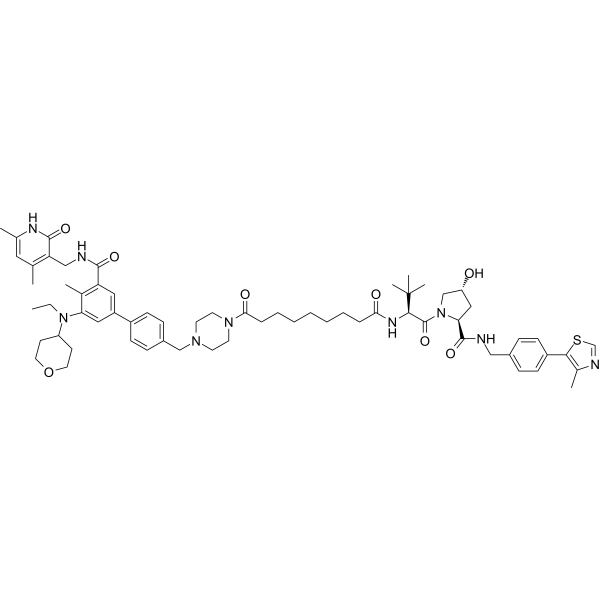
Physicochemical Properties
| Molecular Formula | C65H87N9O8S |
| Molecular Weight | 1154.51 |
| Exact Mass | 1153.639 |
| CAS # | 2855085-25-3 |
| PubChem CID | 165368931 |
| Appearance | White to off-white solid powder |
| Density | 1?+-.0.06 g/cm3(Predicted) |
| Boiling Point | 1245.7±65.0 °C(Predicted) |
| LogP | 8.1 |
| Hydrogen Bond Donor Count | 5 |
| Hydrogen Bond Acceptor Count | 12 |
| Rotatable Bond Count | 24 |
| Heavy Atom Count | 83 |
| Complexity | 2250 |
| Defined Atom Stereocenter Count | 3 |
| SMILES | CCN(C1CCOCC1)C2=CC(=CC(=C2C)C(=O)NCC3=C(C=C(NC3=O)C)C)C4=CC=C(C=C4)CN5CCN(CC5)C(=O)CCCCCCCC(=O)N[C@H](C(=O)N6C[C@@H](C[C@H]6C(=O)NCC7=CC=C(C=C7)C8=C(N=CS8)C)O)C(C)(C)C |
| InChi Key | AOIZISCRIVNZJJ-XWJFFXCMSA-N |
| InChi Code | InChI=1S/C65H87N9O8S/c1-9-73(51-25-31-82-32-26-51)55-35-50(34-53(44(55)4)61(78)67-38-54-42(2)33-43(3)69-62(54)79)48-21-19-47(20-22-48)39-71-27-29-72(30-28-71)58(77)16-14-12-10-11-13-15-57(76)70-60(65(6,7)8)64(81)74-40-52(75)36-56(74)63(80)66-37-46-17-23-49(24-18-46)59-45(5)68-41-83-59/h17-24,33-35,41,51-52,56,60,75H,9-16,25-32,36-40H2,1-8H3,(H,66,80)(H,67,78)(H,69,79)(H,70,76)/t52-,56+,60-/m1/s1 |
| Chemical Name | (2S,4R)-1-[(2S)-2-[[9-[4-[[4-[3-[(4,6-dimethyl-2-oxo-1H-pyridin-3-yl)methylcarbamoyl]-5-[ethyl(oxan-4-yl)amino]-4-methylphenyl]phenyl]methyl]piperazin-1-yl]-9-oxononanoyl]amino]-3,3-dimethylbutanoyl]-4-hydroxy-N-[[4-(4-methyl-1,3-thiazol-5-yl)phenyl]methyl]pyrrolidine-2-carboxamide |
| HS Tariff Code | 2934.99.9001 |
| Storage |
Powder-20°C 3 years 4°C 2 years In solvent -80°C 6 months -20°C 1 month Note: Please store this product in a sealed and protected environment, avoid exposure to moisture. |
| Shipping Condition | Room temperature (This product is stable at ambient temperature for a few days during ordinary shipping and time spent in Customs) |
Biological Activity
| Targets | IC50: 8.6 nM (EZH2); 62 nM (EZH1)[1]. DC50: 140 nM (EZH2 in MDA-MB-453 cells)[1] |
| ln Vitro | MS8815 demonstrates effectiveness in blocking the methyltransferase activity of EZH2 and EZH1 with IC50 values of 8.6 nM and 62 nM, respectively[1]. In MDA-MB-453 cells, MS8815 (0.1–1 μM) destroys EZH2 with a DC50 value of 140 nM[1]. In TNBC cells, MS8815 (1 μM; 48 h) causes substantial EZH2 degradation in a manner that is dependent on concentration, time, and proteasome activity[1]. Multiple TNBC cell lines and primary patient TNBC cells exhibit efficient growth suppression when treated with MS8815 (0.1-10 μM; 5 days)[1]. |
| Cell Assay |
Western Blot Analysis[1] Cell Types: MDA-MB-453 cells and BT549 cells Tested Concentrations: 0.3, 3 μM; 1μM Incubation Duration: 48 h; 24 h Experimental Results: Induced nearly complete degradation of EZH2 and demonstrated the most robust degradation at 0.3 μM. Induced EZH2 degradation in a time-and concentration-dependent manner. Induced EZH2 degradation through the UPS. Cell Proliferation Assay[1] Cell Types: BT549, MDA-MB-468, SUM159 and MDA-MB-453 cells Tested Concentrations: 0.1-10 μM Incubation Duration: 5 days Experimental Results: demonstrated superior cellular growth inhibition activity in a panel of TNBC cells. |
| References |
[1]. Targeting Triple-Negative Breast Cancer by a Novel Proteolysis Targeting Chimera Degrader of Enhancer of Zeste Homolog 2. ACS Pharmacol Transl Sci. 2022 Jun 24;5(7):491-507. |
Solubility Data
| Solubility (In Vitro) | DMSO : 120 mg/mL (103.94 mM) |
| Solubility (In Vivo) |
Solubility in Formulation 1: ≥ 3.25 mg/mL (2.82 mM) (saturation unknown) in 10% DMSO + 90% Corn Oil (add these co-solvents sequentially from left to right, and one by one), clear solution. For example, if 1 mL of working solution is to be prepared, you can add 100 μL of 32.5 mg/mL clear DMSO stock solution to 900 μL of corn oil and mix evenly. (Please use freshly prepared in vivo formulations for optimal results.) |
| Preparing Stock Solutions | 1 mg | 5 mg | 10 mg | |
| 1 mM | 0.8662 mL | 4.3308 mL | 8.6617 mL | |
| 5 mM | 0.1732 mL | 0.8662 mL | 1.7323 mL | |
| 10 mM | 0.0866 mL | 0.4331 mL | 0.8662 mL |