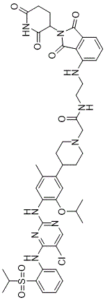
MS4078 is a potent PROTAC degrader of anaplastic lymphoma kinase (ALK) with a Kd of 19 nM for binding affinity to ALK. In SU-DHL-1 lymphoma and NCI-H2228 lung cancer cells, MS4077 and MS4078 significantly and time- and concentration-dependently reduced the cellular levels of oncogenic active ALK fusion proteins. Cereblon and proteasomes were required for the ALK protein degradation that compounds 5 and 6 caused. Furthermore, SU-DHL-1 cell proliferation was potently inhibited by MS4077 and MS4078. Compound 6 is also appropriate for in vivo efficacy investigations because it demonstrated good plasma exposure in a mouse pharmacokinetic study. The next generation of ALK PROTACs was developed thanks to this study.
Physicochemical Properties
| Molecular Formula | C45H52CLN9O8S |
| Molecular Weight | 914.467887878418 |
| Exact Mass | 913.33 |
| Elemental Analysis | C, 59.10; H, 5.73; Cl, 3.88; N, 13.79; O, 14.00; S, 3.51 |
| CAS # | 2229036-62-6 |
| Related CAS # | 2229036-62-6 |
| PubChem CID | 137628668 |
| Appearance | Light yellow to yellow solid powder |
| LogP | 6.7 |
| Hydrogen Bond Donor Count | 5 |
| Hydrogen Bond Acceptor Count | 14 |
| Rotatable Bond Count | 16 |
| Heavy Atom Count | 64 |
| Complexity | 1780 |
| Defined Atom Stereocenter Count | 0 |
| InChi Key | AYMGZLUKTNXEMY-UHFFFAOYSA-N |
| InChi Code | InChI=1S/C45H52ClN9O8S/c1-25(2)63-36-22-30(27(5)21-34(36)51-45-49-23-31(46)41(53-45)50-32-10-6-7-12-37(32)64(61,62)26(3)4)28-15-19-54(20-16-28)24-39(57)48-18-17-47-33-11-8-9-29-40(33)44(60)55(43(29)59)35-13-14-38(56)52-42(35)58/h6-12,21-23,25-26,28,35,47H,13-20,24H2,1-5H3,(H,48,57)(H,52,56,58)(H2,49,50,51,53) |
| Chemical Name | 2-[4-[4-[[5-chloro-4-(2-propan-2-ylsulfonylanilino)pyrimidin-2-yl]amino]-2-methyl-5-propan-2-yloxyphenyl]piperidin-1-yl]-N-[2-[[2-(2,6-dioxopiperidin-3-yl)-1,3-dioxoisoindol-4-yl]amino]ethyl]acetamide |
| Synonyms | MS-4078; MS4078; MS 4078 |
| HS Tariff Code | 2934.99.9001 |
| Storage |
Powder-20°C 3 years 4°C 2 years In solvent -80°C 6 months -20°C 1 month |
| Shipping Condition | Room temperature (This product is stable at ambient temperature for a few days during ordinary shipping and time spent in Customs) |
Biological Activity
| Targets |
NPM-ALK (DC50 = 11 nM); EML4-ALK (DC50 = 59 nM)
MS4078 targets anaplastic lymphoma kinase (ALK) and cereblon (CRBN, a component of the E3 ubiquitin ligase complex). [1] |
| ln Vitro |
MS4078 successfully stops the growth of cancer cells. With an IC50 of 33±1 nM, MS4078 (10-3, 10-2.5, 10-2, 10-1.5, 10-1, 10-0.5, 1 μM; 3 days) concentration-dependently inhibits SU-DHL-1 cell proliferation. The proliferation of NCI-H2228 cells is less sensitive to MS4078(10-2, 10-1.5, 10-1, 10-0.5, 1, 100.5 μM; 3 days) than that of SU-DHL-1 cells[1]. In SU-DHL-1 and NCI-H2228 cells, MS4078 potently lowers the levels of ALK fusion protein, inhibits ALK auto-phosphorylation, and down-steams STAT3 phosphorylation in a concentration-dependent manner. After 16 hours of treatment, MS4078 significantly lowers the NPM-ALK protein levels in SU-DHL-1 cells, with a DC50 (50% degradation) value of 11±2 nM. At 100 nM, both ALK Y1507 and STAT3 Y705 phosphorylation are inhibited to a degree of over 90%. After a 16-hour treatment, MS4078 decreases the EML4-ALK protein levels in NCI-H2228 cells with a DC50 value of 59 ± 16 nM. NCI-H2228 cells lower EML4-ALK protein levels by more than 90% at a concentration of 100 nM[1]. 1. MS4078 is a Proteolysis Targeting Chimera (PROTAC) that potently reduces the cellular levels of oncogenically active ALK fusion proteins in a concentration-dependent manner. After 16 hours of treatment with serial dilutions of MS4078, ALK fusion protein levels (normalized against GAPDH) are significantly decreased in SU-DHL-1 lymphoma cells and NCI-H2228 lung cancer cells, as detected by western blot (three independent experiments, ± SD). [1] 2. MS4078 induces time-dependent degradation of ALK fusion proteins in SU-DHL-1 and NCI-H2228 cells. Treatment with MS4078 for indicated time periods leads to progressive reduction of ALK fusion protein levels and inhibition of downstream ALK signaling pathways. [1] 3. The ALK fusion protein degradation induced by MS4078 is CRBN- and proteasome-dependent. Pre-treatment of cells with pomalidomide (10 μM), MLN4924 (1 μM), or MG-132 (20 μM) for 2 hours abrogates the degradation effect of 100 nM MS4078 (6-hour treatment); pre-treatment with ceritinib (100 nM) also rescues ALK fusion protein levels. [1] 4. MS4078-mediated ALK fusion protein degradation is reversible. SU-DHL-1 or NCI-H2228 cells treated with 100 nM MS4078 for 2 hours show recovery of ALK fusion protein levels after washing with PBS and incubation in fresh medium for indicated time periods. [1] 5. MS4078 potently inhibits the proliferation of SU-DHL-1 cells. Cells seeded at 5000 cells per well (triplicate wells) are treated with serial dilutions of MS4078 for 3 days, and cell growth is measured by the CellTiter-Glo luminescent cell viability assay (three independent experiments, ± SD). [1] |
| Enzyme Assay |
1. ALK competitive binding assay: The binding affinity of MS4078 to ALK is determined using a competitive binding assay. The assay is performed in duplicate with serial dilutions of MS4078, and DMSO is used as a control. Results are presented with error bars representing ± SEM from two independent duplicated experiments. [1] |
| Cell Assay |
1. ALK fusion protein level detection by western blot: SU-DHL-1 and NCI-H2228 cells are treated with DMSO or serial dilutions of MS4078 for 16 hours. Cell lysates are prepared, and ALK fusion protein levels are analyzed by western blot, with GAPDH as the loading control. The protein levels are normalized against GAPDH, and results are from three independent experiments (± SD). [1] 2. Time-dependent degradation assay: SU-DHL-1 and NCI-H2228 cells are treated with DMSO or MS4078 for indicated time periods. Cell lysates are collected, and ALK fusion protein levels and downstream signaling activity are detected by western blot to assess the time-dependent degradation effect. [1] 3. Mechanism validation assay: Cells are pre-treated with DMSO, pomalidomide (10 μM), MLN4924 (1 μM), MG-132 (20 μM), or ceritinib (100 nM) for 2 hours, cells are treated with 100 nM MS4078 for 6 hours. ALK fusion protein levels are measured by western blot to verify the dependence on CRBN and the proteasome pathway. [1] 4. Degradation reversibility assay: Cells are treated with 100 nM MS4078 for 2 hours, then washed with PBS and incubated in fresh medium for indicated time periods. ALK fusion protein levels are detected by western blot to evaluate the reversibility of degradation. [1] 5. Cell proliferation assay: SU-DHL-1 cells are seeded in 96-well plates at a density of 5000 cells per well (triplicate wells). Cells are treated with DMSO or serial dilutions of MS4078 for 3 days. Cell viability is measured using the CellTiter-Glo luminescent assay, and data are analyzed with GraphPad Prism (three independent experiments, ± SD). [1] |
| ADME/Pharmacokinetics |
1. MS4078 (designated as compound 6 in the literature) exhibits good plasma exposure in a mouse pharmacokinetic study. Male Swiss Albino mice receive a single intraperitoneal (IP) injection of MS4078 at 50 mg/kg, and plasma concentrations are monitored over 12 hours. [1] |
| References |
[1]. Proteolysis Targeting Chimeras (PROTACs) of Anaplastic Lymphoma Kinase (ALK). Eur J Med Chem. 2018 May 10;151:304-314. |
| Additional Infomation |
1. MS4078 is a novel PROTAC degrader of ALK, designed to overcome drug resistance to existing ALK inhibitors. [1] 2. The mode of action of MS4078 involves hijacking the E3 ubiquitin ligase CRBN to induce ubiquitination and proteasomal degradation of ALK fusion proteins. [1] 3. MS4078 has a corresponding negative control analog, MS4740 (compound 8), which is structurally similar but incapable of degrading ALK fusion proteins. [1] 4. MS4078 is valuable for investigating the pharmacological effects of ALK degradation and paves the way for the development of next-generation ALK PROTACs. [1] 5. ALK activation is associated with multiple human cancers, and MS4078 targets oncogenically active ALK fusion proteins, which are key drivers in ALK-positive non-small cell lung cancer (NSCLC) and lymphoma. [1] |
Solubility Data
| Solubility (In Vitro) |
DMSO: 50~100 mg/mL (54.7~109.4 mM) Ethanol: ~2 mg/mL (~2.2 mM) |
| Solubility (In Vivo) |
Solubility in Formulation 1: 2.08 mg/mL (2.27 mM) in 10% DMSO + 90% (20% SBE-β-CD in Saline) (add these co-solvents sequentially from left to right, and one by one), suspension solution; with sonication. For example, if 1 mL of working solution is to be prepared, you can add 100 μL of 20.8 mg/mL clear DMSO stock solution to 900 μL of 20% SBE-β-CD physiological saline solution and mix evenly. Preparation of 20% SBE-β-CD in Saline (4°C,1 week): Dissolve 2 g SBE-β-CD in 10 mL saline to obtain a clear solution. (Please use freshly prepared in vivo formulations for optimal results.) |
| Preparing Stock Solutions | 1 mg | 5 mg | 10 mg | |
| 1 mM | 1.0935 mL | 5.4676 mL | 10.9353 mL | |
| 5 mM | 0.2187 mL | 1.0935 mL | 2.1871 mL | |
| 10 mM | 0.1094 mL | 0.5468 mL | 1.0935 mL |