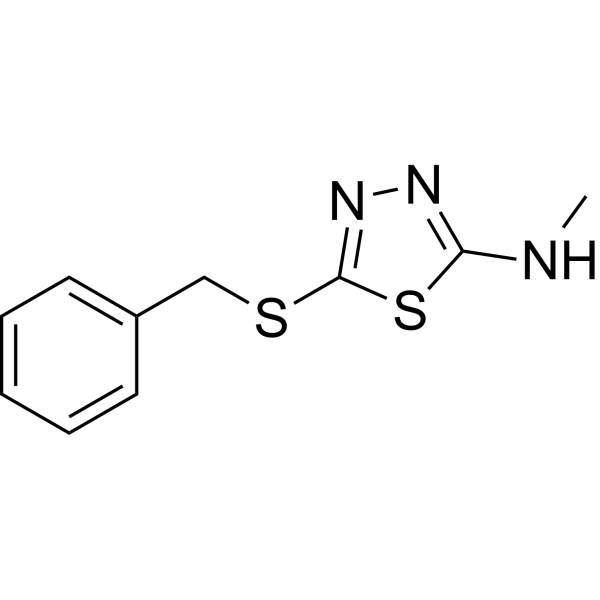
Physicochemical Properties
| Molecular Formula | C10H11N3S2 |
| Molecular Weight | 237.33 |
| Exact Mass | 237.039 |
| CAS # | 65373-29-7 |
| PubChem CID | 805117 |
| Appearance | White to off-white solid powder |
| Density | 1.3±0.1 g/cm3 |
| Boiling Point | 389.6±35.0 °C at 760 mmHg |
| Flash Point | 189.4±25.9 °C |
| Vapour Pressure | 0.0±0.9 mmHg at 25°C |
| Index of Refraction | 1.654 |
| LogP | 2.98 |
| Hydrogen Bond Donor Count | 1 |
| Hydrogen Bond Acceptor Count | 5 |
| Rotatable Bond Count | 4 |
| Heavy Atom Count | 15 |
| Complexity | 186 |
| Defined Atom Stereocenter Count | 0 |
| InChi Key | KFLNRVSOQJTXDG-UHFFFAOYSA-N |
| InChi Code | InChI=1S/C10H11N3S2/c1-11-9-12-13-10(15-9)14-7-8-5-3-2-4-6-8/h2-6H,7H2,1H3,(H,11,12) |
| Chemical Name | 5-benzylsulfanyl-N-methyl-1,3,4-thiadiazol-2-amine |
| Synonyms | MS 21570; MS-21570; MS21570 |
| HS Tariff Code | 2934.99.9001 |
| Storage |
Powder-20°C 3 years 4°C 2 years In solvent -80°C 6 months -20°C 1 month |
| Shipping Condition | Room temperature (This product is stable at ambient temperature for a few days during ordinary shipping and time spent in Customs) |
Biological Activity
| ln Vivo | MS21570 dramatically reduced the increase in food intake mediated by CNO. Interestingly, compared to vehicle, MS21570 significantly increased center time, indicating an impact on anxiety-like behavior. The raised plus maze showed an increase in open-arm time following intra-BLA administration of MS21570, but no change in locomotor activity was observed during the test. Interestingly, MS21570 considerably reduced freezing evaluated 24 hours later when given prior to and right after fear conditioning. The pharmacokinetic and pharmacodynamic characteristics of MS21570 may be the cause of the behavioral variations seen between systemic and intra-BLA treatment. To fully describe GPR171 antagonists, more research is required [1]. |
| References |
[1]. The BigLEN-GPR171 Peptide Receptor System Within the Basolateral Amygdala Regulates Anxiety-Like Behavior and Contextual Fear Conditioning. Neuropsychopharmacology. 2017 Dec;42(13):2527-2536. |
Solubility Data
| Solubility (In Vitro) | DMSO : ~125 mg/mL (~526.67 mM) |
| Solubility (In Vivo) |
Solubility in Formulation 1: ≥ 2.5 mg/mL (10.53 mM) (saturation unknown) in 10% DMSO + 40% PEG300 + 5% Tween80 + 45% Saline (add these co-solvents sequentially from left to right, and one by one), clear solution. For example, if 1 mL of working solution is to be prepared, you can add 100 μL of 25.0 mg/mL clear DMSO stock solution to 400 μL PEG300 and mix evenly; then add 50 μL Tween-80 to the above solution and mix evenly; then add 450 μL normal saline to adjust the volume to 1 mL. Preparation of saline: Dissolve 0.9 g of sodium chloride in 100 mL ddH₂ O to obtain a clear solution. Solubility in Formulation 2: ≥ 2.5 mg/mL (10.53 mM) (saturation unknown) in 10% DMSO + 90% (20% SBE-β-CD in Saline) (add these co-solvents sequentially from left to right, and one by one), clear solution. For example, if 1 mL of working solution is to be prepared, you can add 100 μL of 25.0 mg/mL clear DMSO stock solution to 900 μL of 20% SBE-β-CD physiological saline solution and mix evenly. Preparation of 20% SBE-β-CD in Saline (4°C,1 week): Dissolve 2 g SBE-β-CD in 10 mL saline to obtain a clear solution. Solubility in Formulation 3: ≥ 2.5 mg/mL (10.53 mM) (saturation unknown) in 10% DMSO + 90% Corn Oil (add these co-solvents sequentially from left to right, and one by one), clear solution. For example, if 1 mL of working solution is to be prepared, you can add 100 μL of 25.0 mg/mL clear DMSO stock solution to 900 μL of corn oil and mix evenly. (Please use freshly prepared in vivo formulations for optimal results.) |
| Preparing Stock Solutions | 1 mg | 5 mg | 10 mg | |
| 1 mM | 4.2135 mL | 21.0677 mL | 42.1354 mL | |
| 5 mM | 0.8427 mL | 4.2135 mL | 8.4271 mL | |
| 10 mM | 0.4214 mL | 2.1068 mL | 4.2135 mL |