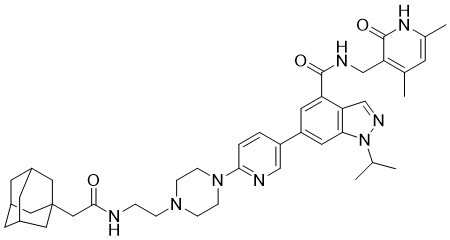
MS1943 (MS-1943) is a novel and potent EZH2 degrader (IC50 = 120 nM) with anticancer activity. It significantly reduces EZH2 protein levels in numerous triple-negative breast cancer (TNBC) and other cancer and noncancerous cell lines.
Physicochemical Properties
| Molecular Formula | C42H54N8O3 |
| Molecular Weight | 718.9300 |
| Exact Mass | 718.431 |
| CAS # | 2225938-17-8 |
| PubChem CID | 139211327 |
| Appearance | Light yellow to yellow solid powder |
| LogP | 5.7 |
| Hydrogen Bond Donor Count | 3 |
| Hydrogen Bond Acceptor Count | 7 |
| Rotatable Bond Count | 11 |
| Heavy Atom Count | 53 |
| Complexity | 1410 |
| Defined Atom Stereocenter Count | 0 |
| SMILES | O=C(C([H])([H])C12C([H])([H])C3([H])C([H])([H])C([H])(C([H])([H])C([H])(C3([H])[H])C1([H])[H])C2([H])[H])N([H])C([H])([H])C([H])([H])N1C([H])([H])C([H])([H])N(C2C([H])=C([H])C(C3=C([H])C(C(N([H])C([H])([H])C4C(N([H])C(C([H])([H])[H])=C([H])C=4C([H])([H])[H])=O)=O)=C4C([H])=NN(C([H])(C([H])([H])[H])C([H])([H])[H])C4=C3[H])=C([H])N=2)C([H])([H])C1([H])[H] |
| InChi Key | WQIQJFXBAJJKNT-UHFFFAOYSA-N |
| InChi Code | InChI=1S/C42H54N8O3/c1-26(2)50-37-18-33(17-34(36(37)25-46-50)40(52)45-24-35-27(3)13-28(4)47-41(35)53)32-5-6-38(44-23-32)49-11-9-48(10-12-49)8-7-43-39(51)22-42-19-29-14-30(20-42)16-31(15-29)21-42/h5-6,13,17-18,23,25-26,29-31H,7-12,14-16,19-22,24H2,1-4H3,(H,43,51)(H,45,52)(H,47,53) |
| Chemical Name | 6-[6-[4-[2-[[2-(1-adamantyl)acetyl]amino]ethyl]piperazin-1-yl]pyridin-3-yl]-N-[(4,6-dimethyl-2-oxo-1H-pyridin-3-yl)methyl]-1-propan-2-ylindazole-4-carboxamide |
| HS Tariff Code | 2934.99.9001 |
| Storage |
Powder-20°C 3 years 4°C 2 years In solvent -80°C 6 months -20°C 1 month |
| Shipping Condition | Room temperature (This product is stable at ambient temperature for a few days during ordinary shipping and time spent in Customs) |
Biological Activity
| ln Vitro | MS1943 (0.625-5 μM; 3 days) inhibits cell growth with a GI50 of 2.2 µM[1]. MDA-MB-468 cells are exposed to MS1943 (0.625-5 μM; 4 days), which causes cell death. The TNBC cells BT549, HCC70, and MDA-MB-231, the lymphoma cells KARPAS-422 and SUDHL8, and the non-cancerous prostate cells PNT2 all exhibit effective reductions in EZH2 levels when exposed to MS1943[1]. Without influencing EED protein levels, MS1943 (1.25-5.0 μM; 2 days) suppresses the H3K27me3 mark and inhibits EZH2 and SUZ12 protein levels in a concentration- and time-dependent manner[1]. |
| ln Vivo | Tumor development is suppressed by MS1943 (150 mg/kg body weight; ip; once daily for 36 days)[1]. MS1943 causes the MDA-MB-468 xenograft model to undergo apoptosis[1]. A single intraperitoneal (i.p.) injection of MS1943 at a dose of 50 mg/kg body weight produced plasma concentrations above its cellular IC50 value for approximately two hours, with a peak plasma concentration (Cmax) of 2.9 µM. A single dose of 150 mg/kg body weight po produced a Cmax of 1.1 µM; however, the cellular IC50 value was not reached by the plasma concentrations[1]. |
| Cell Assay |
Cell Viability Assay[1] Cell Types: MDA-MB-468 cells Tested Concentrations: 0.625, 1.25, 2.5, 5 μM Incubation Duration: 3 days Experimental Results: Inhibits cell growth with an GI50 of 2.2 µM. Western Blot Analysis[1] Cell Types: MDA-MB-468 cells Tested Concentrations: 1.25, 2.5, 5.0 µM Incubation Duration: 2 days Experimental Results: decreased EZH2 protein levels in a concentration- and time-dependent manner. |
| Animal Protocol |
Animal/Disease Models: Eightweeks old female BALB/c nude mice (MDA-MB-468 xenografts)[1] Doses: 150 mg/kg body weight Route of Administration: ip; one time/day for 36 days Experimental Results: Suppresses tumor growth. |
| References |
[1]. Discovery of a first-in-class EZH2 selective degrader.Nat Chem Biol. 2020 Feb;16(2):214-222. |
Solubility Data
| Solubility (In Vitro) | DMSO : ~125 mg/mL (~173.87 mM) |
| Solubility (In Vivo) |
Solubility in Formulation 1: ≥ 6.25 mg/mL (8.69 mM) (saturation unknown) in 10% DMSO + 40% PEG300 + 5% Tween80 + 45% Saline (add these co-solvents sequentially from left to right, and one by one), clear solution. For example, if 1 mL of working solution is to be prepared, you can add 100 μL of 62.5 mg/mL clear DMSO stock solution to 400 μL PEG300 and mix evenly; then add 50 μL Tween-80 to the above solution and mix evenly; then add 450 μL normal saline to adjust the volume to 1 mL. Preparation of saline: Dissolve 0.9 g of sodium chloride in 100 mL ddH₂ O to obtain a clear solution. Solubility in Formulation 2: ≥ 6.25 mg/mL (8.69 mM) (saturation unknown) in 10% DMSO + 90% (20% SBE-β-CD in Saline) (add these co-solvents sequentially from left to right, and one by one), clear solution. For example, if 1 mL of working solution is to be prepared, you can add 100 μL of 62.5 mg/mL clear DMSO stock solution to 900 μL of 20% SBE-β-CD physiological saline solution and mix evenly. Preparation of 20% SBE-β-CD in Saline (4°C,1 week): Dissolve 2 g SBE-β-CD in 10 mL saline to obtain a clear solution. Solubility in Formulation 3: ≥ 6.25 mg/mL (8.69 mM) (saturation unknown) in 10% DMSO + 90% Corn Oil (add these co-solvents sequentially from left to right, and one by one), clear solution. For example, if 1 mL of working solution is to be prepared, you can add 100 μL of 62.5 mg/mL clear DMSO stock solution to 900 μL corn oil and mix evenly. (Please use freshly prepared in vivo formulations for optimal results.) |
| Preparing Stock Solutions | 1 mg | 5 mg | 10 mg | |
| 1 mM | 1.3910 mL | 6.9548 mL | 13.9096 mL | |
| 5 mM | 0.2782 mL | 1.3910 mL | 2.7819 mL | |
| 10 mM | 0.1391 mL | 0.6955 mL | 1.3910 mL |