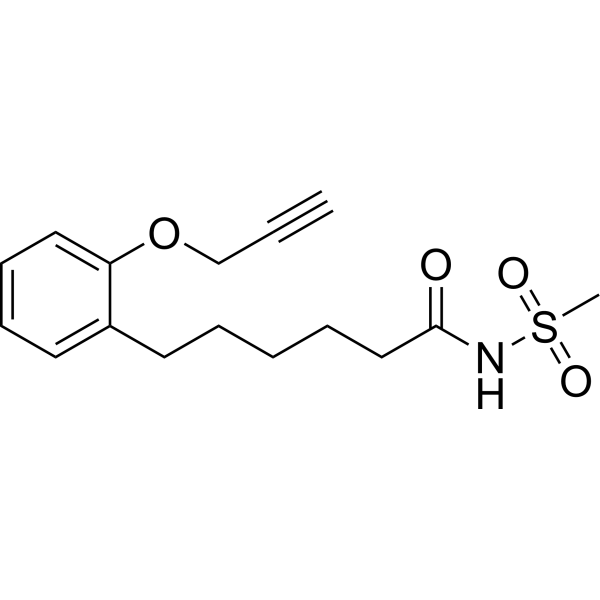
Physicochemical Properties
| Molecular Formula | C16H21NO4S |
| Molecular Weight | 323.41 |
| Exact Mass | 327.15 |
| CAS # | 206052-02-0 |
| PubChem CID | 10087567 |
| Appearance | White to off-white solid powder |
| Density | 1.1±0.1 g/cm3 |
| Index of Refraction | 1.517 |
| LogP | 3.16 |
| Hydrogen Bond Donor Count | 1 |
| Hydrogen Bond Acceptor Count | 4 |
| Rotatable Bond Count | 9 |
| Heavy Atom Count | 22 |
| Complexity | 486 |
| Defined Atom Stereocenter Count | 0 |
| InChi Key | REUHFEYPDFRRGJ-UHFFFAOYSA-N |
| InChi Code | InChI=1S/C16H21NO4S/c1-3-13-21-15-11-8-7-10-14(15)9-5-4-6-12-16(18)17-22(2,19)20/h1,7-8,10-11H,4-6,9,12-13H2,2H3,(H,17,18) |
| Chemical Name | N-methylsulfonyl-6-(2-prop-2-ynoxyphenyl)hexanamide |
| HS Tariff Code | 2934.99.9001 |
| Storage |
Powder-20°C 3 years 4°C 2 years In solvent -80°C 6 months -20°C 1 month Note: Please store this product in a sealed and protected environment (e.g. under nitrogen), avoid exposure to moisture and light. |
| Shipping Condition | Room temperature (This product is stable at ambient temperature for a few days during ordinary shipping and time spent in Customs) |
Biological Activity
| Targets | CYP2 |
| ln Vitro | MS-PPOH prevents the formation of EET in cells. MS-PPOH diminishes the 11,12-EET (1.0 μM)-induced cell motility and prevents invasion and migration of basal (tonic) cells[1]. |
| ln Vivo | Dahl salt-resistant rats on 2% NaCl drinking solution had significantly lower renal levels of epoxyeicosatrienoic acids (EETs) after 6 days of treatment with MS-PPOH (20 mg/kg/day, iv)[3]. |
| Cell Assay |
Cell Viability Assay[1] Cell Types: PC -3 cells Tested Concentrations: 2.0 and 10.0 μM Incubation Duration: 24 hrs (hours) Experimental Results: Inhibited tonic (basal) cell invasion and migration. |
| Animal Protocol |
Animal/Disease Models: Sixweeks old male stroke-prone spontaneously hypertensive rats (SHRSP)[3] Doses: 20 mg/kg/day Route of Administration: intravenously (iv) Experimental Results: Treatment had negligible effects on systolic blood pressure (SBP) in saline-drinking SHRSP after 1 week, 160 vs. 167 mmHg, or 2 weeks of treatment, 171 vs. 175 mmHg, for vehicle vs. MS-PPOH, respectively. |
| References |
[1]. Inhibition of carcinoma cell motility by epoxyeicosatrienoic acid (EET) antagonists. Cancer Sci. 2010 Dec;101(12):2629-36. [2]. Cytochrome P450 2C24: Expression, Tissue Distribution, High-Throughput Assay, and Pharmacological Inhibition. Acta Pharm Sin B. 2012 Apr;2(2):137-145. [3]. Pharmacological manipulation of arachidonic acid-epoxygenase results in divergent effects on renal damage. Front Pharmacol. 2014 Aug 15;5:187. |
Solubility Data
| Solubility (In Vitro) | DMSO: 200 mg/mL (618.41 mM) |
| Solubility (In Vivo) |
Solubility in Formulation 1: ≥ 5 mg/mL (15.46 mM) (saturation unknown) in 10% DMSO + 40% PEG300 + 5% Tween80 + 45% Saline (add these co-solvents sequentially from left to right, and one by one), clear solution. For example, if 1 mL of working solution is to be prepared, you can add 100 μL of 50.0 mg/mL clear DMSO stock solution to 400 μL PEG300 and mix evenly; then add 50 μL Tween-80 to the above solution and mix evenly; then add 450 μL normal saline to adjust the volume to 1 mL. Preparation of saline: Dissolve 0.9 g of sodium chloride in 100 mL ddH₂ O to obtain a clear solution. Solubility in Formulation 2: ≥ 5 mg/mL (15.46 mM) (saturation unknown) in 10% DMSO + 90% (20% SBE-β-CD in Saline) (add these co-solvents sequentially from left to right, and one by one), clear solution. For example, if 1 mL of working solution is to be prepared, you can add 100 μL of 50.0 mg/mL clear DMSO stock solution to 900 μL of 20% SBE-β-CD physiological saline solution and mix evenly. Preparation of 20% SBE-β-CD in Saline (4°C,1 week): Dissolve 2 g SBE-β-CD in 10 mL saline to obtain a clear solution. Solubility in Formulation 3: ≥ 5 mg/mL (15.46 mM) (saturation unknown) in 10% DMSO + 90% Corn Oil (add these co-solvents sequentially from left to right, and one by one), clear solution. For example, if 1 mL of working solution is to be prepared, you can add 100 μL of 50.0 mg/mL clear DMSO stock solution to 900 μL of corn oil and mix evenly. (Please use freshly prepared in vivo formulations for optimal results.) |
| Preparing Stock Solutions | 1 mg | 5 mg | 10 mg | |
| 1 mM | 3.0921 mL | 15.4603 mL | 30.9205 mL | |
| 5 mM | 0.6184 mL | 3.0921 mL | 6.1841 mL | |
| 10 mM | 0.3092 mL | 1.5460 mL | 3.0921 mL |