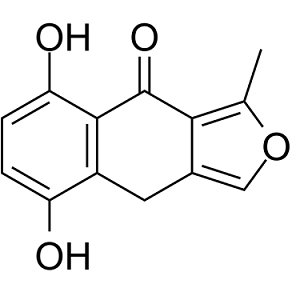
MS-444 (MS444; BE-34776; BE34776) is a novel and potent small-molecule inhibitor of HuR, which is an RNA-binding protein implicated in immune homeostasis and cancers. It also inhibits the activity of purified smooth muscle myosin light chain kinase (MLCK) with an IC50 value of 10 μM. MS-444 treatment of glioblastoma cells resulted in loss of viability and induction of apoptosis, with evidence implicating death receptor 5. BTICs were particularly sensitive to MS-444. At sub-lethal doses, MS-444 attenuated invasion of glioblastoma cells and BTICs in a transwell model.
Physicochemical Properties
| Molecular Formula | C13H10O4 |
| Molecular Weight | 230.21 |
| Exact Mass | 230.058 |
| CAS # | 150045-18-4 |
| Related CAS # | 150045-18-4 |
| PubChem CID | 132904 |
| Appearance | Light yellow to brown solid powder |
| Density | 1.452g/cm3 |
| Boiling Point | 448.7ºC at 760mmHg |
| Flash Point | 225.2ºC |
| Vapour Pressure | 1.15E-08mmHg at 25°C |
| Index of Refraction | 1.673 |
| LogP | 2.134 |
| Hydrogen Bond Donor Count | 2 |
| Hydrogen Bond Acceptor Count | 4 |
| Rotatable Bond Count | 0 |
| Heavy Atom Count | 17 |
| Complexity | 329 |
| Defined Atom Stereocenter Count | 0 |
| SMILES | O=C(C1=C(C)OC=C1C2)C3=C2C(O)=CC=C3O |
| InChi Key | TZUYDLKHNQUNKS-UHFFFAOYSA-N |
| InChi Code | InChI=1S/C13H10O4/c1-6-11-7(5-17-6)4-8-9(14)2-3-10(15)12(8)13(11)16/h2-3,5,14-15H,4H2,1H3 |
| Chemical Name | 5,8-Dihydroxy-3-methyl-naphtho[2,3-c]furan-4(9H)-one |
| Synonyms | MS-444 BE-34776 BE34776 MS 444 MS444 |
| HS Tariff Code | 2934.99.9001 |
| Storage |
Powder-20°C 3 years 4°C 2 years In solvent -80°C 6 months -20°C 1 month Note: (1). This product requires protection from light (avoid light exposure) during transportation and storage.(2). Please store this product in a sealed and protected environment (e.g. under nitrogen), avoid exposure to moisture. |
| Shipping Condition | Room temperature (This product is stable at ambient temperature for a few days during ordinary shipping and time spent in Customs) |
Biological Activity
| Targets |
|
|
| ln Vitro | MS-444 is a little chemical that inhibits the RNA-binding HuR (ELAVL1) protein. HuR overexpressing colorectal cancer (CRC) cells are treated with MS-444 (1-100 μM) for 48 hours, with IC50s for HCT116, HCA-7, RKO, HT-29, and SW480 cells being 10.98±1.76 μM, 12.84±2.10 μM, 5.60±0.90 μM, 14.21±2.11 μM, and 10.98±1.24 μM, respectively. All CRC lines exhibit growth suppression, with IC50 values ranging from 5.60 μM to 14.21 μM. Significant effects are evident at 10 μM MS-444. Non-transformed small intestinal (RIE-1; IC50=40.70±3.53 μM) and colonic (YAMC; IC50=28.16± 3.23 μM)) epithelial cells are used to observe contrasts. Both cell types are skilled in the degradation of 3′UTR AU-rich elements (ARE)-mRNA and exhibit characteristics of typical intestinal epithelial cells. With IC50 values of 40.70 μM and 28.16 μM (P<0.05), both non-transformed cell lines are approximately three to four times less susceptible to MS-444-mediated growth inhibition[2]. | |
| ln Vivo | Mice containing HCT116 cell xenografts are given IP injections of MS-444 (25 mg/kg bw) or vehicle every 48 hours in order to examine the impact of the drug on CRC cell proliferation in vivo. The mice maintained their weights and showed no negative effects during the experiment. Tumor size is reduced by around 1.7 times as a result of MS-444's anti-tumor activities. Microvessel density (MVD) in mice treated with MS-444 decreases noticeably by two to three times, suggesting that the compound has anti-angiogenic properties[2]. | |
| Cell Assay |
|
|
| References |
[1]. MS-444, a new inhibitor of myosin light chain kinase from Micromonosporasp.KY7123. The Journal Of Antibiotics. 1995,48(9):948-951. [2]. Fernando F. Blanco.et al, Impact of HuR inhibition by the small molecule MS-444 on colorectal cancer cell tumorigenesis. Oncotarget. 2016 Nov 8; 7(45): 74043-74058. |
|
| Additional Infomation |
MS-444 is a naphthofuran. 5,8-Dihydroxy-3-methyl-4-(9H)-naphtho(2,3-c)furanone has been reported in Micromonospora with data available. |
Solubility Data
| Solubility (In Vitro) |
DMSO : ~50 mg/mL (~217.18 mM) 1-Methyl-2-pyrrolidinone : 20 mg/mL (~86.87 mM) |
| Solubility (In Vivo) |
Solubility in Formulation 1: 2 mg/mL (8.69 mM) in 10% DMSO + 40% PEG300 + 5% Tween80 + 45% Saline (add these co-solvents sequentially from left to right, and one by one), suspension solution; with sonication. For example, if 1 mL of working solution is to be prepared, you can add 100 μL of 20.0 mg/mL clear DMSO stock solution to 400 μL PEG300 and mix evenly; then add 50 μL Tween-80 to the above solution and mix evenly; then add 450 μL normal saline to adjust the volume to 1 mL. Preparation of saline: Dissolve 0.9 g of sodium chloride in 100 mL ddH₂ O to obtain a clear solution. Solubility in Formulation 2: 2 mg/mL (8.69 mM) in 10% DMSO + 90% (20% SBE-β-CD in Saline) (add these co-solvents sequentially from left to right, and one by one), suspension solution; with ultrasonication. For example, if 1 mL of working solution is to be prepared, you can add 100 μL of 20.0 mg/mL clear DMSO stock solution to 900 μL of 20% SBE-β-CD physiological saline solution and mix evenly. Preparation of 20% SBE-β-CD in Saline (4°C,1 week): Dissolve 2 g SBE-β-CD in 10 mL saline to obtain a clear solution. Solubility in Formulation 3: 2 mg/mL (8.69 mM) in 10% 1-Methyl-2-pyrrolidinone 90% PBS (add these co-solvents sequentially from left to right, and one by one), suspension solution; with ultrasonication (<50°C). (Please use freshly prepared in vivo formulations for optimal results.) |
| Preparing Stock Solutions | 1 mg | 5 mg | 10 mg | |
| 1 mM | 4.3439 mL | 21.7193 mL | 43.4386 mL | |
| 5 mM | 0.8688 mL | 4.3439 mL | 8.6877 mL | |
| 10 mM | 0.4344 mL | 2.1719 mL | 4.3439 mL |