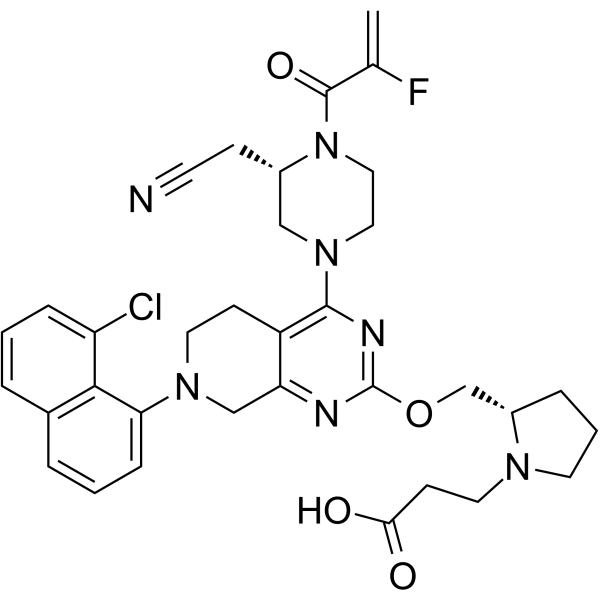
Physicochemical Properties
| Molecular Formula | C34H37CLFN7O4 |
| Molecular Weight | 662.15 |
| Exact Mass | 661.257 |
| CAS # | 2561529-96-0 |
| Related CAS # | 2561529-96-0 |
| PubChem CID | 156613479 |
| Appearance | Light yellow to yellow solid |
| LogP | 2.3 |
| Hydrogen Bond Donor Count | 1 |
| Hydrogen Bond Acceptor Count | 11 |
| Rotatable Bond Count | 10 |
| Heavy Atom Count | 47 |
| Complexity | 1190 |
| Defined Atom Stereocenter Count | 2 |
| SMILES | C=C(C(=O)N1CCN(C[C@@H]1CC#N)C2=NC(=NC3=C2CCN(C3)C4=CC=CC5=C4C(=CC=C5)Cl)OC[C@@H]6CCCN6CCC(=O)O)F |
| InChi Key | CWTHNCSWSDACRS-DQEYMECFSA-N |
| InChi Code | InChI=1S/C34H37ClFN7O4/c1-22(36)33(46)43-18-17-42(19-24(43)10-13-37)32-26-11-15-41(29-9-3-6-23-5-2-8-27(35)31(23)29)20-28(26)38-34(39-32)47-21-25-7-4-14-40(25)16-12-30(44)45/h2-3,5-6,8-9,24-25H,1,4,7,10-12,14-21H2,(H,44,45)/t24-,25-/m0/s1 |
| Chemical Name | 3-[(2S)-2-[[7-(8-chloronaphthalen-1-yl)-4-[(3S)-3-(cyanomethyl)-4-(2-fluoroprop-2-enoyl)piperazin-1-yl]-6,8-dihydro-5H-pyrido[3,4-d]pyrimidin-2-yl]oxymethyl]pyrrolidin-1-yl]propanoic acid |
| Synonyms | MRTX849 acid; MRTX849 acid; 2561529-96-0; EX-A5368; AKOS040757850; 3-[(2S)-2-[[7-(8-chloronaphthalen-1-yl)-4-[(3S)-3-(cyanomethyl)-4-(2-fluoroprop-2-enoyl)piperazin-1-yl]-6,8-dihydro-5H-pyrido[3,4-d]pyrimidin-2-yl]oxymethyl]pyrrolidin-1-yl]propanoic acid; |
| HS Tariff Code | 2934.99.9001 |
| Storage |
Powder-20°C 3 years 4°C 2 years In solvent -80°C 6 months -20°C 1 month Note: (1). This product requires protection from light (avoid light exposure) during transportation and storage.(2). Please store this product in a sealed and protected environment (e.g. under nitrogen), avoid exposure to moisture. |
| Shipping Condition | Room temperature (This product is stable at ambient temperature for a few days during ordinary shipping and time spent in Customs) |
Biological Activity
| Targets | KRas G12C |
| ln Vitro |
In several KRAS mutant cancer cells (NCI-H2030, MIA PaCa-2, SW1573, NCI-H23, and NCI-H358 cells), LC-2 causes endogenous KRASG12C to degrade, with DC50s ranging from 0.25 to 0.76 μM. A genuine PROTAC mechanism drives the degradation of KRASG12C induced by LC-2. Treatment with 2.5 μM of LC-2 is applied to MIA PaCa-2, NCI-H23, and SW1573 cells for 6, 24, 48, and 72 hours. Maximum KRAS degradation happened in less than 24 hours and continued for up to 72 hours in all three cell lines[1]. In homozygous and heterozygous KRAS mutant cell lines, LC-2-induced (2.5 μM; 6-24 hours) KRAS G12C degradation modifies Erk signaling[1]. |
| References |
[1]. Targeted Degradation of Oncogenic KRASG12C by VHL-Recruiting PROTACs. ACS Cent Sci. 2020;6(8):1367-1375. |
| Additional Infomation | KRAS is mutated in ∼20% of human cancers and is one of the most sought-after targets for pharmacological modulation, despite having historically been considered "undruggable." The discovery of potent covalent inhibitors of the KRASG12C mutant in recent years has sparked a new wave of interest in small molecules targeting KRAS. While these inhibitors have shown promise in the clinic, we wanted to explore PROTAC-mediated degradation as a complementary strategy to modulate mutant KRAS. Herein, we report the development of LC-2, the first PROTAC capable of degrading endogenous KRASG12C. LC-2 covalently binds KRASG12C with a MRTX849 warhead and recruits the E3 ligase VHL, inducing rapid and sustained KRASG12C degradation leading to suppression of MAPK signaling in both homozygous and heterozygous KRASG12C cell lines. LC-2 demonstrates that PROTAC-mediated degradation is a viable option for attenuating oncogenic KRAS levels and downstream signaling in cancer cells. [1] |
Solubility Data
| Solubility (In Vitro) | DMSO: ~130 mg/mL (~196.3 mM) |
| Solubility (In Vivo) |
Solubility in Formulation 1: ≥ 3.25 mg/mL (4.91 mM) (saturation unknown) in 10% DMSO + 90% Corn Oil (add these co-solvents sequentially from left to right, and one by one), clear solution. For example, if 1 mL of working solution is to be prepared, you can add 100 μL of 32.5 mg/mL clear DMSO stock solution to 900 μL of corn oil and mix evenly. (Please use freshly prepared in vivo formulations for optimal results.) |
| Preparing Stock Solutions | 1 mg | 5 mg | 10 mg | |
| 1 mM | 1.5102 mL | 7.5512 mL | 15.1023 mL | |
| 5 mM | 0.3020 mL | 1.5102 mL | 3.0205 mL | |
| 10 mM | 0.1510 mL | 0.7551 mL | 1.5102 mL |