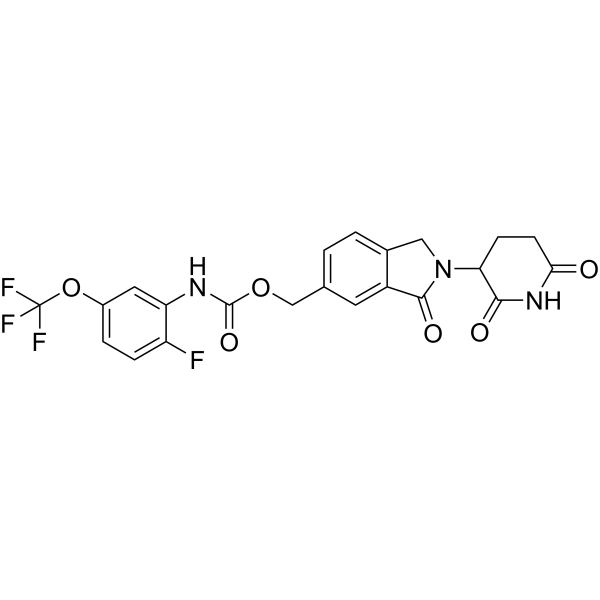
Physicochemical Properties
| Molecular Formula | C22H17F4N3O6 |
| Molecular Weight | 495.380499601364 |
| Exact Mass | 495.11 |
| Elemental Analysis | C, 53.34; H, 3.46; F, 15.34; N, 8.48; O, 19.38 |
| CAS # | 2803881-11-8 |
| PubChem CID | 164584214 |
| Appearance | White to off-white solid |
| LogP | 2.5 |
| Hydrogen Bond Donor Count | 2 |
| Hydrogen Bond Acceptor Count | 10 |
| Rotatable Bond Count | 6 |
| Heavy Atom Count | 35 |
| Complexity | 856 |
| Defined Atom Stereocenter Count | 0 |
| InChi Key | HNTGMIGBGVFOBT-UHFFFAOYSA-N |
| InChi Code | InChI=1S/C22H17F4N3O6/c23-15-4-3-13(35-22(24,25)26)8-16(15)27-21(33)34-10-11-1-2-12-9-29(20(32)14(12)7-11)17-5-6-18(30)28-19(17)31/h1-4,7-8,17H,5-6,9-10H2,(H,27,33)(H,28,30,31) |
| Chemical Name | (2-(2,6-dioxopiperidin-3-yl)-3-oxoisoindolin-5-yl)methyl (2-fluoro-5-(trifluoromethoxy)phenyl)carbamate |
| Synonyms | MRT-2359; GTPL12629; MRT 2359; MRT2359 |
| HS Tariff Code | 2934.99.9001 |
| Storage |
Powder-20°C 3 years 4°C 2 years In solvent -80°C 6 months -20°C 1 month |
| Shipping Condition | Room temperature (This product is stable at ambient temperature for a few days during ordinary shipping and time spent in Customs) |
Biological Activity
| Targets | GSPT1[1] |
| ln Vitro | MRT-2359 was rationally designed using the QuEENTM discovery engine and optimized to achieve a profound and preferential antiproliferative activity in MYC-driven cell lines, such as high N- and L-MYC mRNA expressing non-small cell lung cancer (NSCLC) and small cell lung cancer (SCLC) lines. In line with expectations, MRT-2359 activity is dependent on both CRBN and the GSPT1 G-loop degron. We further demonstrate using an inducible system that the sole expression of either N- or L-MYC is sufficient to sensitize initially resistant NSCLC cells to MRT-235. Mechanistically, RiboSeq and polysome profiling revealed that treatment with MRT-2359 in the N- or L-MYC high cell lines induces ribosome stalling at the stop codon, increased monosomes and decreased polysomes. These changes are indicative of translational repression and were confirmed using puromycilation assays. Proteomics and RNAseq studies finally demonstrated a significant reduction in the total levels of N- or L-MYC leading in turn to the downmodulation of MYC target genes. Despite robust degradation of GSPT1, no marked effect was observed in these assays in low N- or L-MYC lines, confirming the selective activity of MRT-2359 in MYC-driven lung cancers. [1]. |
| ln Vivo | the anti-tumor activity of MRT-2359 was assessed in >80 lung patient-derived xenografts (PDXs). MRT-2359 demonstrated preferential activity in N- and L-MYC high NSCLC and SCLC PDXs, including numerous instances of tumor regressions, when dosed orally daily or intermittently. Similar levels of anti-tumor activity were also observed in neuroendocrine lung cancer and lymphoma PDXs [1]. |
| Cell Assay | MRT-2359, which has been rationally designed and optimized to selectively induce apoptosis in translationally addicted cells. MRT-2359 promotes complex formation between CRBN and GSPT1 and potently induces GSPT1 degradation in a CRBN- and degron-dependent manner. The high selectivity of MRT-2359 was subsequently demonstrated by the lack of activity in cells expressing a non-degradable GSPT1 mutant. Although MRT-2359 degrades GSPT1 in all the cell lines tested, profiling in a large panel of cancer lines revealed profound and preferential antiproliferative activity in Myc-driven cell lines, such as high N-Myc expressing non-small cell lung cancer (NSCLC) lines and high L-Myc expressing small cell lung cancer (SCLC) lines. In the Myc-driven cells, degradation of GSPT1 led to translational repression as manifested by a global shift from polysomes to monosomes resulting in the reduction of a subset of proteins as assessed by quantitative proteomics. In particular, N- or L-Myc protein levels decreased and as a consequence the known Myc target genes were downregulated at the mRNA level. Despite the robust degradation of GSPT1, no marked effect was observed in low N-Myc lines, confirming the selective activity of our GSPT1 degrader in Myc-driven lung cancers [2]. |
| Animal Protocol |
Oral administration of MRT-2359 in high N-Myc NSCLC xenografts and PDXs led to complete intratumoral GSPT1 degradation and concomitant decrease in N-Myc protein levels, resulting in tumor regression. In contrast, MRT-2359 had limited or no activity in low N-Myc NSCLC models, further corroborating the selective vulnerability of Myc-driven tumors to GSPT1 degradation [2]. In immunocompromised mice, xenografts of the AR-V7-positive cell line 22RV1 and the neuroendocrine prostate cell line NCI-H660, both of which are sensitive to MRT-2359 in vitro, were treated with several MRT-2359 dose regimens including continuous as well as intermittent (5 days on/9 days off) dosing. Most regimens led to marked tumor regression. Tumors of both models fully regressed after a 4-week course of 10 mg/kg MRT-2359 once daily, and no tumor regrowth could be detected after cessation of treatment. No significant in vivo response was observed for xenografts of the insensitive cell line PC-3 [3]. |
| References |
[1]. Development of MRT-2359, an orally bioavailable GSPT1 molecular glue degrader, for the treatment of lung cancers with MYC-induced translational addiction[J]. Cancer Research, 2023, 83(7_Supplement): 3449-3449. [2]. Abstract 3929: Identification of MRT-2359 a potent, selective and orally bioavailable GSPT1-directed molecular glue degrader (MGD) for the treatment of cancers with Myc-induced translational addiction. Cancer Res 15 June 2022; 82 (12_Supplement): 3929. [3]. Abstract 3294: The GSPT1 molecular glue degrader MRT-2359 is active against prostate cancer. Cancer Res 15 March 2024; 84 (6_Supplement): 3294. |
Solubility Data
| Solubility (In Vitro) | DMSO: 100 mg/mL (201.87 mM) |
| Solubility (In Vivo) |
Solubility in Formulation 1: 2.5 mg/mL (5.05 mM) in 10% DMSO + 90% (20% SBE-β-CD in Saline) (add these co-solvents sequentially from left to right, and one by one), suspension solution; with sonication. For example, if 1 mL of working solution is to be prepared, you can add 100 μL of 25.0 mg/mL clear DMSO stock solution to 900 μL of 20% SBE-β-CD physiological saline solution and mix evenly. Preparation of 20% SBE-β-CD in Saline (4°C,1 week): Dissolve 2 g SBE-β-CD in 10 mL saline to obtain a clear solution. (Please use freshly prepared in vivo formulations for optimal results.) |
| Preparing Stock Solutions | 1 mg | 5 mg | 10 mg | |
| 1 mM | 2.0187 mL | 10.0933 mL | 20.1865 mL | |
| 5 mM | 0.4037 mL | 2.0187 mL | 4.0373 mL | |
| 10 mM | 0.2019 mL | 1.0093 mL | 2.0187 mL |